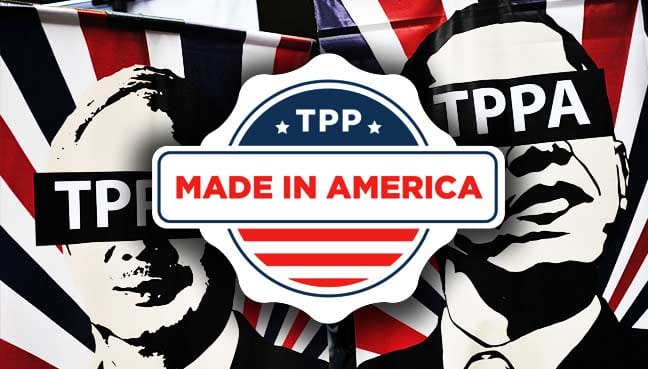
While I do not entirely disagree with Amalina Anuar’s article about the TPPA having both political and economic agendas, I contend that it is precisely this formula that will cause the agreement to be less than successful.
As she correctly puts it, the agreement boils down to a “jostling for power and influence in the Asia Pacific” between two heavyweights – the United States and China. In fact, US President Barack Obama has repeatedly said that the TPPA will determine whether it will be America or China that will write the 21st Century’s trade rules.
If we subscribe to this argument, it would mean that the TPPA is yet another trade pact that rewards the rich and powerful at the expense of the small and weak nations.
If we care to scrutinise the TPPA in its original form, we will probably deduce that the rules governing global trade and investment written in it have an American bias and perpetuate the “business as usual” model that is already outdated. It clearly favours US corporations because it specifically caters to US interests. So, the US is expected to hugely benefit from it and the rest of the other so-called trade “partners” get the crumbs.
Of course, the richer and more powerful a country is, the more concessions it can negotiate for itself. Countries like Malaysia are there to just make up the numbers. In reality, Malaysia’s participation or non-participation does not benefit the US or Malaysia in any significant way.
Look at the TPPA as a US strategy that is all about divide and conquer because it is created to allow America to continue to influence, if not control, global trade. It is based on overlapping trade blocs and agreements that allow the US to stay dominant.
I believe we should change the rules of the game. In the name of global governance and to give some semblance of democracy, we should have rules and regulations that are arrived at collectively and with all voices equally heard.
And I am suggesting we embrace the spirit of the Paris climate agreement because that landmark accord will sustain genuine global cooperation.
In fact, the way the COP21 agreement was reached was unique. For the first time, the negotiation framework used successfully ensured the commitment of nearly every country to lowering planet-warming greenhouse gas emissions to help stave off the most drastic effects of climate change. The COP21 accord changes that dynamic by requiring action in some form from every country, rich or poor. In other words, the deal unites all the world’s nations in a single agreement on tackling climate change for the first time in history. It works because it came up with a system of Intended Nationally Determined Contributions.
As a trading nation, we cannot allow ourselves to cede authority over our own domestic policies – even if we manage to defend some of them – to supranational entities and in the process lose our sovereignty, albeit partially.
Economic integration must involve all countries and be implemented in a manner that is fair and just. There should be a new world order that we conscientiously promote, not one that camouflages colonialism by telling the world the TPPA promotes global trade that benefits all.
I do not believe the TPPA is good for Malaysia.
Victor Ong is an FMT reader
With a firm belief in freedom of expression and without prejudice, FMT tries its best to share reliable content from third parties. Such articles are strictly the writer’s personal opinion. FMT does not necessarily endorse the views or opinions given by any third party content provider.