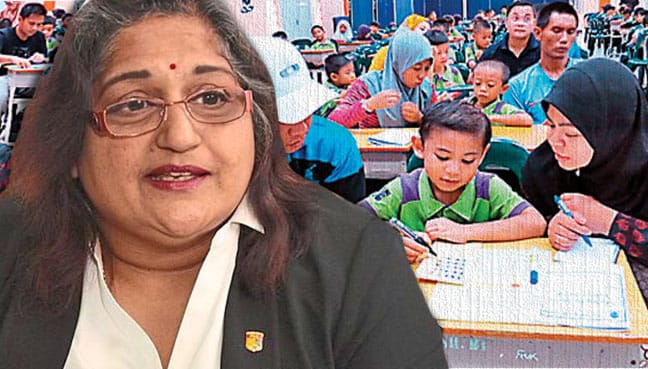
Radha Nambiar, who teaches critical literacy at Universiti Kebangsaan Malaysia, said parents were as much to blame as the national schooling system.
“Parents are too protective of their children” she told FMT. “In Western society, they allow kids to make choices and learn from their mistakes.”
The spoon feeding of children in Malaysian schools, she added, was also a form of protection.
“The curricular and co-curricular syllabuses are rigid, with the focus on finishing the syllabus and passing exams. How can we create critical thinkers this way?”
She noted that in a typical Western education system, students would study according to their interests and would have fewer subjects to learn. Furthermore, grades are based on hands-on projects.
In Malaysian schools, at the moment, there are “too many subjects and very little time given to teachers to teach a classroom full of students”.
She said a teacher would have 35 minutes to teach a subject. By the time the teacher calms the class down, he or she will have only 20 to 25 minutes of proper teaching, and this is the reason teachers rush through a subject.
“It becomes difficult to fully benefit from the subject because there is no discussion or interaction with the students.”
Radha, formerly a school teacher, said project-based assignments were the key to creating critical thinkers of the future.
“Students choose who they want to work with. They learn to deal with the problems they encounter while engaged in the projects. Sometimes they’ll have to look for project partners they can get along with. That helps them to discover themselves and others.
“They will start thinking when they are not in their protective environment.”
The teaching of such skills was missing in Malaysian education until recently, when the Education Ministry decided to introduce project-based assignments in secondary schools, she said.
“We will see the results in 10 years,” she added.
She said it had taken a similar span of time to see positive results in the teaching of mathematics and science in English.
“We at the tertiary level are seeing the results now, with students having a higher command of the language. They are performing better in these two subjects at the tertiary level because they have a better grasp of the formulas in English.”
Another reason for the lack of critical thinking skills among students is the large number of students in each classroom.
“The teacher is unable to even remember the names of students, much less get to know them.”
She said the ideal classroom would have 20 to 25 students.
The Education Ministry is trying to rectify this problem by having more schools in residential areas.
“The ministry is now looking at ways to produce more critical thinkers,” Radha said. “But we have to deal with all the previous mistakes made for so many decades before the new policies, such as a reduced focus on exams, see fruit.”