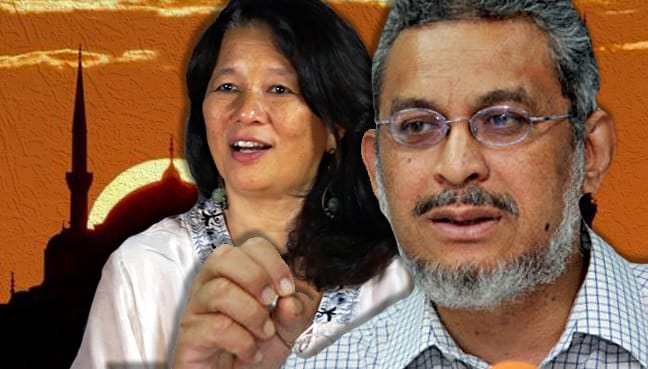
He was responding to a statement by Sisters in Islam (SIS) co-founder Zainah Anwar who said that one of the challenges facing Muslims today was the search for ways to live their faith in a world where democracy, human rights and women’s rights constituted the dominant ethical paradigm.
Speaking to FMT, Khalid pointed out that the concept of Maqasid al-Shariah (Goals of the Shariah) had been around since the time of al-Ghazali, the eminent jurist, philosopher and mystic.
“Maqasid al-Shariah says that the purpose of the Shariah is, among other things, to protect human rights; to protect freedom of religion, free will and the ability to think; to protect freedom of expression and freedom of association and to protect property,” he said.
“All of these were written in the time of al-Ghazali. So we can conclude that human rights and liberalisation were already in the minds of the ulamas back then, but they never got to push these ideas forward as they were living in a monarchy.”
Abu Ḥamid Muḥammad ibn Muḥammad al-Ghazali was born in 1058. He was known as Algazelus or Algazel to the Western medieval world.
According to Khalid, Muslims who are unwilling to open up to reinterpretations of juristic opinions will be unable to solve modern day problems in modern day circumstances. He gave divorce in Islam as an example.
“Traditionally the power of divorce was given to the man, but sometimes you had irresponsible men who would not take care of their wives but wouldn’t divorce them either.
“Today, the state muftis and shariah judges have come up with a solution. In Selangor, for instance, you have the ‘talak taqliq.’ At the time of marriage, a man is required to declare: ‘If I hit you, or I don’t look after you or don’t give you what is owed to you as a wife, and after six months you make a complaint to the court, then it will be considered that divorce has been declared.’”
He said that in finding solutions to modern day problems, people should go back to the basic principles that are found in the Quran.
“The Quran says that a woman should not be forced into a marriage against her will, should not remain in a marriage against her will, and that if you want to keep the wife then keep her in goodness and if you want to divorce her, then divorce her in goodness.
“These are basic concepts. The form may change according to circumstances and interpretation.”
Khalid said it was the failure to recognise Islam’s allowance for flexibility that had led to the problem of Muslims labeling other Muslims as liberal or conservative.
On whether the word “conservative” should be seen in a negative light, he said it depended on how one defined it.
“Are conservatives just those who want to follow the juristic opinions of the past without thinking of their relevance or correctness or appropriateness to changed circumstances? If so, then obviously they will have a difficult time adjusting those opinions to modern day issues.
“If, however, conservatism means to hold to the precepts of Islam but at the same time understanding that these precepts do not come in the way of relooking at past juristic opinions, then obviously there’s no problem.”