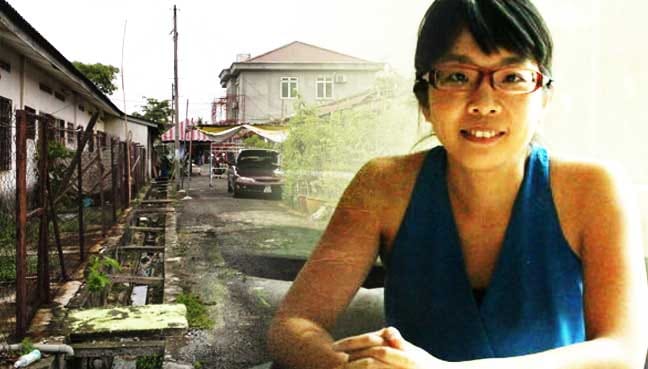
Foo Hui Ping suggests that residents work with their local authorities to rejuvenate and make use of the back lanes that thread through the rows of terrace houses in established ungated neighbourhoods, turning them into positive spaces for residential use.
Foo, winner of the Genovasi Malaysia Challenge in 2013, raised the idea at a talk entitled ‘Transforming Back Lanes into Positive Spaces’, organised in conjunction with the launch of the Library for Social Democracy.
“The idea here is to turn negative back lane spaces into positive public spaces, leveraging on the existing space to increase the productivity of existing space,” Foo said.
“Take Kelana Jaya for example. Although it is already quite developed, we know that there are still a lot of in-between spaces that we can still build on. I do not think that it is urgent for us to go all the way to Setia Alam, or to clear another forest to build more houses. I think we should start to tackle some of these issues.”
Foo’s thoughts on the matter had begun before 2012, when she made observations of the odd problem of back-lane security in her old neighbourhood in USJ3, Subang Jaya.
“The traffic in the morning was horrible. While squeezing through the traffic, I noted that gates were put up, [closing off] every back lane along Jalan USJ 4. These gates were not built by local authorities. The residents had actually met and collected funds to make this happen. Security was an issue,” she said.
Quoting American-Canadian journalist and activist Jane Jacobs, who said that a “well-used city street is apt to be a safe street; a deserted city street is apt to be unsafe”, Foo argued that these gates are not a very constructive solution, and that it was better instead to clear and open the lanes to the public eye.
After leaving her job as an architecture lecturer in 2012, Foo moved to Section 21 in Petaling Jaya, where she made a case study of the area.
“Behind my house is a back lane which cuts through two rows of terrace houses. Looking back at the gates…security was and is a concern, but the thing is that (gates) leave the space as just another deserted, dead space. It is counterproductive to put gates there,” she said.
Foo took a simple survey of 10 houses around her neighbourhood to gauge her neighbours’ thoughts on back lanes.
“We asked three basic questions. What is the back lane space to you? Do you actually use it? How would you want to use it?” she said. Most residents were taken aback by the questions, she said. They had not previously considered the back lanes as a viable, usable space.
“One retired lady said ‘Oh no, that’s not my space, I don’t need to use that space.’ Another younger lady was more puzzled, wondering why we’d need to ask about the back lane space. The question had never crossed her mind and she didn’t know how to answer.
“We asked her if she would use it as a shortcut if it was clean. She said maybe. So we concluded that the response was generally okay, because it wasn’t that they didn’t want to use it, they just didn’t know how,” she said.
Foo said that the public had to first be appraised of the reality that back lanes are usable spaces.
“We can make this happen through a bottom-up or top-down approach with the intervention of the local authorities. We can start organising activities or programmes in these back lanes itself, such as a garage sale or potluck. The idea here is to expose the space, to allow a venue for people to experience being outside and to realise that this is a space that they can capitalise on. It is very easy to make happen,” she said.
Foo noted however that most residents were reluctant to make use of back lanes due to their filthy and uninviting nature, but said that this could also be tackled.
“We need caretakers to provide basic infrastructure, such as clean drainage and so on. It is not very expensive, and the authorities could also consider planting trees at certain intervals. If you don’t have the money, you can start with small trees, and five to ten years later it will be a tree that can give shade.
“Changing the nature of back lanes today may involve regulation, maintenance and the consideration of the local authorities,” Foo noted.
“Imagine a new layer to the city,” she said, pointing to a map of Petaling Jaya. “Imagine changing the nature and quality of these spaces. The big picture here is about more than just a few back lanes.
“People who live in condominium apartments have a floor with landscaped areas with barbecue pits, meeting room, playgrounds, and so on. People who live in old non-gated neighbourhoods could also have similar facilities in their backyards. It depends on the intensity of our efforts. The authorities can also decide to build an open sepak takraw court or slides every one or two kilometers.
“The residents can do a lot. It could be something very easy like landscaping the backyard. Those with more money can get contractors to build something. But whether or not you have the money and skills, this is something very doable on your own.”