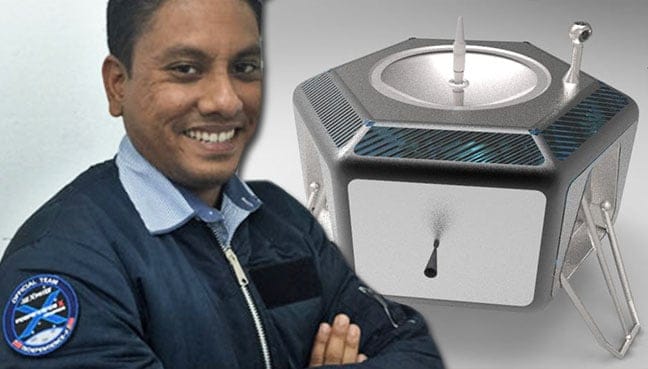
In a CNBC report today, Independence-X unveiled ‘Henry’, a hefty 850 kilogramme, 1.4 metres tall and 2 metres wide spacecraft.
The aim is to get ‘Henry’ to the moon by the end of 2017 – next to the other 15 participants in the Google Lunar XPrize competition.
The Google Lunar XPrize competition will see private-sector players racing to land a robotic spacecraft on the moon, have it travel 500 metres and transmit high-definition (HD) video and images back to Earth by the end of 2017.
The competition stipulates that government funding can only account for 10 per cent of a team’s total mission cost, to foster entrepreneurship and a low-cost space economy.
According to team leader Izmir Yamin, most of Independence-X’s cash has come from private corporations, crowd funding donations and reward-based contributions so far.
The first team to complete the mission gets US$20 million, with US$5 million for second-place.
Independence-X’s next step is to secure a contract to launch ‘Henry’ into orbit, something only four teams, including Israel’s SpaceIL and the U.S’s Moon Express, have done so far.
Independence-X has a launch provider in the pipeline and is now finalising the process, aiming for a January 2017 announcement.
“I feel both worried and confident at the same time as this is the first attempt of its kind in Southeast Asia,” Yamin said on the sidelines of the inaugural Global Entrepreneurship Community conference in Kuala Lumpur.
“We admit SpaceIL is one of the toughest competitors, but we’re going to do our best to make the mission cost-effective and reliable.”