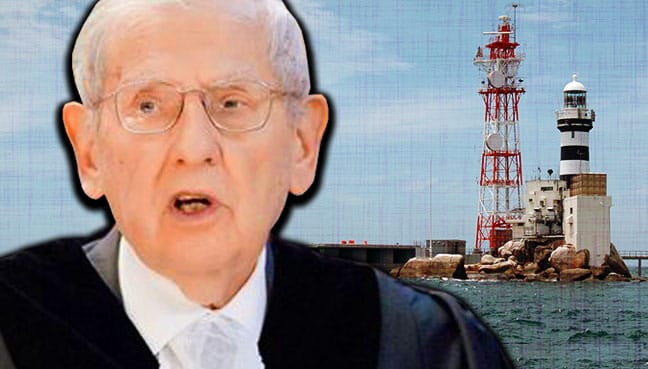
Singapore’s foreign affairs ministry announced this in a press statement today.
It said Guillaume was a member of the ICJ from 1987 to 2005, and served as its president from 2000 to 2003. He is currently a member of the Permanent Court of Arbitration.
Under the statute of the ICJ, if there is no judge of the nationality of the parties on the bench of the court, the parties may each choose a judge ad hoc who will take part in the decision on the case.
The ministry said Singapore would be filing comprehensive and compelling written observations on the admissibility of Malaysia’s application by June 14, the deadline fixed by the ICJ.
Foreign Minister Dr Vivian Balakrishnan was reported to have said that Singapore was confident of its case against Malaysia over the claim over Pedra Branca.
He said Singapore’s legal team “strongly” believed the three documents that Malaysia were relying on in its application to overturn the ruling on Pedra Branca did not satisfy the criteria for a revision of judgement.
“We are confident of our legal team and our case,” he was quoted as saying in Parliament by Channel NewsAsia today.
He said that after careful study of Malaysia’s application, Singapore’s legal team believed the documents did not satisfy the criteria under Article 61.
He said Singapore was committed to resolving the issue amicably and in accordance with international law.
Malaysia on Feb 2 filed an application for a revision of the May 23, 2008 ICJ judgment on claims over Pedra Branca, Middle Rocks and South Ledge.
To support the application, Malaysia cited three documents which it said were recently declassified by the United Kingdom.
The documents are the internal correspondence of the Singapore colonial authorities in 1958, an incident report filed by a British naval officer in the same year, and an annotated map of naval operations from the 1960s.
The ICJ in The Hague, the Netherlands, had ruled that Singapore had sovereignty over Pedra Branca and Malaysia, over Middle Rocks.
The court determined that South Ledge belonged to the state in whose territorial waters it was located.