Adli Amirullah, who works with the Institute for Democracy and Economic Affairs (Ideas), said such trade pacts would encourage competition and thereby push local businesses towards innovativeness and improved productivity.
“Resources in the country will naturally go to the most productive companies,” he said. “The failure of a business to remain relevant will see it being pushed out of the market.”
He said history had shown that nations experienced improvements in their economies when they embraced the open market.

“When countries open themselves up to trade, they see their domestic economy become more prosperous. This happened in Japan in the 1950s, South Korea in the 1960s, Vietnam in the 1990s and China since 2001.”
He also said free trade would result in the raising of living standards.
Neither CPTPP nor the RCEP has been as much criticised in Malaysia as the Trans-Pacific Partnership, which was driven by the United States and abandoned when President Donald Trump took office.
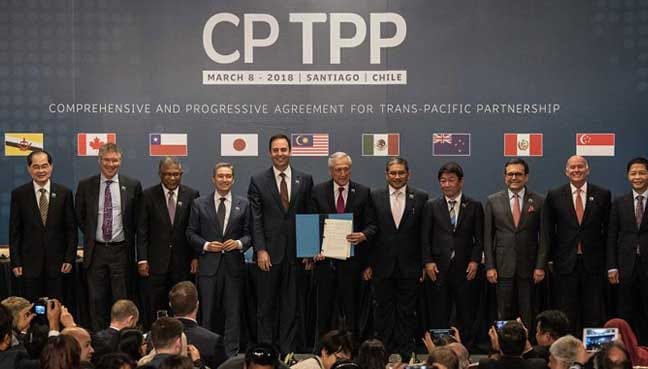
The CPTPP brings together Malaysia, Singapore, Brunei, Vietnam, Australia, New Zealand, Japan, Canada, Mexico, Chile and Peru, accounting for a market of 476 million people. The combined gross domestic product (GDP) of the 11 countries is US$11 trillion or 13% of the global GDP.
The agreement covers, among other things, the exchange of goods and services, intellectual property rights and issues of government procurement and labour standards.
Adli said the lifting of trade barriers meant that local businesses would have to compete with their counterparts from the other 10 countries and consumers would thus have more choices and enjoy cheaper prices.
The CPTPP was signed early this month.
The RCEP is targeted for signing before the end of the year. It involves the 10 Asean countries and Australia, New Zealand, China, India, Japan and South Korea, representing a combined GDP of US$21.4 trillion or 30% of the global GDP and a market of 3.4 billion people.
“RCEP is geared more towards enhancing trade and investment-related activities with the ultimate purpose of minimising development gaps among member countries,” Adli noted.
The pact will eliminate 90% of tariff lines.
“This is notable given that tariffs in Asia are high,” Adli said.
He noted that the agreement would also allow for back-to-back shipment of goods as well as third-party invoicing of goods.
“Consumers might not directly feel the benefits of RCEP as it is geared more towards investment-related activities. It is Malaysian exporters who will reap the benefits, particularly those exporting to India, where many tariff lines will be eliminated.”
He said Malaysian exporters could scale up their domestic businesses out of profits gained from the expansion of their market share.
He added that this could lead to the creation of new jobs not only in the local companies, but also the foreign companies that might be attracted to set up business in Malaysia.