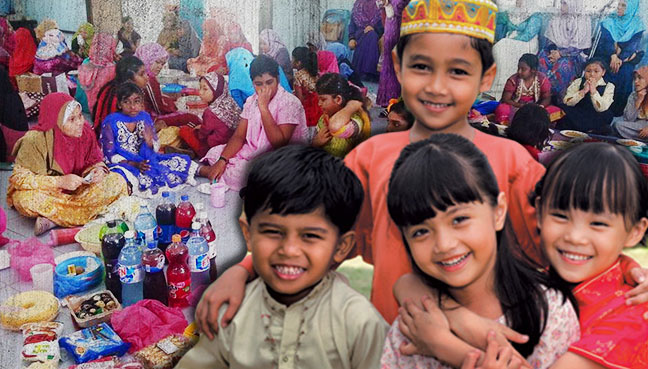
Around this time every year, many schools start planning for their Hari Raya celebrations. I still remember how excited my kids used to get, waiting excitedly to wear their new baju Raya to school and to share Raya cookies with classmates.
My eldest, Sabrina would wake up extra early to get her hair done and made sure all the necessities were packed for the day while my son, Arshad would throw his usual tantrums, trying to justify to his sister why it was not practical to wear a ‘samping’ and songkok with his baju Melayu to school on a hot day.
Often, I found myself among those other mommies, who waited patiently outside the school gates, armed with a camera. Upon hearing the school bell and seeing the guards opening the gates, we mommies would march into the school compound to snap pictures of our children with their friends – all clad in their different traditional attire.
I have in my collection, photographs of my daughter in her baju kurung, kebaya, Punjabi dress, cheongsam and my son in his baju Melayu and kurta. Their friends from different racial and religious backgrounds too are seen dressed up in various traditional clothes. It was simply beautiful to see these children portray what Malaysia really was – a melting pot of diversity.
Cherishing those wonderful memories, I decided to text my close friends whose children are still in primary schools via our group chat, wanting to know what their kids were up to and to ask about preparation for this annual event. The answer I received was somewhat upsetting although honestly it did not really shock me.
“Fa, the letter from school says ‘wear your OWN traditional attire’. It seems that even the teachers reminded the kids to do so. My Olivia is really upset. She was looking forward to wearing her baju kurung to school,” said my friend.
“It’s okay, Olivia can still wear the baju kurung. I am sure the teachers are not going to send her home if she does. It is our national identity anyway,” I answered.
“No, Fa! After hearing her teacher’s instruction and reading the letter, she told me that only Malays should wear baju kurung. She said if her Malay teachers think baju kurung is only for the Malays, then there is no reason for her to wear something that is not her own. She merajuk la, Fa – she doesn’t want to wear her baju kurung, cheongsam or even Punjabi dress. Instead, she wants me to get her traditional Siamese attire – where to find one, lah?”
(Please take note that Olivia is only nine.)
Schools are supposed to be a place where our children learn to assimilate and bond with others of different races, religions, backgrounds and habits. It is a platform for them to learn to adjust, accept, tolerate and compromise. However, schools today prefer to put people in their place – reminding students who they are, where they came from and which categories they belong to.
Truth be told, there are many other ways our children are being segregated in schools these days.
I remember asking a group of students I met a few months ago: “Do you know where the students of 5A are?”
One girl replied, “The moral students are at the science lab. The agama students are in their own class.”
I found her answer rather funny at first – some students are taught to be religious and some are taught to have good moral values. But giving it more thought, I found nothing funny about it.
During school assemblies we have teachers reciting the doa in Arabic – the non-Muslims are required to pray in their own way.
During special religious celebrations such as the Prophet’s birthday, Muslim students attend religious speeches – and non-Muslims continue classes as usual.
During Ramadan, Muslim students read the Holy Book before assembly and during recess – and non-Muslims are free to mingle with their friends or have a meal.
Even the school regulation book shows what a Muslim student ought to wear – and what non-Muslim students should.
When did our schools start to segregate pupils according to their respective races and religions?
Whatever happened to the essence of togetherness as Malaysians, and the sense of belonging to this great nation?
While I tried to wrap my mind around what little Olivia said about traditional attire, I worried about how this episode could cloud her perception of people from different races. Soon enough another friend joined our conversation.
“Same thing here, Fa. Daniel too received a similar letter from his school. So I got both his kurta and barong tagalog ready, not knowing which of our traditional attires he wanted to wear. But you know what my amazing boy did?”
“What?”
“He borrowed a baju Melayu, samping and songkok from his friend and is adamant to wear it. He says despite being of Filipino and Indian descent, he feels more Malaysian than anything.”
That last text message brought a smile to my face.
There is hope.