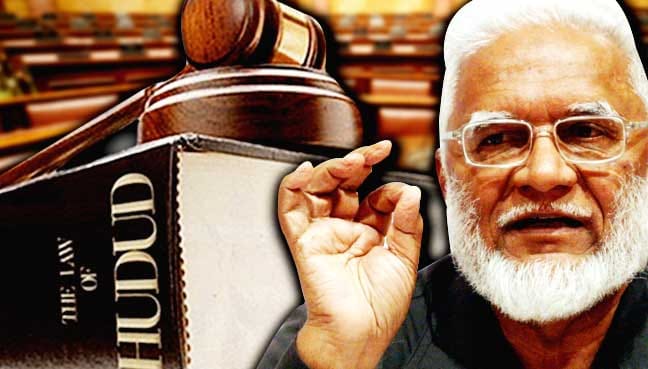
Speaking to FMT, former Islamic Research Institute general director Muhammad Khalid Masud said it was likely that such people understood neither hudud nor reform as taught by the Quran and through the Sunnah (prophetic tradition).
“The problem is that some jurists and religious groups talk only in terms of fiqh (legal philosophy and theory) and not in terms of the Quran or Sunnah,” he said.
“To them, hudud has a definite meaning, but it’s possible to see different meanings of it in the Quran.”
He said such people would usually speak of hudud as a system that would bring about the betterment of society and individuals through through punishment.
However, according to him, Islam recognises many other ways of achieving reform.
“Yes, there must be punishments for crimes, but reform is not through punishment alone,” he said. “In fact, studies have shown that the more you punish people, the more they want to rebel and depart from righteousness.”
Hudud has resurfaced as a controversial topic since early last year, when PAS president Abdul Hadi Awang tabled in the Dewan Rakyat a private member’s bill seeking to amend the Syariah Courts (Criminal Jurisdiction) Act of 1965.
Many, including politicians from both the opposition and Barisan Nasional, see the bill as a way of introducing hudud in Malaysia. It is often referred to as “the hudud bill”.
There is debate within the Muslim community on whether or not it would be blasphemous to reject the bill.
Masud, who is also a former chairman of the Council of Islamic Ideology in Pakistan, which gives legal advice on Islamic issues to the government, said the issue was a complex one and those accusing rejectors of hudud of committing blasphemy were taking the wrong approach.
“The best policy is to have public discussions on this and not make accusations,” he said. “Such discussions should be viewed as beneficial to Islam and Muslims.”