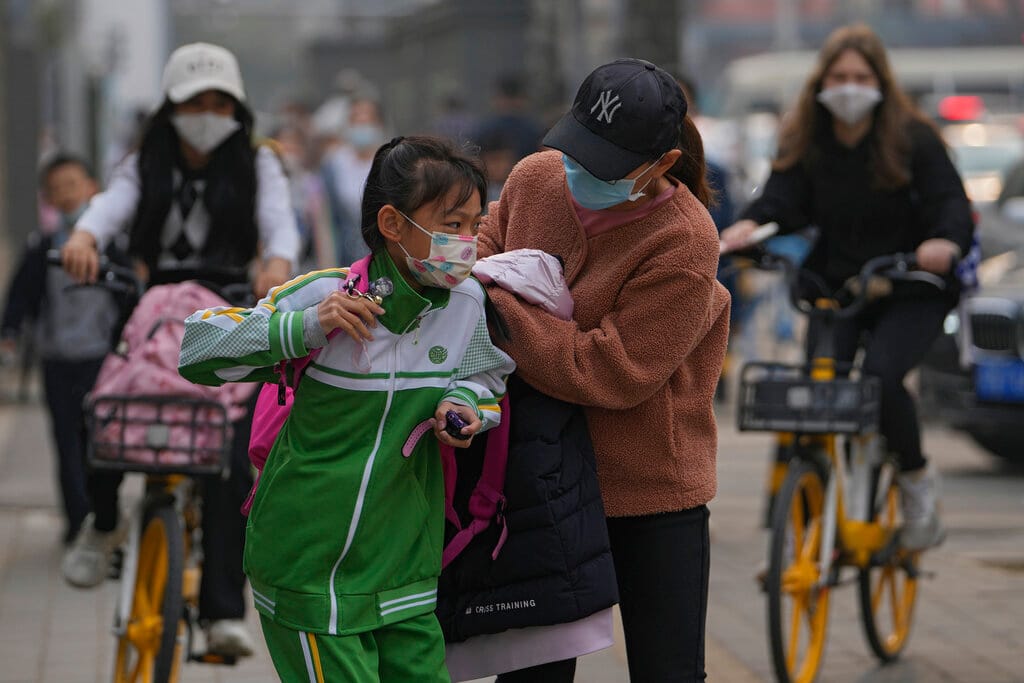
“This winter, each ski class had 700 children and students, which is nearly nine times the 80 people that came two years ago,” said a person who requested to go by the name Zhang and runs athletics-themed classes in Beijing.
Much of the increase can be traced to the influence of the Beijing Winter Olympics, which were held earlier this year. But the biggest factor, according to Zhang, is the government’s crackdown on so-called cram schools.
“Cram schools that teach English and mathematics are no longer able to stay open during weekends or long holidays, so more parents are having their kids learn sports,” said Zhang.
Last July, the Communist Party and the State Council, which serves as China’s cabinet, tightened rules governing cram schools serving elementary and middle-school students. The changes targeted five subjects, including English and mathematics.
Authorities imposed controls on soaring tuition rates in a bid to take pressure off household finances. That way, the country will be able to curb the decline in its birthrate, went the reasoning.
But households merely refocused their educational demands to sports, with children sent to participate in skiing, swimming, basketball and football. In shopping malls, there are classes that teach kids how to jump rope and run competitively. Kung fu and judo dojos are available as well.
A Beijing resident who asked to be identified only as Wei has an 8-year-old son who started attending a skateboard school two years ago. At 1,000 yuan (US$156) per one-hour session, the tuition is not cheap.
“I was a little worried at first because he seemed to be losing weight, but he grew interested in it, stuck with it, and he’s even built up physical strength,” said Wei.
Over 60% of households in Beijing, Shanghai and other provincial-level metropolises have spent between 10,000 and 50,000 yuan on athletics-themed classes, according to a survey of parents of elementary and middle-school students by a Shanghai data provider. Some parents have even reported spending 1 million yuan over multiple years.
Parents in China are putting money into sports classes with a singular goal in mind: the Senior High School Entrance Examination, better known as the zhongkao.
Physical education has been promoted to a required subject on the zhongkao at the same level as Chinese language, mathematics and English. Authorities issued directives in October 2020 to concentrate more on fitness in high school entrance exams.
In response, Beijing at the end of last year said it will grant up to 70 points for fitness on its entrance exam over seven or eight years, more than double the current 30. Part of the score will reflect physical fitness tests from a student’s elementary and middle-school years.
In the southern city of Guangzhou, high school applicants last year needed to jump rope 182 times in a minute to receive a perfect score in their entrance exams, up from 176 times in previous years. The greater focus on physical education has led many Chinese parents to enroll their children in fitness classes.
China’s education services sector, which has suffered numerous layoffs and bankruptcies due to the government crackdown on cram schools, has jumped on the new opportunity. New Oriental Education & Technology Group last summer launched classes in Qingdao and Tianjin to help prepare students for the physical portion of high school entrance exams.
The country’s market for fitness and sport-related education will jump 80% to 130 billion yuan by 2023 from 2020, before the government crackdown on education companies began, according to a key Chinese education research company.
Many Chinese families have only one child, and parents and grandparents tend to be extremely invested in their children’s education.
Fees for cram schools in subjects like English and math have fallen due to government intervention, but those for fitness classes, which were not targeted by the crackdown, could surge with demand.
“There are rumours that sports and music classes could also become subject to price controls,” said an industry insider in Beijing.
“But even if the government imposes more restrictions, parents will just find new things to spend on like tutoring at home, if they think that will help their children’s future,” the insider said.