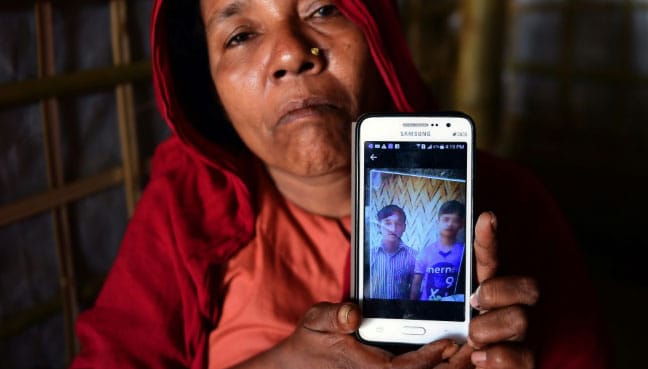
“We were still a family then under one roof, in one country,” the 16-year-old says, from his current home – a bamboo shack in a Bangladesh refugee camp.
By then Myanmar, had already lurched into a dark new phase of an old conflict between their Muslim Rohingya minority and the Buddhist Rakhine majority.
Violence unravelled after the alleged rape and murder of a Buddhist woman by Rohingya men; neighbour turned on neighbour as villages across Rakhine State were set ablaze.
Still, where they could, Rohingya families celebrated Eid, the end of the fasting month of Ramadan.
Robi recalls being carried on his older siblings’ shoulders as they went door-to-door through Maungdaw gorging on snacks.
Nearly six years on, the eight brothers are now split across four countries: Bangladesh, India, the United States, and Myanmar.
One is in a Myanmar jail, another has vanished on the treacherous trafficking route south – a painful family history that traces the key events in the dispossession of the Rohingya in Myanmar, and their dispersal overseas.
When the brothers were last united in 2012, there were around 1.2 million Rohingya living in Rakhine State.
Now fewer than a third remain.
Myanmar, which denies the Rohingya citizenship, drove most of the minority out in October 2016 and August 2017 in army-led crackdowns that the United Nations has said may amount to “ethnic cleansing”.
Separated from their four older brothers, the younger siblings – Robi, Jaber, 18, Hashim, 17, and Faiz, 12 – are starting new lives as refugees.
For now, home remains a 10-metre (30 foot) hut covered by a UN-branded tarpaulin in the Kutupalong camp, which the brothers share with 15 other relatives including their mother.
“We can’t work here, it’s a place we know nothing about,” says Robi. “But how do we go back to Myanmar again?”
Violence and repression have hit the Rohingya in waves since the late 1970s.
In 1982 Myanmar’s ruling junta stripped the Muslim minority of citizenship, stirring up hatred towards the group and casting them as “Bengali” infiltrators to the Buddhist-majority country.
As such, life in Rakhine has always been hard, says Jaber, the oldest of the four brothers in the Kutupalong camp.
“But after the violence started in 2012, the “Moghs” (a pejorative word for ethnic Rakhine) gradually took everything.”
Rohingya who strayed from their villages were frequently lynched or beaten, he says – allegations backed up by rights monitors.
One of the brothers, Abul Kashim, now 19, suffered a beating while fishing with friends.
A teenager at the time, he was jolted into leaving by the brutality of the attack, first for Bangladesh, then overland to join an uncle in India.
For now, he has a made a decent life – he is married and works as a mason in Haryana state.
But India has threatened to deport 40,000 of the minority.
“I miss my family,” he said, saying each phone call leaves a yearning to travel to Bangladesh.
“But I can’t. I don’t have any travel documents.”
On October 9, 2016, Rakhine again went up in flames as a nascent Rohingya militant group known now as the Arakan Rohingya Salvation Army (ARSA) raided border posts.
The army response was swift and unforgiving.
Tens of thousands of Rohingya were driven into Bangladesh, fleeing murders, rapes, and mass arrests.
The crackdown visited more tragedy on Robi Alam’s family.
Their 60-year-old father Nagu Miah was arrested and, the family alleges, beaten to death in police custody.
Confined to their homes with food running scarce, the oldest brother Hamid Hussein, 28, defied a strict curfew and went fishing after his children complained of eating rice every day.
He was arrested by soldiers.
Soon after, soldiers swarmed their village, ordering Rohingya residents to sit hands on their heads in a field as they ransacked homes.
“Then they started to burn our homes, they raped some women and pushed them inside burning homes,” says 17-year-old Mohammad Hashim, from Kutupalong camp.
“We could not stay any longer.”
Over the next six weeks the extended family crept over to Bangladesh.
In August 2017, another 700,000 others began to join them after an even more ferocious army crackdown.
With their land taken and security still parlous, Robi and his family have little expectation of returning to Rakhine.
Instead, they are preparing for long-term life as refugees.
And in their freshly trimmed haircuts, football shirts, and fixation with mobile phones, there are even flickers of teenage normality in the most abnormal of circumstances.
But the fragmentation of their family is never far away.
Through the smudged memories of life in Rakhine, the youngest brother Abul Faiz recalls flecks of freedom – playing football or fishing – as a child in Rakhine.
“My older brothers would hug me, give me money for the shop,” the watchful youngster adds in a near-whisper.
“I miss them.”