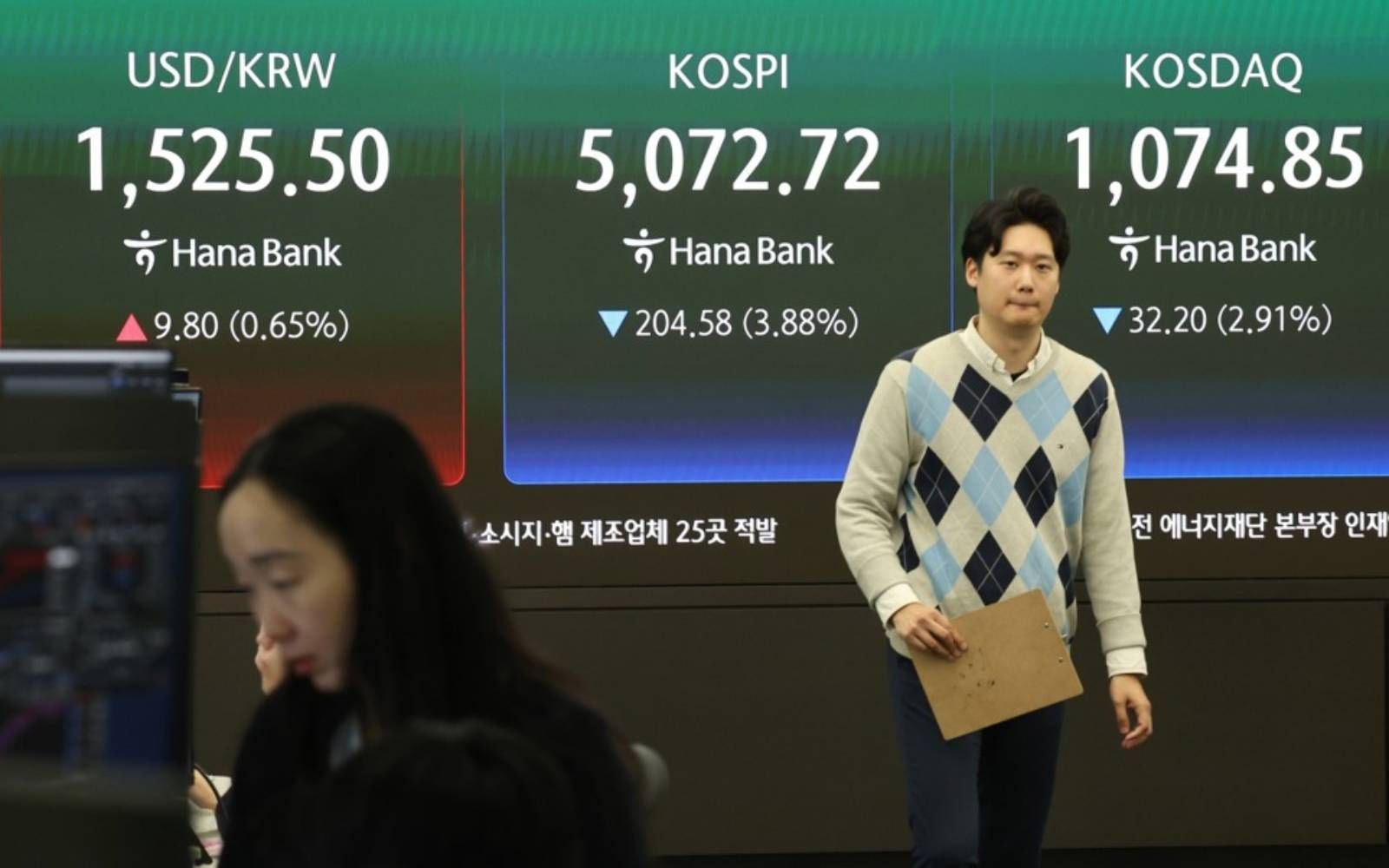
By far the world’s best-performing market before Middle East tensions flared up, Korean equities have been sold off heavily as a jump in oil prices dampened the outlook for the energy-dependent economy. At the same time, optimism over memory chip demand has started to cool.
The benchmark Kospi Index has fallen nearly 17% this month, down the most among 92 major indexes tracked by Bloomberg. Foreign investors are also headed for a record outflow. Overall, US$739 billion of the country’s market cap has been wiped out this month through Monday.
“I am not touching Korean stocks at the moment due to dual headwinds, war and memory – a battle is enough but not two at the same time,” said Matthew Haupt, a fund manager at Wilson Asset Management in Sydney. “We are entering more uncertain outcomes, which makes trading Kospi risky due to some crowding.”
The Kospi tumbled as much as 4.1% on Tuesday before paring the drop to 1.6%. The gauge is edging closer to breaching the 5,000 milestone championed by President Lee Jae Myung, underscoring how quickly sentiment can turn.
What’s proving most challenging for investors is the market’s extreme volatility, with steep drops followed by outsized rebounds triggering an unusual wave of trading halts.
The Kospi circuit breaker – which temporarily suspends trading after an 8% drop – has been activated twice this month alone, accounting for a quarter of all such events since 2000. Meanwhile, a 10th sidecar, activated when Kospi futures move 5% or more, has been triggered this year, compared with three for the whole of 2025.
The multiple halts over the past few weeks indicate “lots of flighty capital in there so it makes it tough to trade,” Haupt said.
Korea’s status as an energy importer also raises the risk of higher inflation and monetary policy tightening.
The country depends on the Middle East for over 70% of its crude oil imports, leaving it highly exposed to an oil shock. Authorities are already mulling widening restrictions on driving, highlighting mounting concerns over rising energy costs.
There has yet to be “any real pricing in of war,” said Marvin Chen, strategist at Bloomberg Intelligence. “There may be further loss in earnings momentum the longer oil prices stay elevated.”
Concerns over aggressive AI spending are also rising as Google’s newly-publicised TurboQuant technique, which makes operating AI more efficient, raises questions about the sustainability of chip demand. That’s weighing on SK Hynix Inc and Samsung Electronics Co, which together account for nearly 40% of the Kospi.
Recent foreign outflows have been driven largely by a selloff in the chipmaker duo, according to a Goldman Sachs note. The note added that foreign ownership in the two stocks have fallen to the lowest level since 2022.
Kospi’s epic rise through the end of last month means that, even after the latest retreat, the benchmark is still up 23% for the year. Some investors remain optimistic about the long-term trajectory of Korean stocks, citing strength in core memory such as high bandwidth memory, a surge in chip exports and ongoing corporate governance reforms.
For now, many prefer to stay on the sidelines until there’s greater clarity on the impact of supply chain disruptions from the Middle East conflict.
“If the scenario of war prolongs maybe for the next one or two more months, I think I will continue to wait till at least end of the year or early next year to start looking at Korean equities again,” said Gerald Gan, chief investment officer at Reed Capital Partners, adding that he prefers to hold cash and buy gold.