Earlier, the statistics department stated that Malaysia’s economy is projected to grow by 5.3% in Q1 2026 based on advance estimates despite rising global uncertainties, particularly elevated oil prices driven by geopolitical tensions.
IPPFA Sdn Bhd investment strategy director and country economist Sedek Jantan said the GDP outlook is firmer than expected, compared with Bloomberg’s consensus of 5.1%, reinforcing Malaysia’s relative growth resilience within the region despite intensifying geopolitical headwinds.
“While a stronger dollar amid Middle East tensions continues to cap upside, the currency’s stabilisation reflects improving confidence in domestic demand durability and structural growth drivers, keeping the ringgit anchored within a constructive near-term range rather than a directional depreciation trend,” he told Bernama.
Meanwhile, Bank Muamalat Malaysia Bhd chief economist Afzanizam Abdul Rashid said full employment, sustained domestic demand, and encouraging external sector performance during January and February have helped the economy maintain a decent GDP growth.
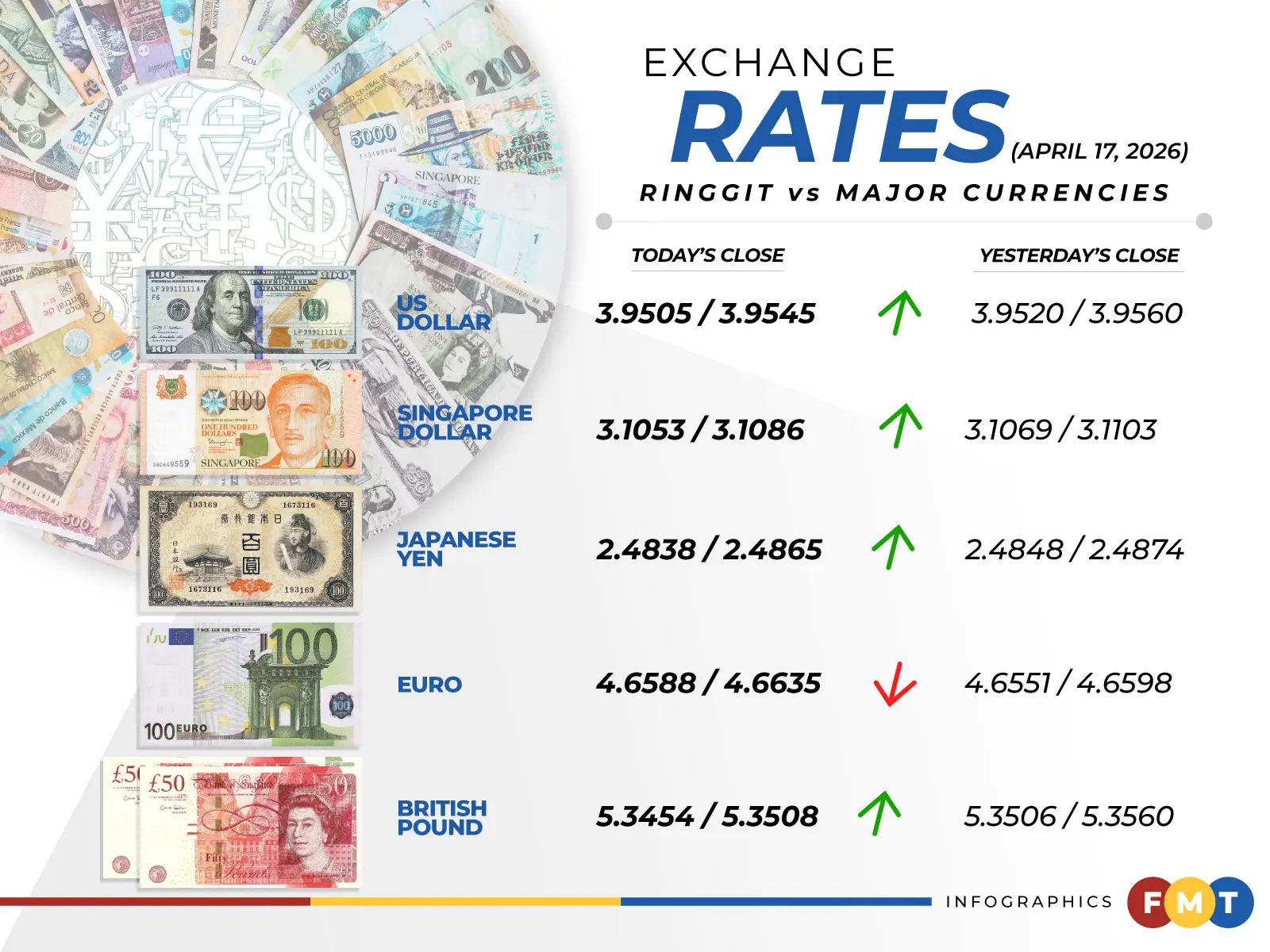
At the close, the ringgit traded mostly higher against a basket of major currencies.
At 6pm today, the local currency rose to 3.9505/3.9545 versus the greenback from 3.9520/3.9560 at yesterday’s close.
It strengthened versus the British pound to 5.3454/5.3508 from 5.3506/5.3560 at Thursday’s close, increased against the Japanese yen to 2.4838/2.4865 from 2.4848/2.4874, and slipped against the euro to 4.6588/4.6635 from 4.6551/4.6598 yesterday.
The local currency traded higher against its Asean peers.
It climbed versus the Singapore dollar to 3.1053/3.1086 from 3.1069/3.1103 on Thursday and inched up against the Indonesian rupiah to 229.8/230.1 from 230.5/230.9.
The ringgit gained against the Thai baht to 12.3084/12.3274 from 12.3473/12.3664 and edged up against the Philippine peso to 6.58/6.59 from 6.59/6.60 previously.