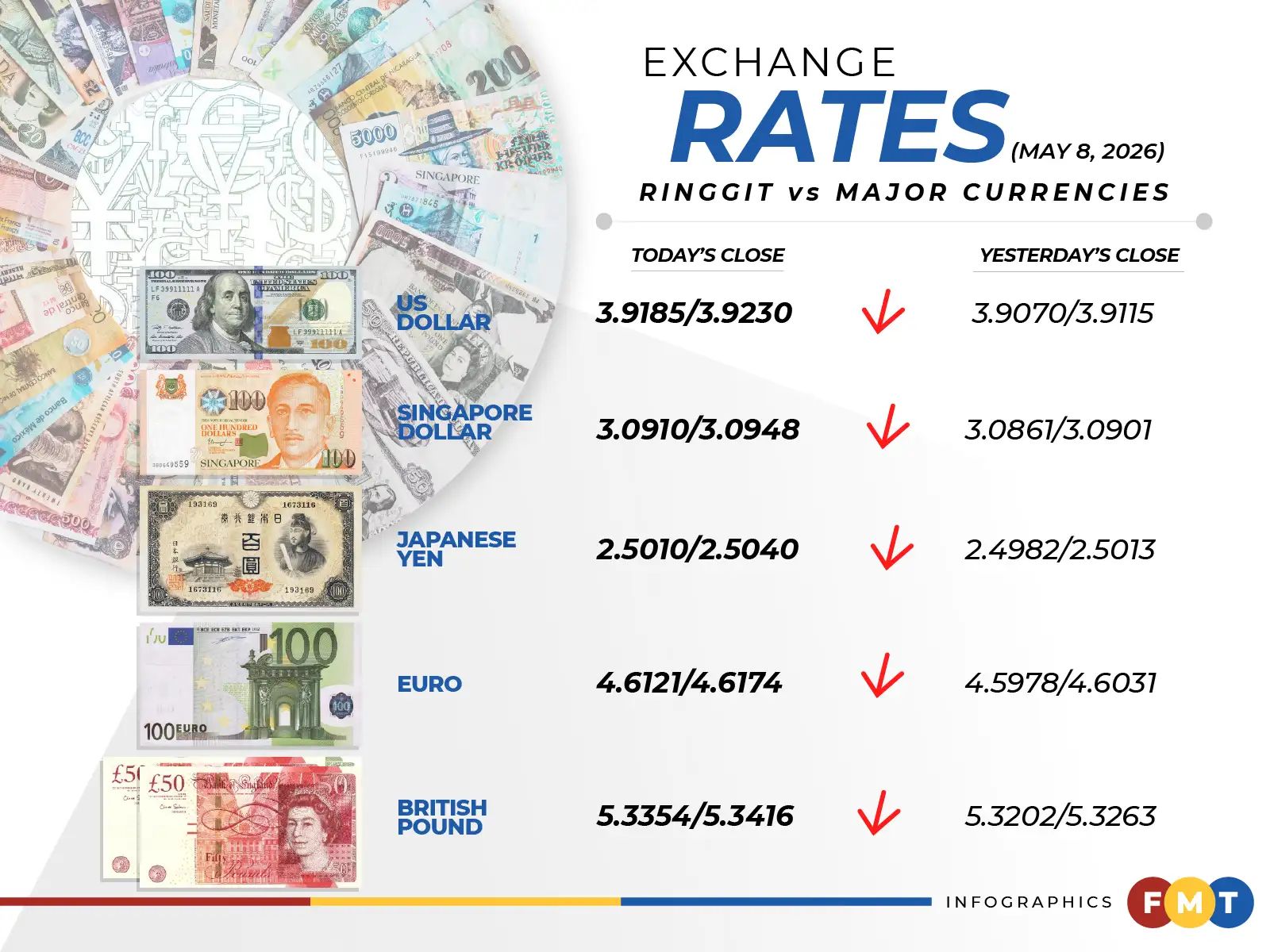
At 6pm, the ringgit inched down against the US dollar to 3.9185/3.9230 from 3.9070/3.9115 at yesterday’s close.
Bank Muamalat Malaysia Bhd chief economist Afzanizam Rashid said the NFP is expected to decline to 65,000 in April based on consensus estimates versus 178,000 in March.
“The local currency softened by 0.31% in light of the unsettling events in the Middle East,” he told Bernama.
Meanwhile, SPI Asset Management managing partner Stephen Innes said profit-taking activities emerged after another Middle East conflict escalation which briefly tested risk sentiment.
He said Iranian attacks on US warships that transited the Strait of Hormuz added a fresh layer of caution towards market sentiment.
“However, the broader ceasefire narrative remains intact after president Donald Trump continued to signal that the truce is still holding,” he said.
Innes said the market still believes in Middle East conflict de-escalation trade, which should be supportive for Asian currencies and regional risk appetite.
“On the other hand, traders are reluctant to add fresh exposure before the US jobs print, especially if a stronger-than-expected number keeps the US Federal Reserve away from the easing path and supports the greenback,” he added.
At the close, the ringgit traded lower against a basket of major currencies.
It slipped versus the Japanese yen to 2.5010/2.5040 from 2.4982/2.5013 at yesterday’s close, eased against the British pound to 5.3354/5.3416 from 5.3202/5.3263 yesterday and fell vis-a-vis the euro to 4.6121/4.6174 from 4.5978/4.6031 previously.
The local currency was mostly lower against regional peers.
It edged down against the Singapore dollar to 3.0910/3.0948 from 3.0861/3.0901 at yesterday’s close, depreciated versus the Thai baht to 12.1640/12.1844 from 12.1486/12.1687 previously, and remained unchanged vis-a-vis the Indonesian rupiah at 225.4/225.7.
The ringgit was little changed against the Philippine peso at 6.46/6.47 from 6.46/6.48 at the previous close.