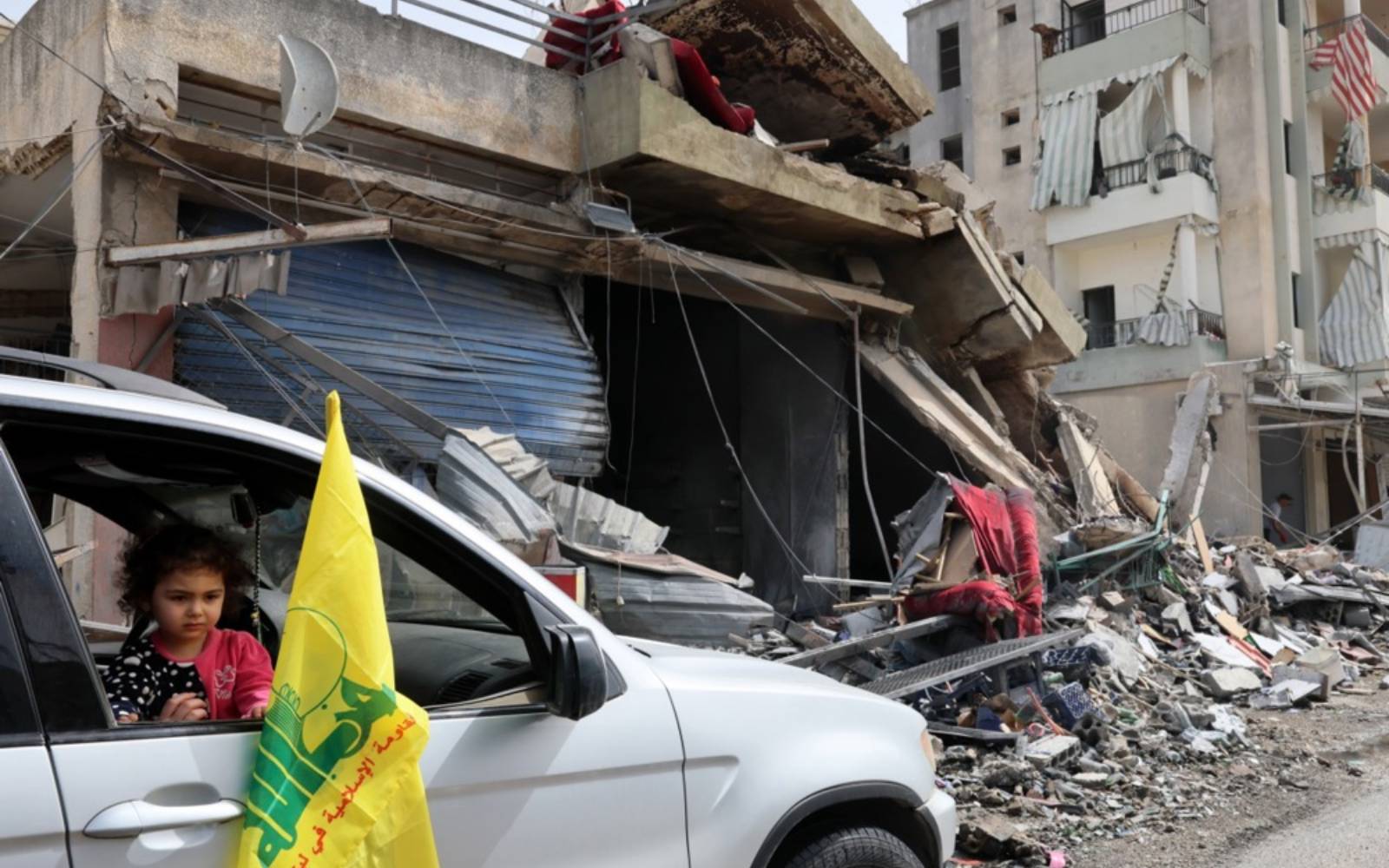
Some displaced residents have rushed back to their homes in the south but others are hesitant, uncertain about the durability of the 10-day truce that came into effect on Friday, halting weeks of fighting between Israel and Hezbollah.
In the village of Dibbine, an AFP correspondent saw a man inspecting damage to his home and people walking near the rubble of destroyed buildings.
In Srifa, another correspondent saw people unloading belongings including mattresses and a washing machine as they returned to the southern village.
Elsewhere, an AFP correspondent saw people travelling away from the south after retrieving belongings from their homes.
Israeli defence minister Israel Katz said he and prime minister Benjamin Netanyahu had instructed the army “to act with full force, both on the ground and from the air, including during the ceasefire, in order to protect our soldiers in Lebanon from any threat”.
He said the military had also been ordered to demolish any structure or road that was “booby-trapped”, and “to remove the houses in the contact villages near the border that served in every respect as Hezbollah terror outposts”.
Lebanon’s state-run National News Agency (NNA) said that “the Israeli enemy is still destroying what remains of houses” in Bint Jbeil on Sunday after reporting demolitions a day earlier in the town, which saw heavy fighting between Israeli forces and Hezbollah before the ceasefire.
The NNA also said the Israeli army was “blowing up houses in Mais al-Jabal” and “carrying out a sweep operation and detonations” in Deir Seryan, both also near the border, while the town of Kunin “was subjected to enemy artillery shelling”.
On Saturday, Israel’s military said it had established a “Yellow Line” in south Lebanon, similar to the one in Gaza that separates areas held by Israeli forces from those controlled by militant group Hamas.
‘Expansionism’
On Sunday, the military published a map showing its “forward defence line” and an area in red stretching the length of the border where it said forces were operating to dismantle Hezbollah infrastructure and “prevent direct threats to communities in northern Israel”.
It later said soldiers killed an “armed terrorist” who crossed the line.
Turkish Foreign Minister Hakan Fidan on Sunday denounced what he called “Israeli expansionism” in Lebanon.
The truce took effect days after the first high-level meeting between Lebanon and Israel in decades, pausing a war that has killed nearly 2,300 people in Lebanon and displaced more than a million since erupting on March 2.
On Tuesday, French President Emmanuel Macron will meet Lebanese Prime Minister Nawaf Salam in Paris in a visit aiming to demonstrate France’s support for Lebanon’s “territorial integrity”, the president’s office said.
Macron will also urge Lebanese authorities to prosecute those responsible for an attack on UN peacekeepers in south Lebanon on Saturday that killed a French soldier and wounded three others.
France and the UN force (UNIFIL) have blamed Hezbollah, which denied involvement.
A memorial ceremony was held at Beirut airport for the French peacekeeper, Florian Montorio, who UNIFIL said was “posthumously awarded UN and Lebanese Army medals in recognition of his dedicated service for peace in south Lebanon”.
Salam’s office said the premier would also travel to Luxembourg on Tuesday “to meet EU foreign ministers”.
Earlier Sunday, Lebanon’s military said it had reopened a road linking the city of Nabatiyeh with the Khardali area, and had partially reopened the Burj Rahal-Tyre bridge in the country’s south.
Israeli strikes on several bridges across the Litani River, which runs around 30 kilometres from the border, have limited access to the area.