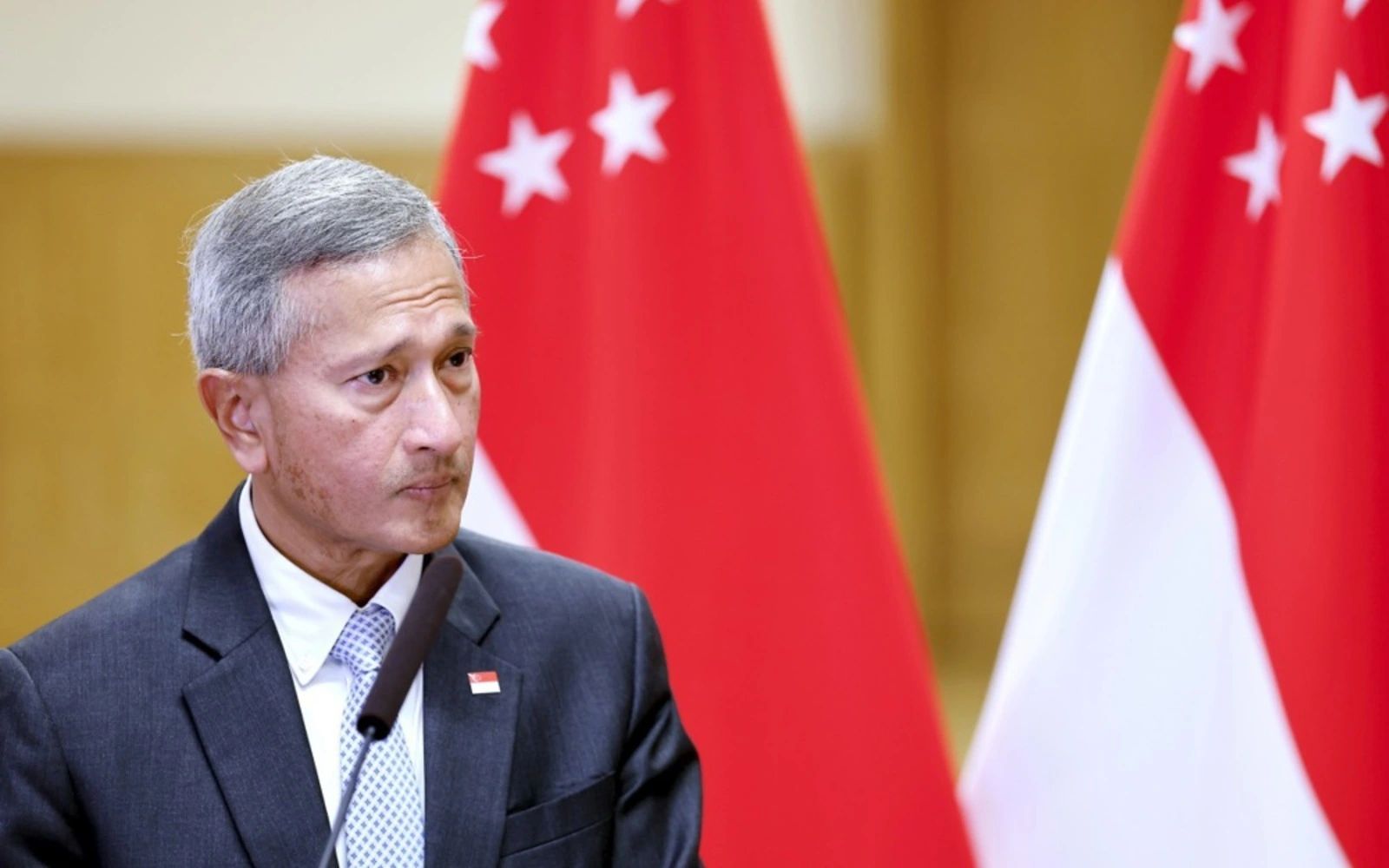
“The right of transit passage is guaranteed for everyone,” Balakrishnan said in an interview at a CNBC event in Singapore.
“We will not participate in any attempts to close or interdict or to impose tolls in our neighborhood,” he said.
He added that this message had been conveyed to both Beijing and Washington. Asked if Singapore had ever been pressured by other countries to change its position, he said “not yet, for us” and that “they may very well do so,” he said.
The Straits of Malacca – bordered by Singapore, Malaysia and Indonesia – is the key trade route for energy and goods between the Indian and Pacific oceans and considered a major economic chokepoint, similar to Hormuz or the Suez and Panama canals.
Patrolled by the US Navy’s Seventh Fleet, the strait has long been identified by China’s leaders as a vulnerability in a war scenario, termed the “Malacca Dilemma”.
Beijing has made efforts to lessen its energy dependence on the maritime route, via oil and gas pipelines through Myanmar and from Russia, as well as a massive renewable energy and electrification drive.
Referring to tensions between US and China, “the main danger is that relationship fractures,” he said.
“If they go to war in the Pacific, what you’re witnessing now in the Strait of Hormuz is just a dry run,” he said.
Indonesian president Prabowo Subianto had earlier this month highlighted Indonesia’s position along the Straits of Malacca, as well as the Straits of Sunda and Makasser, through which he said 70% of East Asia’s energy and trade passes.
“Are we aware of how important Indonesia is?” Prabowo said April 8. “We must understand that we are always the focus of the world’s attention. That is why we must also lead this nation well, correctly, and reliably,” he said.
Balakrishnan added that Singapore, Malaysia and Indonesia are all aligned on maintaining free passage.
“All of us are trade-dependent economies. All of us know it is in our interest to keep it open,” he said.
“The point here is that all three countries have a strategic interest and are strategically aligned in keeping it open. That’s not something which you can take for granted in many other places,” he added.