In Horsens, Denmark, it sounded like something else entirely — a memory, not a guarantee.
A 1-4 defeat to France has sent the 14-time champions crashing out of the Thomas Cup at the group stage for the first time in their history.
It is the kind of result that does more than end a campaign; it shakes an assumption that has long sat at the heart of the sport.
Indonesia did not arrive as underdogs. They came with depth in both singles and doubles, with pedigree that few nations can match, and with the quiet expectation that, when it mattered, they would find a way.
Instead, they unravelled early and never quite found their footing again. The collapse began in singles, where Indonesia have so often built their platform.
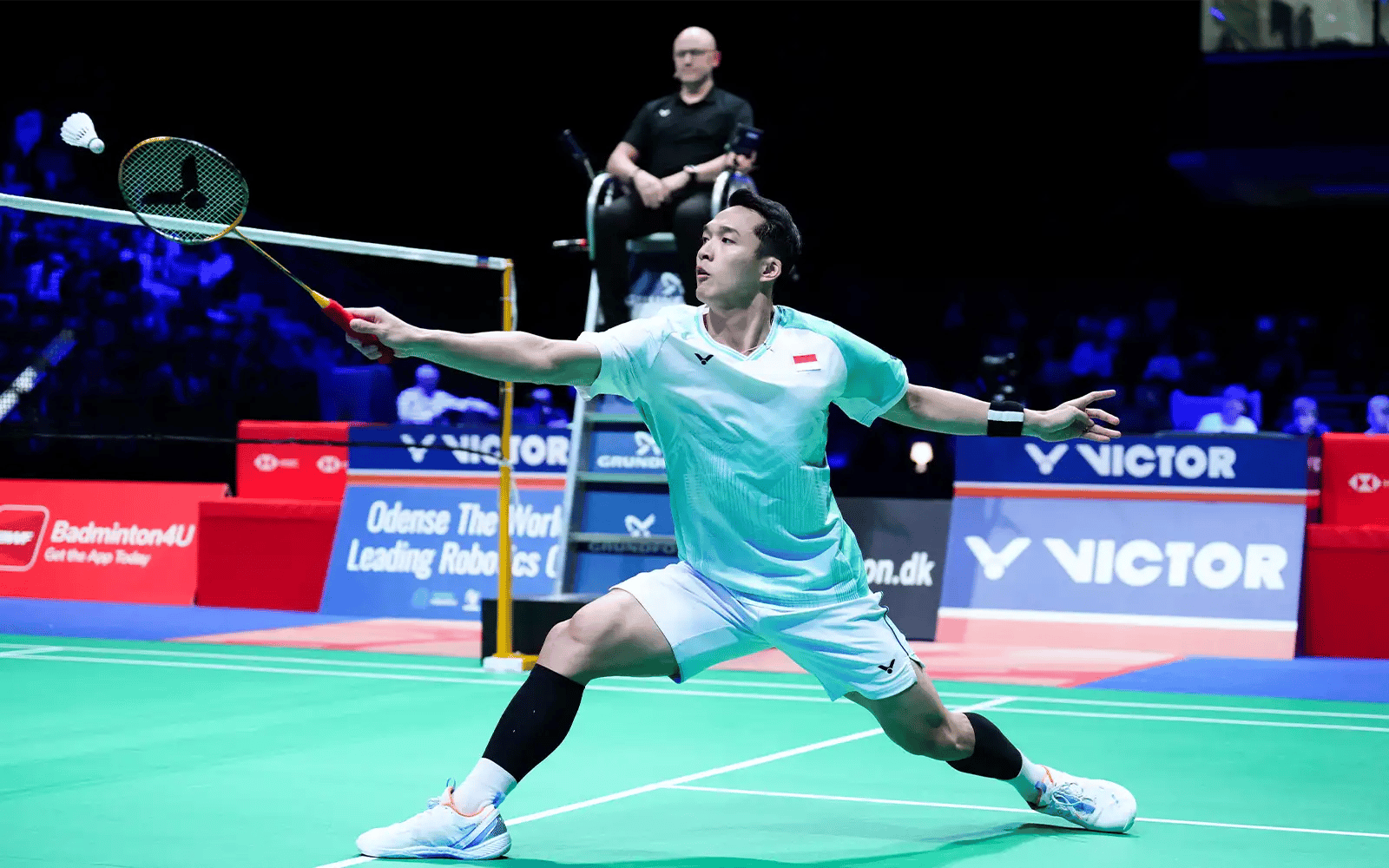
Jonatan Christie started well enough against Christo Popov, pushing through a tight opening game, but the resistance faded too quickly in the second.
It was not just the loss, but the manner of it, that set the tone. France had drawn first blood, and the edge that Indonesia usually carry in these moments was nowhere to be seen.
Alwi Farhan then ran into a sharper, more assured Alex Lanier. The Frenchman, subdued in earlier matches, played with urgency and clarity, forcing errors and dictating tempo.
Two matches in, Indonesia were chasing the tie rather than controlling it.
Anthony Sinisuka Ginting offered a route back. He surged ahead in the decider against Toma Junior Popov and looked ready to tilt the momentum. Then came the fall.
From that moment, the match shifted. The explosiveness dulled, the initiative slipped, and a match point disappeared with it.
Popov stayed composed, nudged the door open, and France walked through.
At 3-0 down, the equation had already turned unforgiving. Yet if there was one area Indonesia could still lean on, it was doubles.
On paper, the gap was clear. Sabar Karyaman Gutama and Moh Reza Pahlevi Isfahani held a top-10 ranking advantage over Eloi Adam and Leo Rossi.
In reality, rankings meant little against the wave of belief that France carried into the fourth match. The rallies tightened, the margins shrank, and under pressure, Indonesia cracked.
The final serve that fell short felt symbolic of the night itself, a small error that captured a broader drift.
The only point Indonesia claimed came late, through Fajar Alfian and Muhammad Shohibul Fikri, a consolation that prevented a sweep but did little to soften the blow.
More than one bad night
Indonesian media did not struggle for words. The defeat was described as stunning, unprecedented, a wake-up call.
There were images of disbelief, of players slumped on court, of a team grappling with a result that did not fit the script.
Yet to frame this purely as failure would miss half the story.
France did not arrive here by accident. Their rise has been building, through European team success, through the emergence of the Popov brothers, through the steady progress of players like Lanier.
They did not just win matches; they played with cohesion, energy, and a belief that held at the tightest moments. As a unit, they looked ready for this stage.
That contrast matters. Indonesia have long thrived on individual brilliance supported by tradition and depth. On this night, France looked like the more complete team.
The deeper discomfort for Indonesia lies beyond a single tie. Badminton is not just another sport in the country; it is woven into its national identity, the arena in which Olympic gold has been won and global respect consistently earned.
Results like this do not pass quietly because they challenge more than form; they challenge expectation.
None of this signals a collapse. Indonesia still possess talent, history, and the capacity to respond.
But the assumption that they will always rise, always find a way, feels less certain today than it did a week ago.
France’s victory stands as both statement and signal. The sport has shifted, even if only slightly, and the space at the top is no longer reserved.
For Indonesia, the task now is not to defend a reputation, but to rebuild the certainty that once made that old phrase feel unquestionable.