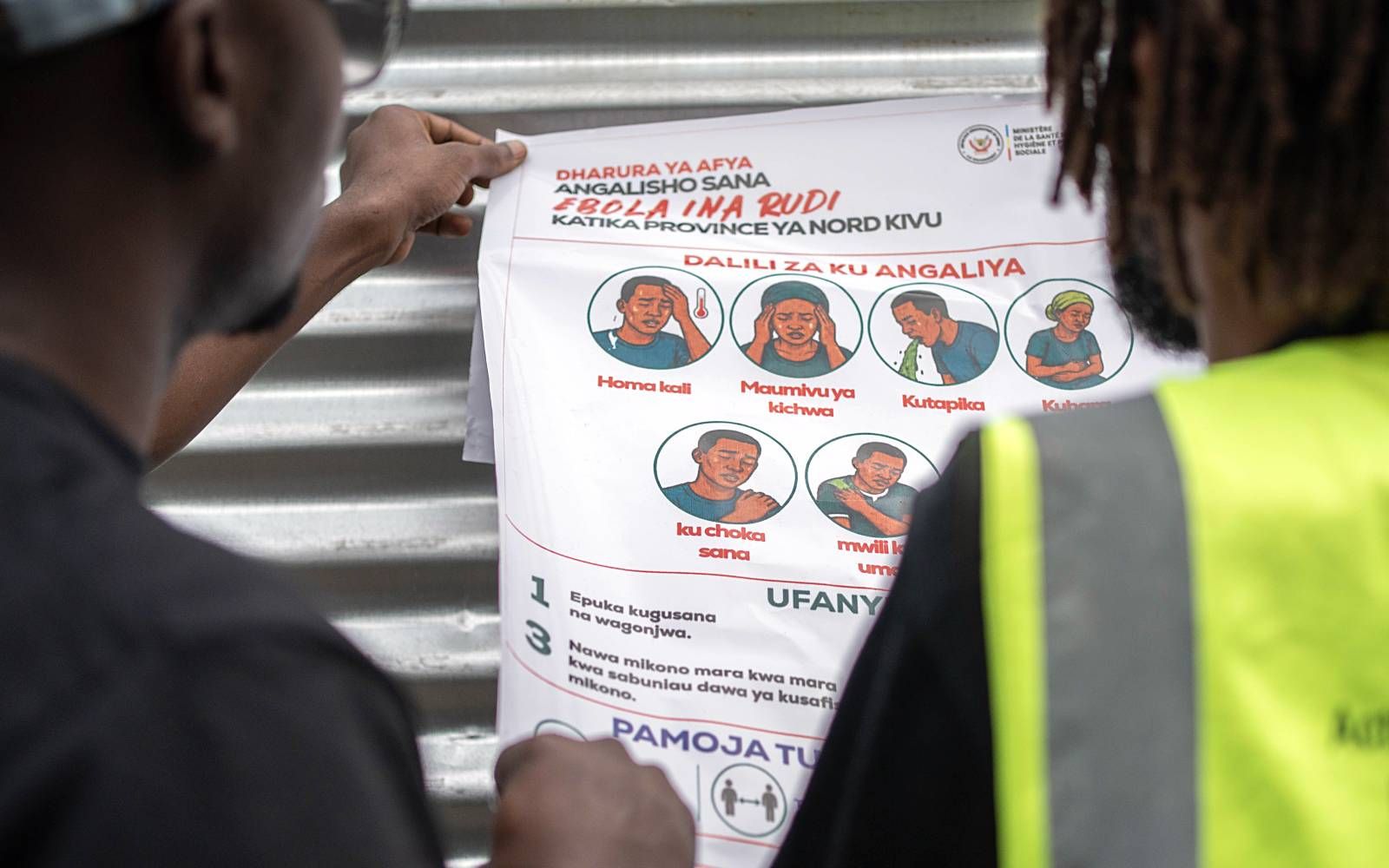
Efforts to get a grip on the latest outbreak of the highly contagious haemorrhagic fever, which the World Health Organization has declared an international emergency, have been hampered by the DRC’s long-running conflicts, including between the Congolese army and the M23.
Having seized swathes of land in the mineral-rich east with Rwanda’s help, the M23 has installed a parallel administration in areas under its control.
But the armed group has never had to manage the response to a serious epidemic of a disease like Ebola, which has killed more than 15,000 people in Africa in the past half-century.
The virus is suspected to have claimed 160 lives out of nearly 671 probable cases, according to figures published by the National Institute for Public Health (INSP) on Thursday.
There are 64 confirmed Ebola cases and six confirmed deaths, INSP said.
Tests “confirm a new positive case” in Kabare territory in South Kivu, M23 spokesman Lawrence Kanyuka said in a statement.
Parts of South Kivu, including the provincial capital Bukavu, fell to the M23 in February 2025 after fierce clashes.
The case involved a “person coming from Kisangani”, a major city in the eastern Tshopo province, where no Ebola infections from the current outbreak have so far been recorded.
Congolese authorities, in a statement on Thursday, reported two cases identified in South Kivu province – one suspected case and one confirmed.
Riot at hospital
The outbreak’s epicentre is in northeastern Ituri province, with many cases in hard-to-access areas plagued by the Congolese east’s litany of armed groups and where measures to respond to the crisis have been slow to get off the ground.
“We have no sanitary facilities at all, not even a handwashing station, for 16,000 displaced people,” said Desire Grodya, an official at a site for displaced people in Kigonze, on the outskirts of Bunia, Ituri’s provincial capital.
“We’re really crammed in here; it’s total overcrowding… If the outbreak starts on the site, it will be catastrophic,” he warned.
On Thursday, a brief riot erupted at the hospital in Rwampara, one of the outbreak’s focal points located about 12km from Bunia.
Young people who “wanted to retrieve the body” of a deceased patient “entered the hospital and burned down the two isolation tents”, a hospital official told AFP.
A healthcare worker was also injured by stone-throwing before law enforcement intervened, the official said.
The isolation tents had only just been put up at the hospital.
Cases have also been recorded in North Kivu province and neighbouring Uganda, where one person has died.
Split by front lines
Both North and South Kivu are split in two by the front lines dividing the Congolese army from the M23 armed group and its Rwandan allies.
No vaccine or clinical treatment exists for the Bundibugyo strain of the Ebola virus responsible for the current epidemic.
“Every passenger who arrives here, whether at the airport entry point or elsewhere, is subject to a temperature check,” said Aime Prospere, head of border hygiene at Bunia airport, in a statement.
Tonnes of equipment have been delivered at the airport by the WHO and NGOs since Monday.
In the city “we’re not allowed to carry two people on the same motorcycle”, Paulin Kibondo, a motorcycle taxi driver, said.
While the WHO believes the risk from the Ebola outbreak is high both in the DRC and the wider central African region, it considers the risk of a worldwide pandemic to be “low”.
The United States is diverting arrivals who recently travelled to Ebola-hit countries to a single Washington area airport for screening.
Uganda has suspended all public transport to DRC while India is rescheduling next month’s summit on the conservation of big cat species to ensure the participation of African nations.