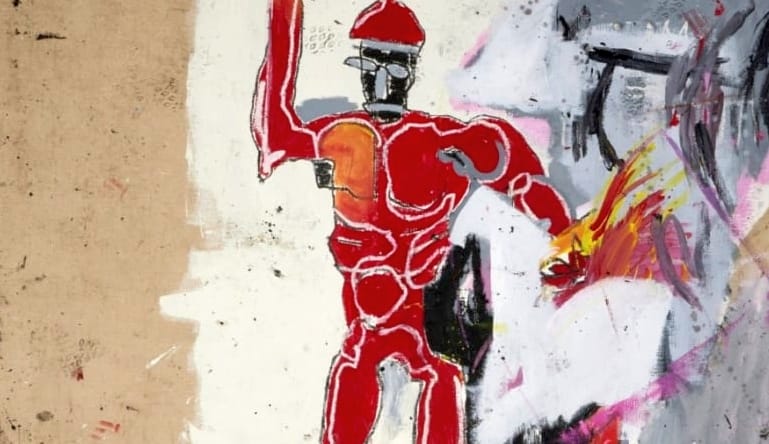
“Untitled (Red Warrior)” was created in 1982, a pivotal year in which the New York artist painted nearly 200 canvases. And if few of these appear at auction, it’s because only a rare few of Basquiat’s “Warrior” artworks remain in private hands.
The artwork offered at auction features Basquiat’s favourite motif, the lone hero, whom he often depicts with an upraised arm or brandishing various objects such as arrows and swords.
“The warrior can be interpreted as a self-portrait, a triumphal symbol of the Black artist conquering the invisible oppressor within the image, succeeding in an art world that was predominantly white,” Sotheby’s explains.
This is the first time “Untitled (Red Warrior)” has appeared on the market, making its debut in Asia. It is estimated to fetch between HK$150 million (RM86 million) and HK$200 million.
Still, there is little chance that the painting will exceed the US$110.5 million fetched by “Untitled” in 2017 at Sotheby’s New York.
Bids, however, could rise quickly, given Asian collectors’ appetite for artwork by the enfant terrible of contemporary art. Christie’s made headlines in February when “Warrior” sold for US$41.8 million at one of its Hong Kong auctions, making this particular Basquiat warrior painting the most expensive Western artwork ever sold at auction in Asia.
A safe bet
This impressive performance came as no surprise to the New York art dealer Christophe Van de Weghe.
“Basquiat is one of the strongest markets coming out of the pandemic,” he told The New York Times at the time of the sale. “It’s worldwide. You can sell Basquiat, like Picasso, to someone in India or Kazakhstan or Mexico.
“You can have a 28-year-old spending millions on Basquiat and you can have a guy who is 85. He appeals to all kinds of people, from rappers to hedge-fund guys.”
Basquiat’s popularity has soared in recent years, fuelling the exorbitant prices his works can fetch at auction, not to mention in contemporary art fairs. One of his diptychs titled “Hardware Store” was offered US$40 million during the last edition of Art Basel.
It is a “very correct” price, according to Van de Weghe, even in the absence of the American and Asian collectors who usually lead the way at Basel – proof, if any were needed, that Basquiat is a pretty safe investment.