
Smart homes are becoming more mainstream, although the idea has yet to become popular on a larger scale in Malaysia.
And with more and more devices being announced in recent times, it makes sense for the different smart-home players to come together and decide on a standard that lets everybody play nice with one another.
Out of the ensuing chaos, a new standard has arisen – Matter. First announced at the end of 2019 by Amazon, Apple, Google, and the Zigbee Alliance, Matter was described as a “royalty-free connectivity standard to increase compatibility among smart-home products”.
The original name was boring – Connected Home over IP (CHIP) – as it relied on internet protocol to bring different devices, ecosystems, and apps together on a single connection.
One name change later and four communication protocols are currently supported: Ethernet / LAN cable (IEEE 802.3); Wi-Fi/WLAN (IEEE 802.11); Thread (IEEE 802.15.4); and Bluetooth Low Energy.
Explaining Matter
Think of Matter as the USB connector for smart-home devices. What used to be hugely popular connectivity standards – the serial (DE-9), parallel (DB-25), game port (DA-15), DisplayPort (DP), and different charging ports – are now defunct.
Matter wants to prevent such obsolescence regardless of your technological allegiance to the likes of Siri, Alexa, or Google Assistant. Use any of these and they can still control devices over Z-Wave, Wi-Fi, and Zigbee.
Major players in the industry such as Amazon, Apple, Google, SmartThings (Samsung), Huawei, Oppo, Texas Instruments, and Signify (Philips Hue) have thrown their weight behind Matter, which makes it all the more difficult to fail.
As the main standard, the communication protocol in action is duly known as Thread.
Thread-ing the future
Thread differentiates itself from Wi-Fi and Bluetooth by building a mesh network. In layman’s terms, a device that remains permanently connected to the Thread-compatible power grid will be able to extend the smart-home network.
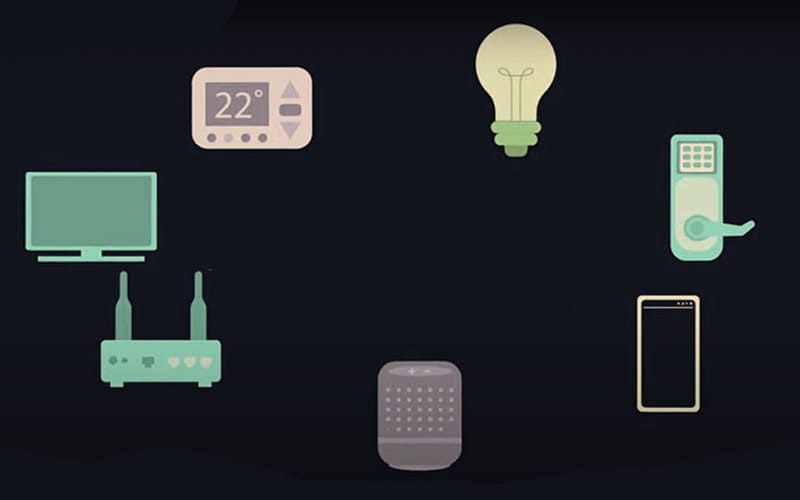
Imagine, for example, your door lock being out of range of your home-security setup. Do not be alarmed – said door lock can still find a way around by communicating via a Matter lightbulb.
Thread intends to be intuitive and user-friendly since there is no need for manual configuration of the network. All Matter devices have been designed to coordinate with one another, and will eventually form the most efficient method of communication among themselves without human input.
This removes a lot of guesswork and frustration, which would certainly be a good way of increasing the adoption rate. In fact, to start a Thread network connection to the outside world, all you need is a single device back home that plays the role of the Matter “border router”.
Right now, popular devices that boast such capability include the latest-generation Amazon Echo, the Apple TV 4K (3rd generation), and the HomePod Mini.
Smart homes Matter
If you want an appealing reason to jump aboard the Matter bandwagon, here’s one: interoperability. You can have the Apple HomeKit, Samsung SmartThings, or a different ecosystem under the Matter umbrella, and everything will still work like magic.
Someone else under the same roof can control the smart socket via Google Assistant, while you rely on Alexa. Your household is no longer confined to going all-in with iOS or sticking with Android, as each person can use the platform they are most comfortable with.
Another advantage is ease of accessibility when you purchase smart devices for the home. You do not need to worry about compatibility when selecting devices from different vendors, as long as you find the Matter or Thread symbol printed on the box.
Setup is also a breeze: all you have to do is scan a QR code. In addition, Thread’s mesh principle does away with the need for bridges or signal repeaters to expand the coverage area in your home. This helps reduce the cost of entry in the long term.
You might wonder about security issues. Fret not, any Matter-ready device will not be certified unless it meets the minimum security requirements.

Matter takes security seriously, relying on blockchain technology to store software changes in a decentralised location while remaining transparent so it is easily verifiable. All Matter devices are encrypted and hack-proof.
Backward compatibility
There is always collateral damage when adopting any new technology, and the same holds true with Matter. Older devices need to be certified for the new standard, with the high likelihood of them requiring a firmware update.
Still, this is an encouraging sign as it helps reduce electronic waste by prolonging the lifespan of older devices.
Amazon, Google, Samsung, Signify, eWeLink, Ledvance, Sengled, TP-Link, Tuya, and Lifx have already announced that many of their products will gain backward compatibility with Matter through firmware updates – hopefully sooner rather than later.
Should you live in a smart home?
Millennials are certainly at home with technology, having grown up in an era of smartphones and connectivity. To them, the idea of a smart home might be ideal; it is the older generation who might want to mull over the advantages of such added convenience.
Whatever the case, it seems like smart homes will eventually become the norm, and Matter is as good a place as any to start.
Find out more about Matter by clicking here.
Edwin Kee dreamt of being a pro-gamer only to have circumstances mould him into a programmer in a past life. He has since moved on to write about consumer electronics and other topics. Check out his blog at manatau.com.