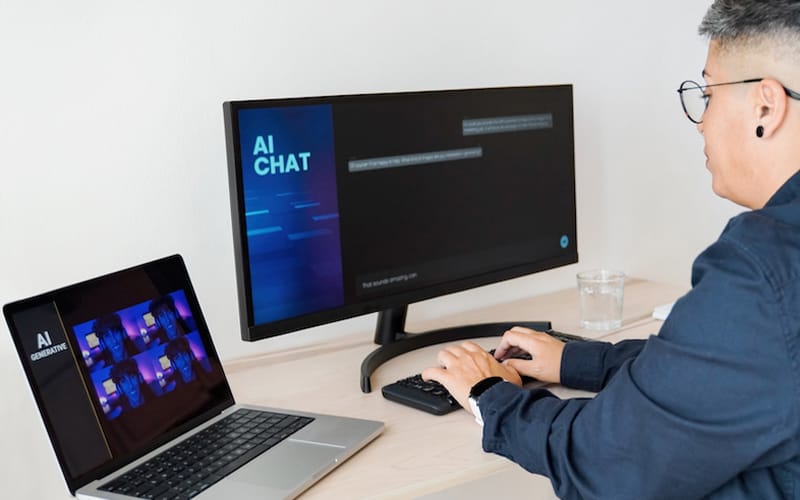
Recent advances in artificial intelligence have rekindled fears of human obsolescence in the workplace. Many employees fear the rise of this software will lead to the loss of their jobs, prompting some to adopt an anti-AI stance.
Recently , job search site Glassdoor asked close to 10,000 working Americans whether they would like their companies to regulate, or even ban, the use of artificial intelligence software.
The overwhelming majority (80%) do not want such measures to be taken, although there are some differences of opinion depending on the ages and professional sectors of those questioned.
Some 28% of employees over 45 would like companies to adopt a more conservative stance on AI, even if it means banning its use altogether. In comparison, only 17% of 21- to 25 year-olds take this view.
The Glassdoor survey shows that some industries are more hostile to AI than others. Employees working in advertising and marketing (87%) strongly oppose a ban or the restriction of ChatGPT and other AI programs in business, as do professionals in consulting (84%) and healthcare (83%).
Conversely, a third of law professionals surveyed would be in favour of a ban or the restriction of ChatGPT in the workplace.
This figure no doubt reflects the transformations that the legal sector has undergone since the advent of “big data” technologies. Indeed, a large number of legal and administrative tasks are now automated, such as the complete, tailor-made drafting of basic deeds, or the retrieval of court rulings.

But automating these tasks does not make legal professionals obsolete. US lawyer Steven Schwartz offers a case in point, having used ChatGPT to draft a legal brief in a case between a private individual and an airline. According to the” New York Times”, the document cited several rulings that never existed, by way of jurisprudence.
This amusing case shows how the automation of professional tasks does not replace the added value of human employees: it merely shifts this to other, more complex activities, in which the machine does not excel.
The consulting firm McKinsey estimates that between 2030 and 2060, AI will make it possible to automate half the tasks currently performed by workers. This represents a considerable gain, not only in productivity but also in GDP, as numerous reports on the subject suggest.
Despite these optimistic forecasts, the advent of AI software in our working lives is, for some people, generating new feelings of anxiety called “AI-nxiety”. This is similar to the “technostress” phenomenon, coined by the clinical psychologist Craig Brod in the early 1980s.
However, “AI-nxiety” takes on a more metaphysical dimension due to the discourse foreseeing the replacement of human workers by machines – all of which contributes to employee malaise in an ever-changing world of work.