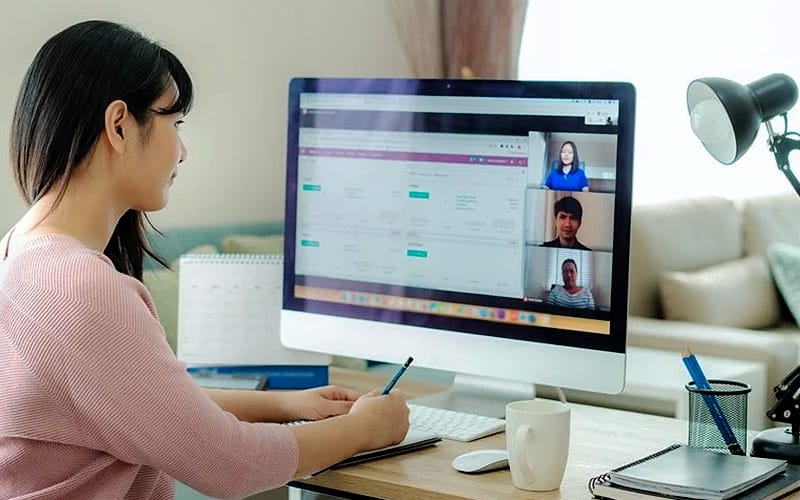
Would you accept a job that involved going into the office five days a week, without any option of working from home? Just a few years ago, this likely wouldn’t have even been asked, but it has become a genuine issue since the start of the pandemic.
Still, feelings about remote work vary significantly according to several criteria and factors associated with each worker. One key factor appears to be gender, a recent survey conducted in the United Kingdom suggests.
Carried out among 2,000 British adults, the survey reveals that women are more likely than men to turn down a job if it involves going to the office every day.
And this also applies even if the work is ideal: according to the survey, only 59% of the women said they would be prepared to go to the office five days a week, even for their dream job, compared with 67% of men.
At the same time, 60% of men said they would be prepared to increase the number of days they spent in the office to help their career progress, while this was the case for only 50% of women.
Nevertheless, young people (of all genders) were more willing to give up hybrid work if they landed their dream job. Some 78% of respondents aged 25-34 said they would be prepared to go to the office five days a week for such a position.
Increased mental load, lack of advancement
This survey is far from the first to note that women are more inclined to favour remote work than men.
In a YouGov study carried out last year among 4,000 Americans, 43% of men considered it “acceptable” to come into the office every day, compared with just 28% of women.

The survey also suggested that women attach greater importance to flexible working hours than men: 57% versus 44%.
While these two surveys don’t really explore the reasons women prefer remote and hybrid work, other studies have documented possible motivating factors, regardless of gender: better time management, reduced stress, increased productivity, and optimised use of time.
But for women, these work habits could come with both positive and negative effects. In February, France’s High Council for Equality warned that remote work could increase inequalities between men and women.
It pointed out that, during the country’s first period of Covid-related lockdown, more than a third of women who worked from home for six hours or more devoted at least two hours to domestic tasks, compared with an average of one in five men.
Although the rise of remote work during the early days of the pandemic highlighted this fact, such awareness did little to reduce the mental burden on women.
Another recent study, this time from United States, highlights another kind of problem: that regular remote work may slow down women’s career advancement, as well as that of young people – insofar as it may delay the acquisition of the professional skills necessary for promotion.