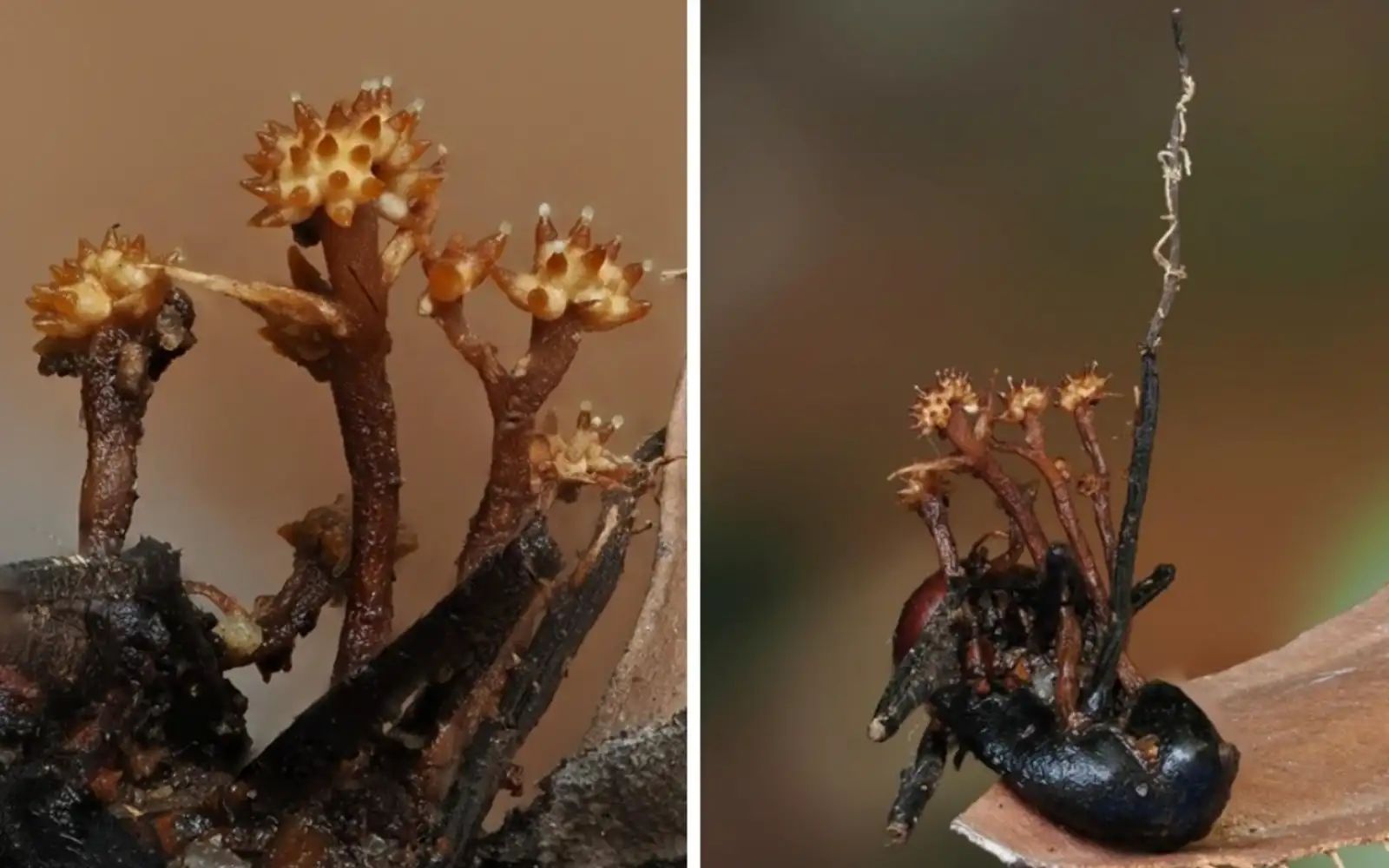
Researchers from Universiti Malaysia Sabah (UMS) have discovered what is believed to be the world’s first horn-shaped fungus species, marking a rare and exciting moment in the study of biodiversity.
The newly identified species, named “Pleurocordyceps cornusynnemata”, stands out for its horn-like structure that sets it apart from other known members of its genus.
For lead researcher Jaya Seelan Sathiya Seelan, from the UMS Institute for Tropical Biology and Conservation (ITBP), the find was as striking as it was significant.
“It is this horn-like structure that makes it unique,” he noted. Among the 26 known Pleurocordyceps species previously recorded in countries such as China, Thailand and Japan, none share this unusual shape.
The discovery was made in the Danum Valley Conservation Area, one of Sabah’s most biodiverse and carefully protected rainforest ecosystems, often regarded as a living laboratory for scientists.
And as it turns out, the team’s find did not stop there. The researchers also recorded two other fungi – “Pleurocordyceps aurantiaca” and “Pleurocordyceps nipponica” – in Malaysia for the first time.
The study, conducted with a mix of experienced researchers, postgraduate students and one citizen scientist, has since been published in the international taxonomy journal Phytotaxa, confirming the global significance of the discovery.
For the team, it is both a scientific milestone and a reminder of how much remains hidden in Malaysia’s forests. The specimens have now been carefully preserved at the Borneensis storage centre at UMS, where they will serve as a reference for future research.
UMS vice-chancellor Kasim Mansor described the discovery as proof that Malaysian scientists are capable of leading research with global impact.
For those working closely with the region’s biodiversity, the find is hardly surprising. According to ITBP director Fiffy Hanisdah Saikim, Sabah’s rainforests still hold countless species waiting to be discovered.
This latest find, she said, is not just about one unusual fungus but about nurturing a new generation of researchers, and continuing the work of uncovering what lies beneath the forest canopy.