
Introduced in the late 19th century during the reign of Sultan Abu Bakar, its origins can be traced to Teluk Belanga in Singapore, Johor’s administrative centre back then.0
Historically, attire reflected social hierarchy: the cekak musang style was reserved for royalty and nobility, while the Teluk Belanga design was worn by the common people.
That distinction was abolished in 1982 by Sultan Iskandar, who established Teluk Belanga as the official attire for all Malays in Johor, symbolising unity across social lines.
Today, the outfit remains a strong cultural marker, closely tied to Johor’s emphasis on formality and etiquette, especially during official occasions and Friday prayers.
At the heart of the Teluk Belanga is a detail that sets it apart: the neckline, hand-stitched using the “tulang belut” technique.
The fine, slanted stitching requires precision and patience – a skill machines have yet to replicate.
Traditional garments also feature three pockets, along with elements such as “pesak” and “kekek”, and are cut loosely for comfort and ease of movement, particularly during prayer.
“In the past, the entire garment was sewn by hand using a method known as ‘sembat satu badan’,” said Jamil Sukaimi, owner of the boutique Teluk Belanga Design.
Another technique, “perenggi”, once practised by the Bugis community in Johor, has largely disappeared due to the lack of skilled practitioners.
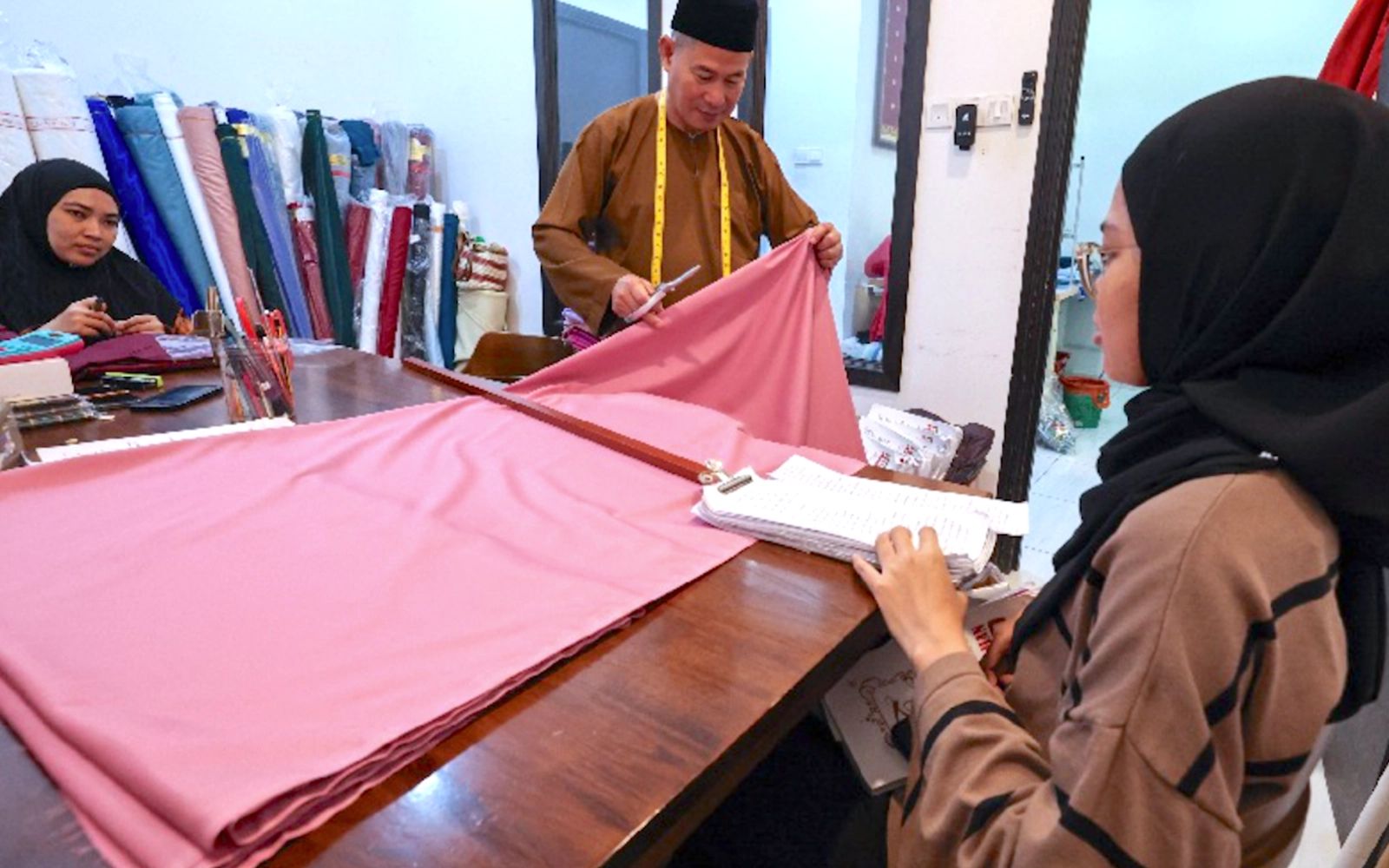
Even tulang belut now faces a similar risk. With most experienced tailors aged 40 and above, concerns are growing over whether the craft can be sustained.
Efforts to preserve these skills include competitions and collaborations with cultural agencies, though mastery still largely rests with older artisans.
“If the younger generation does not learn, not only will tulang belut stitching disappear, other heritage elements may also fade away,” Jamil stressed.
While the craftsmanship remains rooted in tradition, some aspects have evolved. Cotton, long valued for its breathability in Malaysia’s climate, is preferred, though modern variations now include Japanese cotton and linen blends.
A distinctive finishing touch comes in the form of decorative buttons fitted into loops known as “insang pari”, once made from precious stones but now more commonly crafted from accessible materials.
The appeal of the attire has also spread beyond Malaysia, with orders coming from countries such as Singapore, Australia and London.
Despite changing fashion trends, including the rise of modern cuts and styles, Teluk Belanga endures. And as long as its craftsmanship continues to be valued, it will remain a reflection of identity, tradition, and heritage carried forward across generations.