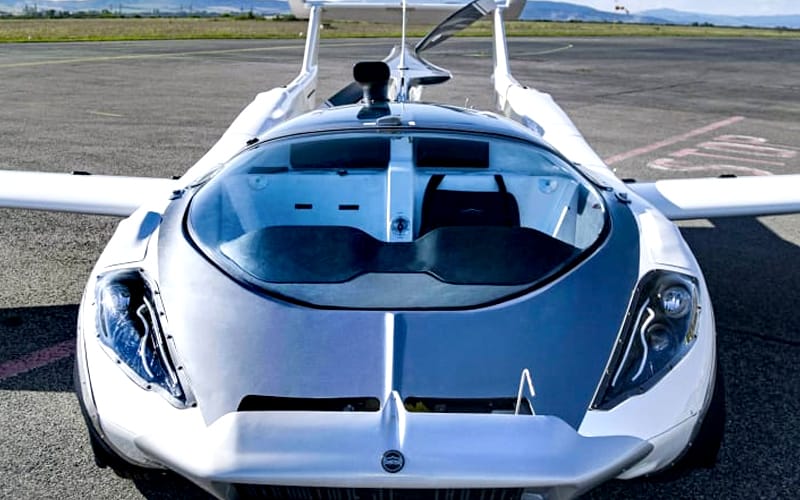
The hybrid vehicle is able to transform from car to aeroplane in a little over two minutes. Thanks to two wings on the sides of the vehicle, a BMW engine and a gigantic rear wing, the flying car is able to take off just like a real plane.
The Slovak Transport Authority has just issued Klein Vision with a certificate of airworthiness for its AirCar, which can reach a maximum speed of 170 km/h and an altitude slightly higher than 2,500m. It runs on gasoline and creators hope when it goes into mass production, it will have a range of 1,000 km.
It will, of course, be necessary to obtain a pilot’s licence in order to use this futuristic vehicle.
The certification follows 70 hours of flight testing and more than 200 takeoffs and landings, the company said.
“AirCar certification opens the door for mass production of very efficient flying cars,” said inventor Stefan Klein. “It is official and the final confirmation of our ability to change mid-distance travel forever.”
The company plans to soon conduct a flight from Paris to London.
Competition on the horizon
Other companies are also developing vehicles capable of flying and driving, including the eVTOL concept – an electric vertical take-off aircraft – and the three-wheeled PAL-V Liberty vehicle, which is already authorised to travel on European roads but is awaiting certification from the European Aviation Safety Agency.
However, there is still a long way to go. Companies are already working on autonomous flying taxis, and the transport revolution may not necessarily be in the personal flying car segment.
Boeing has just invested US$450 million in Wisk, a California-based autonomous air cab company launched by Google co-founder Larry Page.
Whatever the case, one thing is for sure – when you see the first flying car over your city, you’re sure to be amazed.