
His programme has gained followers around the world and remains popular, with approximately 400,000 children globally learning to play instruments – including violin, piano, cello, flute and guitar – the Suzuki way.
The Suzuki Method is based on the idea that the attainment of musical skills can mimic the natural process of an infant acquiring a mother tongue. His approach strives to make music a part of the child’s everyday environment, for instance by constantly playing recordings by masters at home while turning the seemingly daunting technical motions of music-making into fun activities.
Students learn with his repertoire books, which are filled with hummable melodies – the first of which are his rhythmic variations on the theme of “Twinkle Twinkle Little Star”. From the start, Suzuki students nurture their love of playing with their peers in regular group lessons, and occasionally, in huge ensemble performances that have become something of a signature event synonymous with the programme.
There exists an enduring fallacy about the method, however. Suzuki’s goal was never to mass-produce precociously advanced miniature violinists, as is commonly thought. His goal was to unleash a far-reaching social reform so that any and every child would be given chances to grow, in music or in any other pursuit, to live a richer life, and to form a better society as a result.
He insisted that his approach was not about education in the violin, but “by the violin”, meaning that the same methodology he used to teach music could be applied to multiple areas of learning.
The depth of his conviction and the zeal with which he advanced his philosophy matched the dissenting spirit of 20th-century revolutionaries. (Born in 1898 and dying in 1998, Suzuki lived through most of that century.)

His life offers a fascinating story intertwined with the history of modern Japan and the rest of the world. Suzuki was born in Nagoya to a clan of former samurai. The family’s fortunes fell with the Tokugawa Shogunate, which was replaced by the modernising Meiji government in 1868 after 260 years.
Having lost the social privileges of the elite warrior class, his forefathers started supplementing their income by making shamisen – the three-string traditional Japanese instrument. His father, Masakichi Suzuki, however, switched to making violins, rightly sensing that a greater market opportunity lay in the production of western instruments.
The violin was also an acute reminder of how much Japan, as a nation, had to overcome before gaining respect as a modern power. By coincidence, the violin had taken off in a major way in Europe just as Tokugawa Japan was withdrawing into its shell, shutting out foreign influences for the sake of domestic order and stability.
The new government that replaced the Tokugawa was all too aware that classical music – and, by extension, the violin as its representative voice – mattered if Japan were to join the club of “civilised and cultured” nation-states.
True, catching up with the west in the areas of natural sciences, engineering, military science, law and medicine was seen as a more urgent task. But Japan’s new leaders thought music sufficiently important to make western-style music an integral part of the elementary-school curriculum.

Soon the government started sending students abroad so they could study in the world’s top classical-music conservatories.
Masakichi Suzuki’s violin business, Suzuki Violin, thrived along with bigger industries such as shipbuilding, minerals and commodity-trading houses. Japan’s economy as a whole expanded, especially during World War I, shifting its focus from imports to exports, as foreign powers came looking for supplies.
Shinichi Suzuki’s own growth as an adolescent took place at the same time.
Japan’s boom years provided a liberal firmament in which a democratic and progressive experiment in politics, education, art and literature was unleashed. This era, the so-called Taisho Democracy, was short-lived, roughly covering the reign of the Taisho Emperor Yoshihito from 1912-26, and yet it was critical in the making of the humanist Shinichi Suzuki.
His school education as well as his self-education through reading and observation focused on moral improvement as much as academic subjects.
After graduating from high school and a brief stint at Suzuki Violin, Suzuki eventually decided to pursue music, first in Tokyo, then in Berlin, where he arrived in 1921, and would spend much of his 20s. He met his future wife, Waltraud, there.
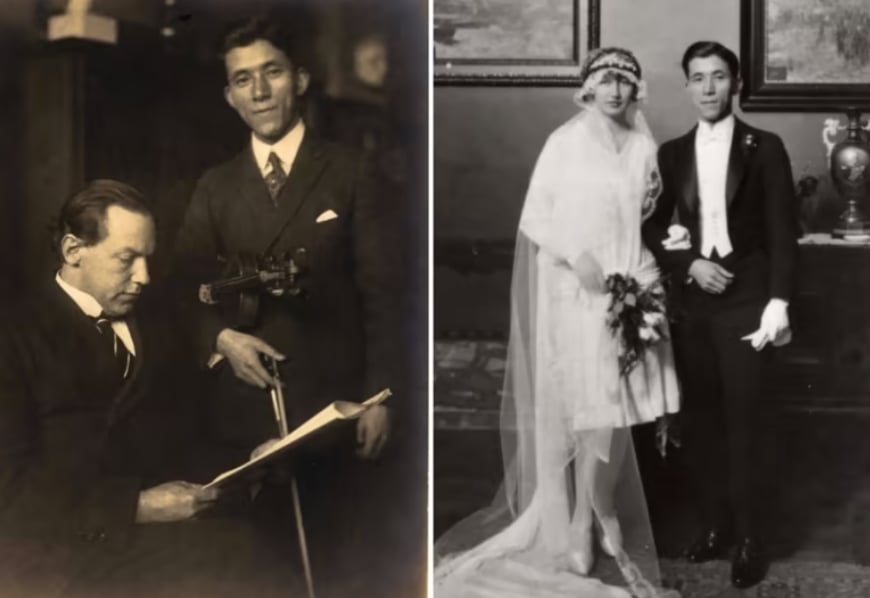
In Weimar, Germany, he followed up on his humanistic tendencies and absorbed the ideals perfected by Berlin’s upper bourgeoisie. Central to their way of life was the belief that education and the arts, especially music, contributed to character formation, and that there was always room for anyone to grow.
Implicit in such ideals was that people, regardless of their background, were all the same.
Many years later, Suzuki would recall a home concert he attended in Berlin, in which he was asked to play a concerto by Max Bruch. Afterward, an old lady was overheard saying to one of the most famous residents of the city, Albert Einstein: “I just don’t understand why Mr Suzuki, who grew up entirely in Japan, could so clearly express the German-ness of Bruch. How is that possible?”
Einstein paused pensively, then replied: “Madam, people are all the same.” Suzuki noted this remark as a powerful statement of humanistic regard that reinforced his own view.
Suzuki returned to Tokyo with his wife and lived there during the 1930s. He formed a successful string quartet with his brothers, and also stumbled into teaching.
Suzuki did not start out as a specialist in children’s education, but he had a quality that disarmed young violinists, who adored him. And so he tirelessly experimented with ways to teach youngsters, which would form the basis of his approach after the war.

The 1930s were troubled times when Japan’s schools became sites of increasing indoctrination, especially after the escalation of Japan’s conflict with China, which developed into war in 1937. This prompted Suzuki, in September 1941, to respond by publishing “Powerful Education”, a book advocating an overhaul of Japan’s public schools.
He advanced the idea that after a decade of successfully teaching a variety of young violinists, he knew there were no dropouts in the world, but only “dropped outs”, who were compromised by adults who did not bother to find a proper way to teach them.
He called for the government to intervene and to adopt his methodology of goal setting, memorisation and repetition, which had been so effective with his violin students. But the government was more preoccupied with Japan’s imminent war with the United States. Suzuki would have to wait another few years to launch his educational campaign.
To show the world what constructive teaching and learning could achieve, Suzuki opened a music school in Matsumoto, central Japan, in the immediate wake of Japan’s 1945 defeat. In less than 10 years, he was holding a huge concert of 1,200 violinists, quite a few of whom seemed too young to even pick up a violin.
His fame as a violin educator would soon spread to the US, where it continues to be embraced. But he never lost sight of his bigger goal.

He collaborated with a local public school in Matsumoto to create a child-focused elementary-school curriculum, and even founded a private preschool to try many of his ideas, which were uniformly successful. (Toru Kumon, a schoolteacher, was inspired by Suzuki, resulting in his own popular Kumon method for learning.)
Yet, to achieve comprehensive social change, Suzuki knew he needed official help. Starting in the early 1960s, he pleaded with successive Japanese prime ministers and education ministers, and with US president Jimmy Carter, whose daughter Amy was a Suzuki violin student, to make effective teaching and learning accessible for all children.
Alas, his success in that social endeavour was limited. He remains someone who made learning classical instruments – rather than all subjects, as he had envisaged – accessible to many.
Still, his legacy is pervasive. The abundance of superb classical Asian musicians and instructors in our own time is considerable due to Suzuki’s work. Classical music can no longer be seen as an exclusively European, western, or even white cultural property, as the music world seeks ways to include various musical traditions and musicians from an array of backgrounds.
Suzuki’s universalising and inclusive approach to what had once been regarded as a strictly western art form is all the more relevant today. He was asked by a visiting American in the late 1950s if his approach, developed by a Japanese man working in Japanese culture, could work in the US.
He replied that it made no difference whether children were “Japanese, American, African, or any other national or ethnic group”. The difference is in the teaching. And this, he proved by example.