
They have a combined wealth of RM77.7 billion, down from the sixth spot last year, according to the 2016 Forbes list of Asia’s Richest Families.
Forbes says while the top 50 richest families in Asia are rooted in Asia, their conglomerates have worldwide footprints. Collectively, they are worth USD519 billion.
India seems to be producing a good share of rich families, with Forbes noting that 17 of the top 50 families hail from India, including three of this year’s four newcomers.
The Lee family of South Korea heads the list. It owns Samsung. Led by Lee Jae-Yong, Asia’s richest clan for the second year in a row is worth USD29.6 billion, according to Forbes.
Thailand’s Chearavanont family rose to the second spot, with a net worth of USD27.7 billion. The family owns Charoen Pokphand Group, one of the world’s largest producers of animal feed and livestock.
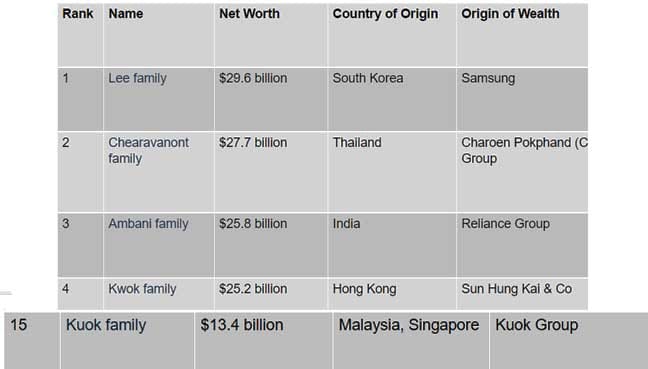
India’s Ambani family is placed third, its wealth rising from USD21.5 billion last year to USD25.8 billion this year.
Meanwhile, theedgemarkets reports that the Kwek/Quek family has more than 15 family members controlling the Hong Leong Group, a conglomerate with interests ranging from finance to property.
The family traces its fortune back to 1941 when Kwek Hong Png founded the company with three brothers.
Hong Png’s eldest son, Kwek Leng Beng, runs operations in Singapore. His grandson Sherman Kwek Eik Tse was appointed deputy CEO of the group’s property unit in April.
Leng Beng’s cousin Quek Leng Chan is a banking and real estate magnate, who was also ranked third in Forbes’ list of Malaysia’s 50 richest people in 2016, with a net worth of USD5.3 billion (RM22.2 billion). The billionaire inherited part of his fortune from his father, who is one of the co-founders of Hong Leong Group.
According to theedgemarkets, Quek owns substantial stakes in conglomerate Hong Leong Financial Group Bhd; diversified group Hong Leong Industries Bhd; Hong Leong Capital Bhd with interests in investment banking, securities and asset management; banking group Hong Leong Bank Bhd; cement manufacturer Hume Industries Bhd, and property developer Guocoland (M) Bhd.
In May last year, the report said, Quek’s youngest son Kon Sean led the family into e-commerce with the launch of GEMFive, an online shopping portal that sells electronics, fashion and health products.
The minimum net wealth to qualify for the Forbes list was USD3.4 billion, up from USD2.9 billion a year ago.
Forbes Asia editor Tim Ferguson said: “You can see that among the rich families here, and even within many of the families – no particular sectors of the economy dominates. For those aiming to be among Asia’s richest, it’s a very wide world.”
Business interests of the top families on the list span technology, livestock producers, real estate and oil and gas.
Asia’s Richest Families list is a snapshot of wealth using stock prices and currency exchange rates from the close of business on October 28, 2016. Private companies were valued based on similar companies that are publicly traded. To qualify, a family’s wealth must be rooted in Asia and participation in building that fortune has to extend at least three generations.