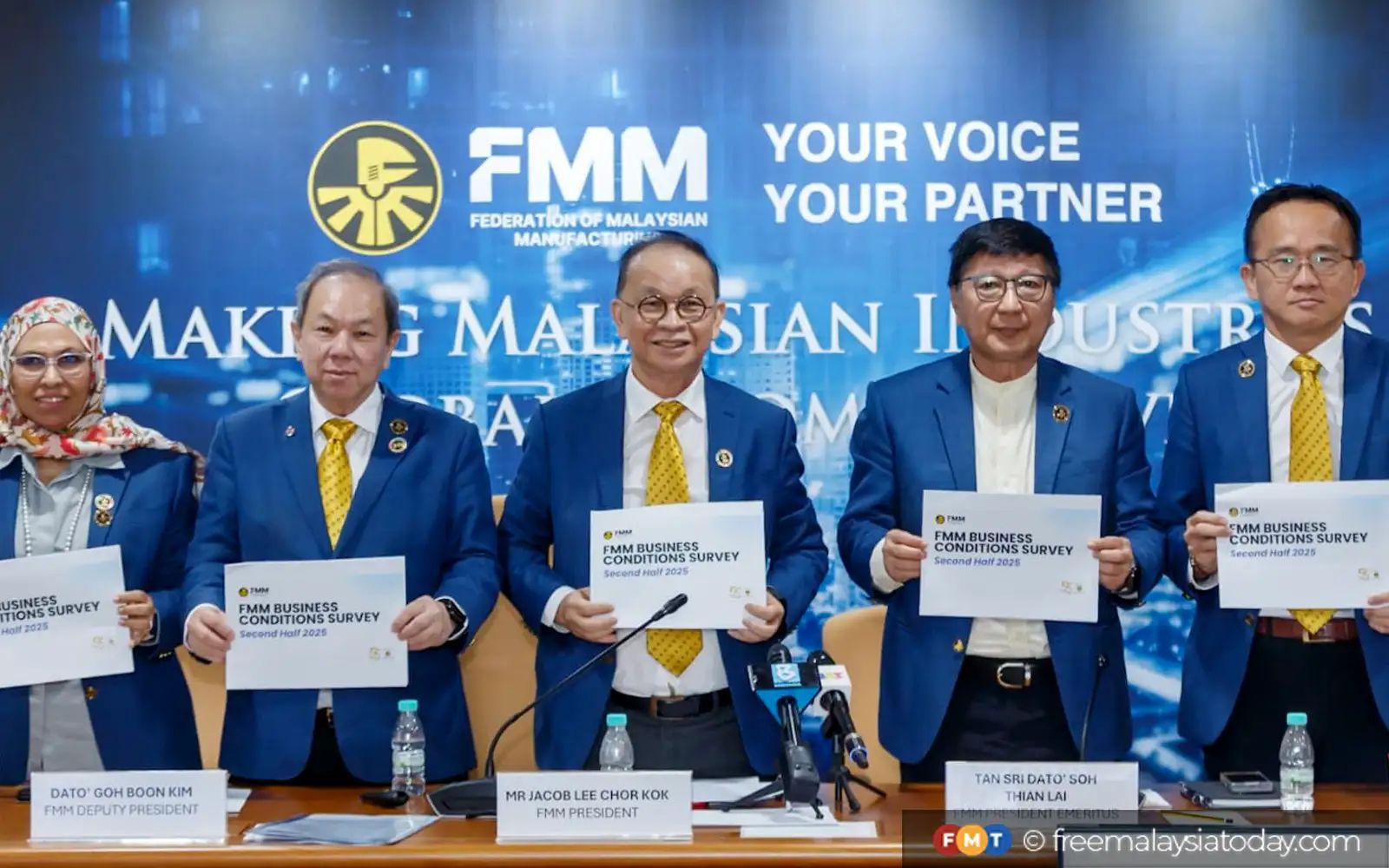
FMM president emeritus Soh Thian Lai said a moratorium would give them breathing space to manage tight finances and prepare for operational challenges in the months ahead.
“At the same time, SMEs involved in exports will gain the financial strength needed to strengthen their operations.
“I believe the banks are in a strong enough position to support this measure,” he told a press conference on the release of FMM’s latest business conditions survey.
On the other hand, FMM president Jacob Lee said there was a need for a data-driven approach and careful monitoring of economic indicators before any intervention.
“Is it the right time to start a moratorium now? Probably when a depression hits or, worse, a recession. That’s my personal view, but probably not immediately,” he said.
Both leaders were responding to questions on whether a moratorium could help SMEs deal with rising costs and financial pressures amid the ongoing Middle East conflict.
In the survey released by FMM today, business activity stabilised in late 2025, although demand remained weak.
“Only 30% of manufacturers reported higher business activity, while nearly half reported that conditions remained stable, indicating that expansion remained moderate,” said Lee.
“For the first half of 2026, manufacturers’ expectations for revenue are cautiously positive, with 48% of firms anticipating higher sales.”
Looking ahead, manufacturers remain cautiously optimistic: 48% expect higher revenue in the first half of 2026, but profit expectations are more restrained, with only 41% forecasting higher profits and 33% expecting further declines.
Rising production costs continue to pressure the sector, with 55% of firms reporting higher costs in late 2025 and 58% projecting further increases in early 2026.