As global tensions reshape supply chains, Malaysia’s agriculture sector also faces a growing threat: fertiliser shortages.
From the ongoing Middle East conflict to export curbs from China, the cost and availability of fertiliser have become increasingly volatile. For Malaysian farmers, especially smallholders, the impact is immediate.
During the launch of the National Food Security Policy 2030 (DKMN 2030) in January 2026, deputy prime minister and energy transition and water transformation (Petra) minister Fadillah Yusof emphasised the urgency of addressing these challenges.
He noted that “when input costs rise, it triggers a domino effect, leading to global food price inflation”.
“This is the burden ultimately borne by the people. Our dependence on external supply chains makes us vulnerable to global economic shocks,” he said.
These vulnerabilities are now becoming increasingly evident within Malaysia’s fertiliser supply landscape.
A growing crisis
Malaysia produces only about 39% of its fertiliser needs domestically, leaving the country heavily reliant on imports. At the same time, China, which supplies a third of Malaysia’s imported fertilisers has tightened exports to protect its own food security.
Adding further pressure, disruptions in key shipping routes such as the Strait of Hormuz, which is a passage that carries one-third of global fertiliser trade, have driven up costs and lengthened delivery times.
In Malaysia, the impact is already being felt. Local fertiliser producers have reportedly halted new orders for raw materials as prices have surged by 100% to 150% within a matter of weeks.
For large-scale vegetable farmers, the risks are equally significant. Heavy reliance on imported fertilisers, particularly for fertigation systems, leaves them exposed to global supply disruptions. Ongoing tensions affecting key routes such as the Strait of Hormuz, along with China’s export curbs on inputs like urea, nitrogen and phosphates, are placing immediate pressure on both supply and production costs.
For smallholders however, the stakes are even higher. Operating on tighter margins, smaller land areas and lower output, they are far less able to absorb price shocks or supply disruptions. Consistent access to fertiliser is not just important, but critical for their survival.
Smallholders need a different solution
While larger players may have the scale and capital to absorb price fluctuations or secure bulk imports, smallholders often do not. This makes it critical to explore alternative, more efficient approaches to support them.
A pre-commercialisation study conducted by the national sewerage company, Indah Water Konsortium (IWK) Sdn Bhd, a company owned by Minister of Finance Incorporated (MoF Inc) under Petra’s purview through its research arm, the Indah Water Research Centre (IWRC), offers a promising solution for agricultural applications.
The study evaluated the bio effectiveness of IWK’s organic fertiliser, produced from biosolids derived from sewage treatment plants, on four landscape plants — Vinca, Marigold, Japanese Rose and Petunia — and four food crops — okra, mustard green, brinjal and sweet potato — under greenhouse conditions.
The trials demonstrated notable improvements in plant growth and soil quality, with the biosolids-based fertiliser supplying essential nutrients such as nitrogen, phosphorus, and potassium required for healthy crop development. Importantly, no heavy metals were detected in the plant tissues of the food crops, indicating that the fertiliser is safe for agricultural use.
In a separate field trial conducted at a coconut farm, trees affected by extreme heat had experienced severe stress, leaving them scorched and significantly impacted. However, following the combined application of IWK’s organic fertiliser and IWK’s plant booster over a five-month period, the results were notable. The coconut trees gradually recovered, emerging with new leaves and resuming fruit production.
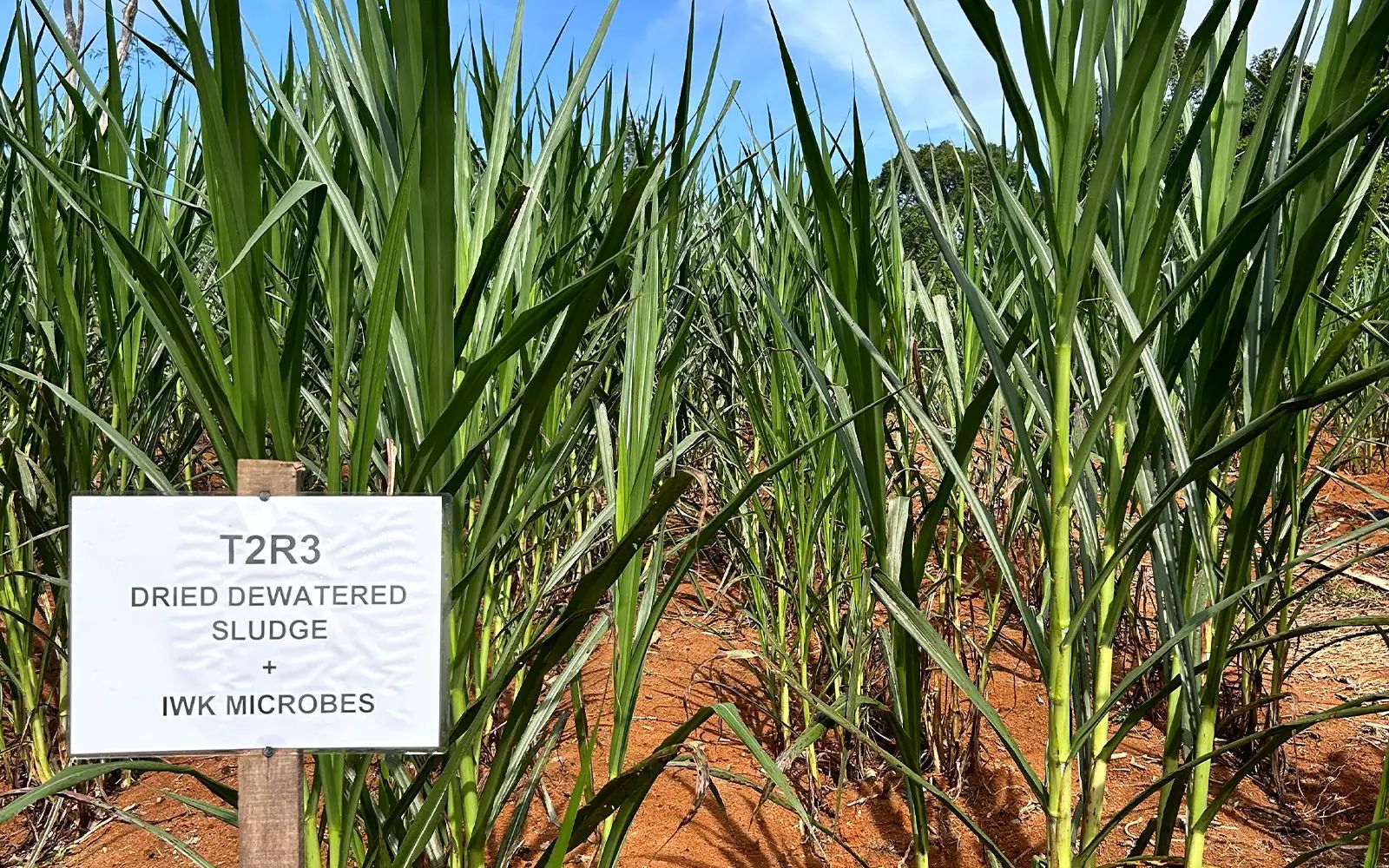
Another field trial involving Napier grass used a combination of dried biosolids as fertiliser and IWK’s plant booster over a 15-month period. The results demonstrated good vegetative growth and a notable enhancement in biomass production, attributed to the essential nutrients supplied by the dried biosolids.
According to IWK CEO Narendran Maniam, these solutions demonstrate how rich IWK’s organic fertilisers are, capable of supporting smallholder recovery and improving crop resilience.
“In fact, in the coconut farm trial, IWK’s fertiliser was applied once every two weeks, resulting in an estimated 68% reduction in fertiliser costs purchased from other vendors. This is a significant advantage for farmers operating under tight margins.
“Rather than rely on higher volumes of conventional inputs, IWK’s organic fertiliser formulation focuses on delivering nutrient-rich applications that maximise the effectiveness of each use.”
For crops like coconut and napier grass, where soil health and long-term productivity are essential, these strategies can help reduce dependence on large quantities of imported fertiliser while sustaining yields.
“IWK’s organic fertiliser is designed to improve nutrient absorption and soil condition, enabling farmers to achieve comparable results with lower application volumes. In a market where availability is uncertain, this efficiency becomes critical.”
IWK’s organic fertiliser: a solution to the growing crisis
Derived from treated sewage sludge from domestic sewage treatment plants (STPs), IWK’s organic fertiliser contains about 7% of NPK (Nitrogen, Phosphorus and Potassium) elements, making them an effective solution for restoring degraded soil and supplied essential nutrient required for plant growth.
Beyond nutrient supply, its organic composition helps rebalance soil acidity often caused by prolonged use of chemical fertilisers, supporting healthier soil ecosystems and more sustainable crop production over time.
IWK’s organic fertiliser has undergone extensive analysis to ensure it contains no harmful heavy metals or pathogenic bacteria, ensuring it is safe for use. A toxicology study for Acute Oral Toxicity Up and Down Procedure (UDP) on rats by Sirim also showed no negative effects, confirming its safety for crop use without contamination risk. Additionally, a Material Safety Data Sheet (MSDS) was developed to document its chemical composition, handling precautions and safety measures, ensuring compliance with environmental and health regulations.
Importantly, the product has also received national-level religious recognition. At the 126th meeting held from Feb 25 to Feb 27, 2025, the Muzakarah Committee of the National Council for Islamic religious affairs (MKI) reviewed the use of biosolids from sewage treatment plants as a source for organic fertiliser.
Following a thorough evaluation of research findings and technical evidence, the committee concluded that the use of biosolids-based organic fertilisers derived from sewage treatment plant is permissible (harus), provided they are proven to be safe and beneficial.
This position is further reinforced by the Pahang Islamic religious council, which issued a fatwa in 2025 permitting the use of biosolids produced through sewage treatment processes as materials for organic fertiliser production. This builds on earlier approvals from Negeri Sembilan, Kedah and Selangor in 2006, 2016 and 2024 respectively, reflecting growing recognition and acceptance.
An important conversation about the future
As global uncertainties continue, the conversation around food resilience is becoming increasingly urgent. Beyond supply concerns, there is a growing need to focus on long-term sustainability, particularly in strengthening local solutions that can better support Malaysia’s smallholders.
Plantation and commodities minister Noraini Ahmad recently stated that the government is looking to expand fertiliser imports through negotiations with existing and new supplier countries. They will also work on activating alternative supply channels within the next three to six months, while ensuring prices remain competitive to minimise pressure.
“Local solutions can play an important role to support this growing challenge. IWK currently produces four to five tons of organic fertiliser daily, with the potential to scale further. IWK is also flexible in implementing fertiliser production facilities across four regions — northern, central, eastern and southern Peninsular Malaysia, to reduce logistic costs and make it even cheaper for interested parties,” said Narendran.
While IWK’s organic fertiliser is not yet positioned to meet the large-scale demands of major plantation players, the company offers a timely alternative for smallholders. This complements national efforts to diversify supply and build greater resilience within the agriculture sector.
Narendran added that the initiative for IWK’s organic fertilisers is clear — it supports soil conservation by reducing reliance on chemical fertilisers and lowering long-term soil treatment costs.
“It also promotes environmental sustainability through the recycling of biosolids and reduced landfill disposal, while advancing a circular economy by creating value from sewage waste. One area that requires further attention is public acceptance of these recycled products.”
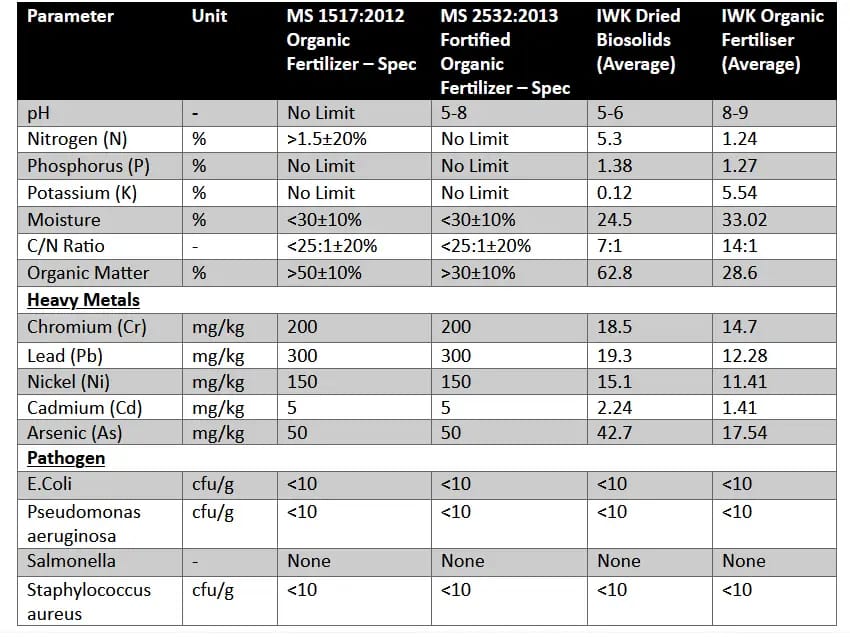
The table below shows the comparison between permissible limits of parameters allowed under the Malaysian Standards versus perimeters of IWK’s Dried Biodolids and IWK’s organic fertiliser