When fireman Muhammad Adib Mohd Kassim died last Monday, it shook a good many of us who had learned that he was showing signs of recovery after being in hospital for close to a month.
We were looking forward to seeing him well again so he could recount the events that ended with his assault by rioters at the Sri Maha Mariammam Seafield Temple in Subang Jaya on Nov 27.
His death cast a shroud of gloom across the nation, and it was in that sombre mood that I travelled to his hometown of Tebengau on Tuesday to witness his burial.
The melancholy was mixed with some trepidation because I am Indian and some quarters have been making all sorts of threats to avenge Adib’s death.
However, the fear left me seconds after I stepped out of my transport into the mosque compound. It was as if it was swallowed up by the smiles that greeted me. The smiles came from sad faces, adding to their sincerity in some poignant and inexplicable way.
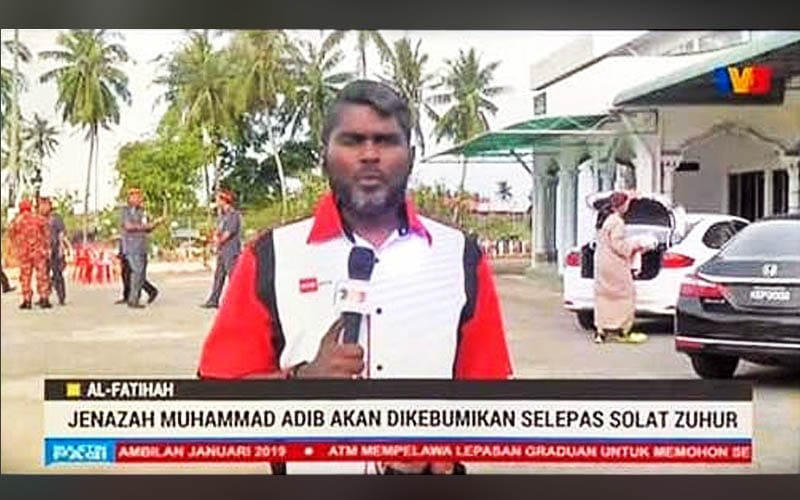
I was one of only two Indians in a crowd of close to 1,000 Malays. The other was TV3’s northern correspondent Kumaran Rajamoney. He was with a lone cameraman broadcasting on Facebook Live and on TV, giving updates from time to time.
Kumaran kept his calm throughout as hundreds watched him describing the scene in perfect Bahasa Malaysia.
An old man in a sarong stopped briefly to tell us he had never seen a TV journalist in person, let alone an assembly of satellite dishes, cameras and other pieces of electronics at one place. He also said Kumaran’s Malay was “quite good” and walked off to perform his ablutions.
Much later, a cameraman sneaked up and told a group of us that Kumaran had been berated on TV3’s Facebook Live stream because, being an Indian, he was “not the right guy” to cover Adib’s funeral.
We shrugged it off, telling ourselves that it must have been the work of some cybertroopers because the situation on the ground was an oasis of calm.
Two days later, a group called Gerakan Pengundi Sedar (GPS) posted a message on Facebook saying it was insensitive of TV3 to send an Indian to cover Adib’s funeral. It hinted that this was a manifestation of Minister of Communications and Multimedia Gobind Singh Deo’s “so-called reforms”.
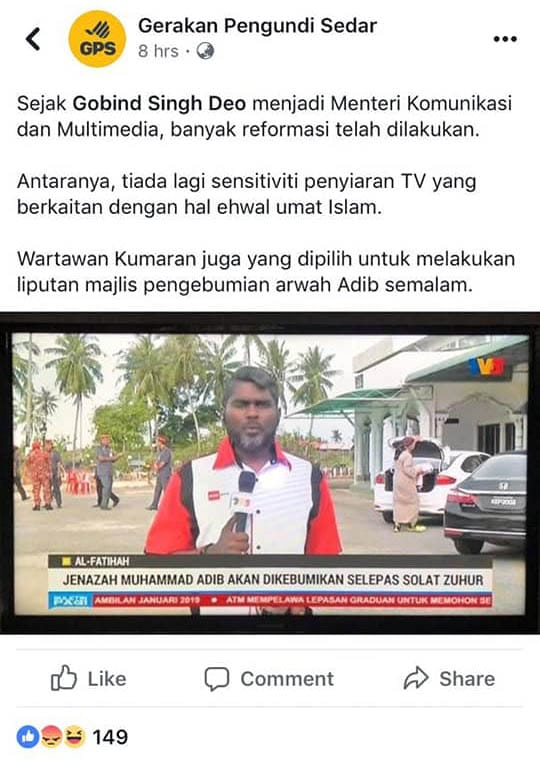
This put the Kedah press corps in a furore, but Kumaran’s friends and many Kedah Malays came out to defend him on Facebook. GPS then issued an apology and retracted the statement.
Kumaran, being the sport that he is, quickly forgave them, saying he was merely doing his job the same way Adib had done his.
To me, the episode seems to show that Malaysians, by and large, love peace and want to preserve it. Those who like to stir up hate and violence probably make up an infinitesimal number.
And I would like to think that the folk of Tebengau are typical of rural folk everywhere in Malaysia. I certainly did not sense any racist feelings in them and it didn’t take me long to feel at home among them. Such was their courtesy to strangers.
I confess that before I arrived in Tebengau, I expected some anger and fury among the conversations at the funeral, but there was calm all around.
But to be honest, there was in fact a little note of anger, and it was directed at the mob that attacked the Seafield temple. As Adib’s body was being lowered into his grave, a turbaned Malay man with a flowing beard was heard saying: “Why are there people attacking a temple? Would we like it if someone attacked our mosque?”
Predeep Nambiar is FMT’s northern region bureau chief.