From Boo Jia Cher
The Malaysian Highway Authority (LLM) argues that highways drive economic growth: more roads support more cars, more movement, and more business.
However, this logic is both mathematically and socially flawed.
By citing the 600,000 new vehicles registered in 2025 to justify for more highways, LLM is effectively trying to solve obesity by loosening a belt. Rising car ownership is treated as something to accommodate rather than manage.
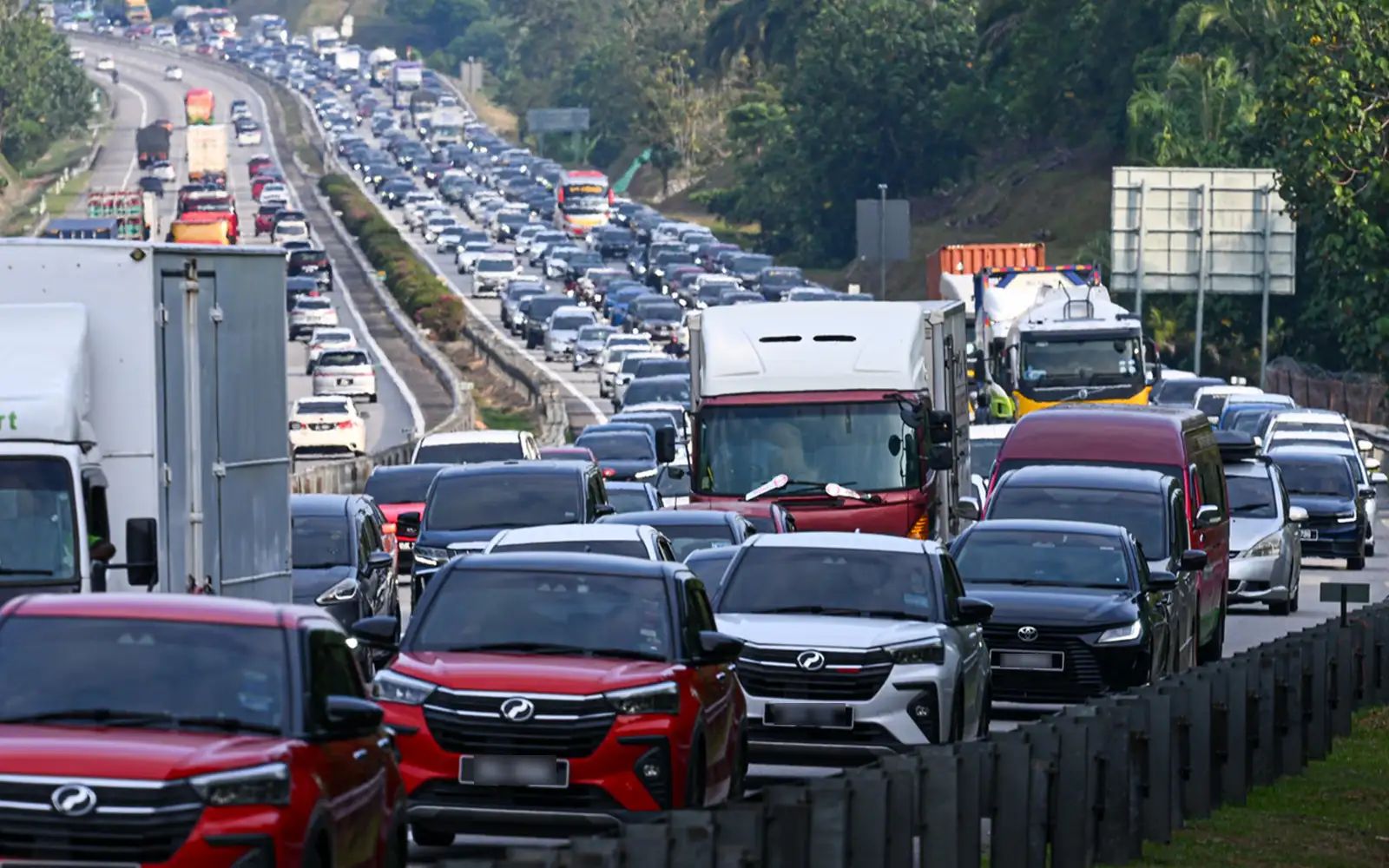
LLM highlights how highways improve supply chains, but ignores the economic cost of congestion. Traffic jams already cost Malaysia an estimated RM20 billion annually, roughly 1.1%-2.2% of gross domestic product (GDP). These are lost hours that could have gone to work, rest, family or productivity.
Each new highway that fills up merely shifts congestion elsewhere. If even part of that RM20 billion were invested in rail and buses, the long-term returns would likely exceed the short-term gains of pouring more asphalt.
Rail creates more and better jobs than highways
Highway expansion is also often defended as a source of jobs. And yes, highways create employment, but rail projects often create more and higher-skilled jobs.
Projects like the East Coast Rail Link require stations, depots, signalling systems and engineering hubs. They employ workers across engineering, electrical systems, construction, design and operations.
Rail also generates deeper supply chains and longer-term employment because maintenance and operations require skilled workers over decades.
In contrast, highways rely more heavily on basic materials and shorter construction cycles. They may deliver faster short-term GDP gains because they are immediately usable, but that is precisely the problem: they optimise for speed, not quality of growth.
The claim that highways naturally strengthen local economies is also misleading. Malaysia’s experience with the North-South Expressway (PLUS) shows this clearly.
While PLUS improved long-distance travel, it also bypassed many small towns that once depended on passing traffic. As movement shifted onto the expressway, these towns lost footfall, businesses declined, and many became economically sidelined.
LLM also points to highway rest stops (R&Rs) as opportunities for small businesses, but these operate on low capture rates. Only a fraction of drivers stop at R&Rs, even on busy highways.
A functioning rail system creates a very different economic environment. A single station, with trains arriving every 15 minutes, can move thousands of people past shopfronts each hour, on foot and with time to engage. Rail stations create concentrated, walkable economic activity. Highways disperse it.
We can’t outbuild induced demand
The deeper problem, however, is induced demand. Highway expansion cannot be outrun.
Every new highway or widened road temporarily reduces congestion, which encourages more people to drive, live farther away and depend more heavily on cars. Over time, the roads fill up again, congestion returns, and LLM concludes that even more highways are needed.
The cycle repeats endlessly. More highways encourage more driving, which creates more traffic, which is then used to justify even more highways.
It is a nonsensical feedback loop producing an increasingly fragmented, polluted, heat-trapping and unliveable Klang Valley dominated by highways, traffic jams and low-density sprawl.
This also exposes a deeper failure in governance. One agency promotes car ownership to support industry. Another builds highways to accommodate those cars. A third attempts to expand public transport while being undermined by the first two.
The result is a fragmented system that creates its own demand, then struggles to cope with it.
Hidden tax of car dependency
For most Malaysians, car dependence also acts as a hidden tax. After housing, a car is often the largest lifetime expense. Loan repayments, fuel, tolls, maintenance and insurance heavily burden lower- and middle-income households.
There are health costs, too. Long hours in traffic contribute to obesity, stress, heart disease and mental fatigue, which in turn translates to rising healthcare costs in an already overstrained healthcare system.
A misplaced solution
Highways do have a role. They support freight, connect rural areas and provide flexibility that rail alone cannot replace. However, the issue is not whether Malaysia needs highways. It is why highways have become the default answer to nearly every mobility problem.
LLM’s argument reflects a problematic system of governance in which agencies only solve the problems they are designed around, without considering the bigger picture.
This is precisely why LLM should no longer function as a siloed highway-building authority. It should instead be integrated into a broader national mobility commission that coordinates public transport, walking, cycling, rail and private vehicles together, rather than viewing mobility solely through the narrow lens of more roads.
Until Malaysia shifts from endlessly accommodating car growth to actively managing it, the country will continue wasting both wealth – our fuel subsidies now cost the government RM7 billion monthly – and human time sitting in traffic of its own making.
Boo Jia Cher is an FMT reader.
The views expressed are those of the writer and do not necessarily reflect those of FMT.