
Malaysia’s constitution awards fathers the automatic right to confer citizenship on their children born abroad but the same does not apply for mothers.
Last September, the Kuala Lumpur High Court ruled that citizenship by operation of law must be granted to children born abroad to Malaysian women as well. However, the government filed an appeal against the ruling and the appellate court will hear the case on March 23.
With tears streaming down her face, Teo, 35, shared her ongoing ordeal of securing Malaysian citizenship for her first daughter who was born abroad. As she did not want her second daughter to suffer the same fate, she made the risky decision to fly back to Malaysia in 2019 at the peak of her pregnancy, just so her baby could be born here.
“I had to wear baggy clothes to hide my pregnancy just to get on the plane. It was extremely distressing and uncomfortable, but I had to do it. I also had my toddler with me,” she said, her voice breaking as she recounted the events.
“After the flight, I was not feeling well and went to the clinic. I found out the baby’s heartbeat was irregular and had to be admitted into the emergency room at the hospital to be monitored.”

Teo also said that the hassle of obtaining Malaysian citizenship for her first daughter meant she had to leave her entire life in Germany behind.
“I had to quit my job and leave my husband for a bit. He too eventually uprooted his life because he knew it was important for me to raise my children as Malaysians,” she said.
The obstacle Teo now faces is enrolling her first daughter in a Malaysian public school. “I have been informed that my daughter can only gain admission if there is a place and until then she would have to miss two weeks of Standard One,” she said.
Rachel Ng’s situation is no bed of roses either. The 42-year-old is a single, working mother with two children, one of whom was born in the UK in 2014.
While Ng was aware of Malaysia’s unequal citizenship law, she chose not to fly back. “I had two miscarriages prior to my son, so I was not willing to take that risk,” she said.
In 2016 Ng moved back to Malaysia and had her second child four years later with her then-husband.
“After gaining full custody, I began to think about what would happen to my kids if something unfortunate were to happen to me unexpectedly,” she said despondently.
“My priority is for both my children to stay together…I don’t ever want them separated just because one of them doesn’t have Malaysian citizenship.”
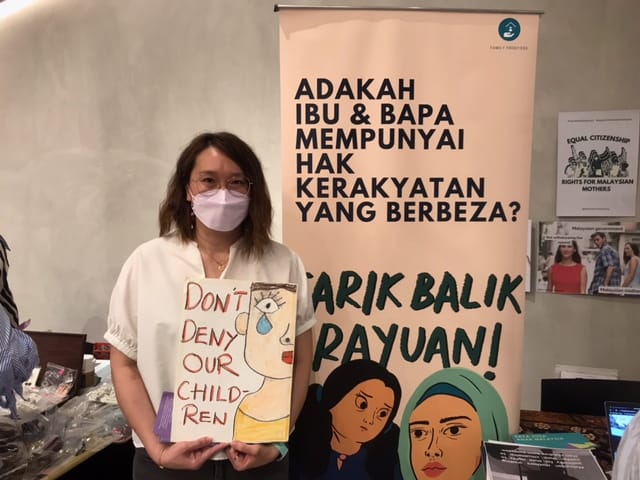
Ng said she has been fighting for her son’s Malaysian citizenship for eight years now, admitting that the pressure of juggling all her commitments has been overwhelming at times.
“I have every intention to raise both my children in Malaysia, but I have had to deal with outrageous comments suggesting I return to the UK and raise my children there.
“If it’s my choice to live and raise my children here, I don’t think it is anyone else’s business to question my decision,” she said.
Ng and Teo have been advocating for equal citizenship rights with an NGO called Family Frontiers and hope the government will stop fighting the KL High Court ruling.
“The ruling for equal citizenship means the world to us. Don’t take it away,” they said.
According to lawyer Abraham Au, who has been assisting several mothers obtain Malaysian citizenship for their children, a further delay in processing their citizenship could have serious repercussions.
“These children would not be able to enjoy the rights of a citizen, such as access to education, healthcare, and they would need to be on a social visa as opposed to free entry with their mothers,” he told FMT.