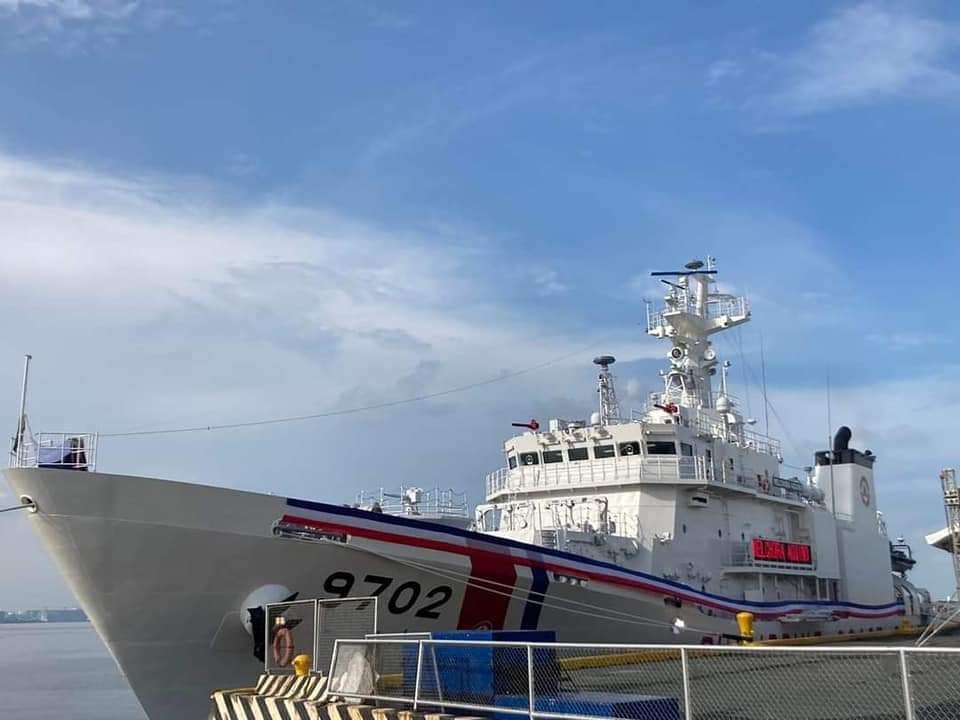
Washington and Tokyo started providing capacity-building support to the Philippine coast guard today as part of the Sapphire framework established by the US and Japanese coast guards. The latest exercises, the second since June, continue through Nov 5.
Philippine president Ferdinand “Bongbong” Marcos Jr, who took office in June, has vowed to protect his country’s territorial waters against claims by China and modernise the coast guard.
The training was opened to the media for the first time on Friday. Coast guard personnel practiced towing a disabled ship in Manila Bay using the recently acquired Melchora Aquino, a 97-metre, Japanese-made patrol ship.
Friday’s training lasted more than five hours and involved about 100 Philippine personnel and roughly a dozen Japanese and American personnel. Seaman first class Aldrin Pontillas of the Philippine coast guard said the training helps ensure “we are ready to rescue.”
The two weeks of training will include loading and offloading smaller ships, extinguishing onboard fires and boarding ships to conduct inspections. Japan and the US are expected to take part in drills with the Philippine coast guard three to four times a year.
The Philippines, Vietnam and other nations in the South China Sea region have territorial disputes with China. On Oct 6, the Philippine coast guard said it spotted four Chinese coast guard vessels around Scarborough Shoal. The Philippines claims the shoal, but China exercises effective control over the rocky outcroppings, called Huangyan Island by Beijing.
Last year, China stationed many vessels around the Spratly, or Nansha, islands in the sea. The area is where Chinese coast guard vessels fired a water cannon against Philippine boats that same year.
China lays claim to nearly all of the South China Sea through its self-declared “nine-dash line.” In 2016, an arbitration tribunal in The Hague rejected China’s territorial claims, but Beijing did not accept the ruling.
Marcos’ predecessor, Rodrigo Duterte, tried to put the simmering territorial row on the back burner in order to prioritise trade relations with Asia’s biggest economy. Marcos is taking a tougher line.
“I will not preside over any process that will abandon even a square inch of territory of the Republic of the Philippines to any foreign power,” Marcos said during a national address in July.
The Philippine coast guard stands “in the frontline in the defence of our maritime territory, in defence of our economic zones,” Marcos said in an Oct 19 speech.
“As your leader, I assure you that this administration will always be behind you, supportive of your efforts and initiatives to modernise the Philippine coast guard,” he also said.
Besides its treaty ally the US, Manila is receiving support from Tokyo in this effort. The Philippines and Japan held their first “two-plus-two” meeting of foreign affairs and defence chiefs in April.
Marcos said on Oct 20 his government will procure military heavy-lift helicopters from the US after scrapping a deal with Russia. The president did not elaborate on the decision.
The American side sees the coast guard programme as contributing to stronger three-way ties. Lieutenant Bryce Matakas of the US coast guard said the cooperation ensures that “we can all achieve our maritime law enforcement and objectives and … we are all able to operate together and build the relationship between the three countries and the three coast guards.”