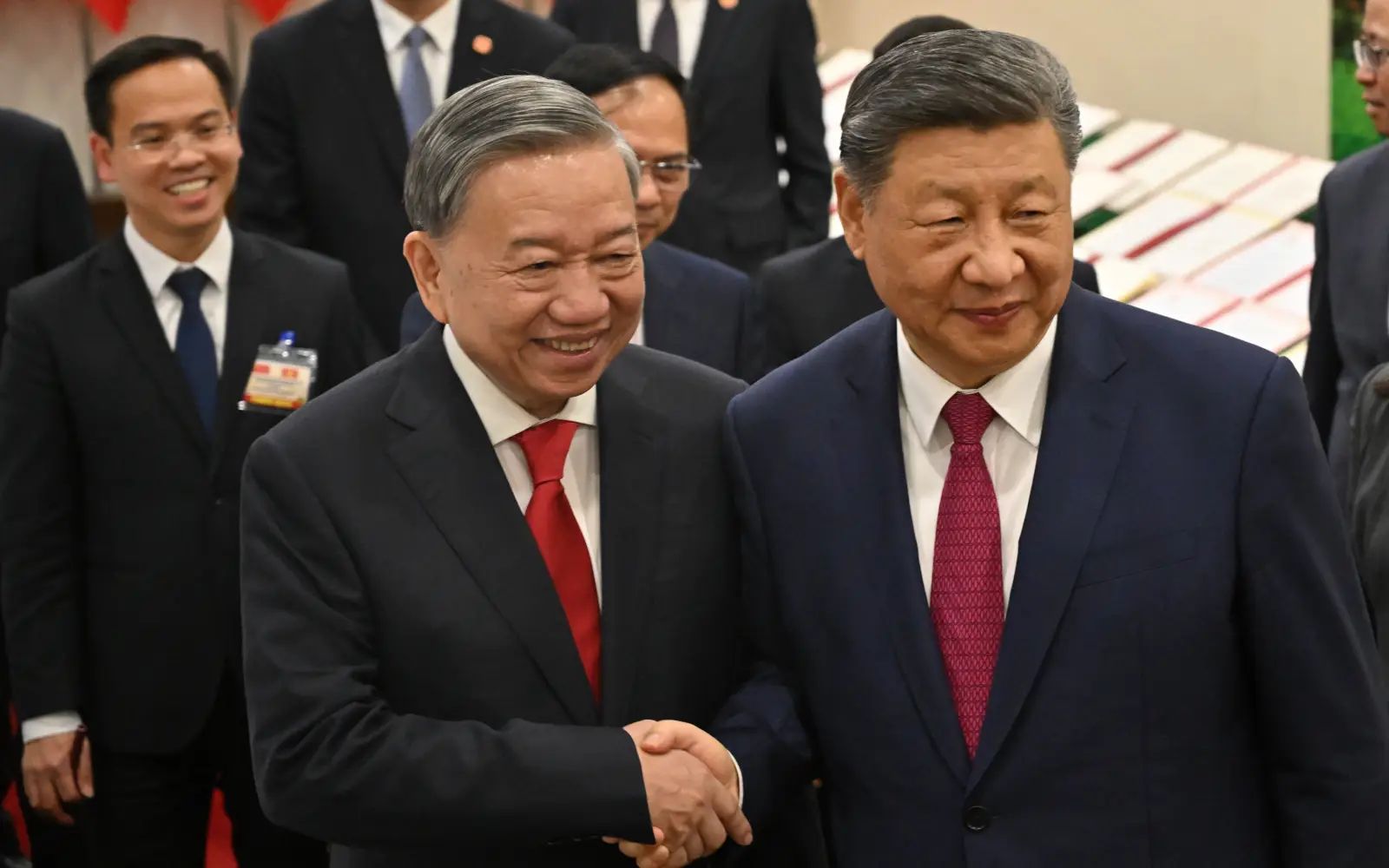
The visit is Lam’s first trip abroad since the Communist Party leader was elected last week as president – the number two position in Vietnamese politics.
He has called ties with Beijing a “top priority” but faces a precarious balancing act between the US – Vietnam’s main export market – and the country’s largest supplier, China.
Xi and Lam met on Wednesday morning in Beijing’s opulent Great Hall of the People and signed several cooperation agreements, state broadcaster CCTV said, without providing immediate details.
Lam wrote in an article published in China’s state-run People’s Daily on Tuesday that ties with China were a “strategic priority” for Vietnam.
“Cooperation between the two countries needs to move strongly from ‘increasing scale’ to ‘improving quality’; from expanding trade to deeper connections between development strategies, economic corridors, production chains, supply chains, and strategic infrastructure,” he wrote.
He reiterated that China was a “strategic choice and top priority” during a speech at Beijing’s Tsinghua University on Tuesday, Vietnamese state media reported.
Despite rival territorial claims in the South China Sea, the two countries have sought to deepen already close economic ties to guard against global trade upheaval caused by US President Donald Trump’s tariffs.
Chinese exports to Vietnam surged 22.4% last year, with Vietnam spending US$198 billion on Chinese goods – more than any other country in Southeast Asia.
But Chinese imports from Vietnam fell 0.7%, leaving Hanoi with a huge deficit close to US$100 billion with Beijing.
Lam is one of a string of leaders to visit this week from countries impacted by the Middle East war and its economic fallout, including Russia’s top diplomat Sergei Lavrov, Spanish Prime Minister Pedro Sanchez and Abu Dhabi’s Crown Prince Mohamed bin Zayed Al Nahyan.
Both Vietnam and China get much of their oil imports via the Strait of Hormuz, where shipping has largely been halted due to the US-Israeli war with Iran.
However, Hanoi sees rivalry between top trading partners the US and China as a major impediment to its ambitious goal of achieving double-digit growth over the next five years.
Last week, Xi expressed his willingness “to work with To Lam… to continuously strengthen our respective socialist causes”, as he congratulated the Vietnamese leader on his election, Chinese state media reported at the time.