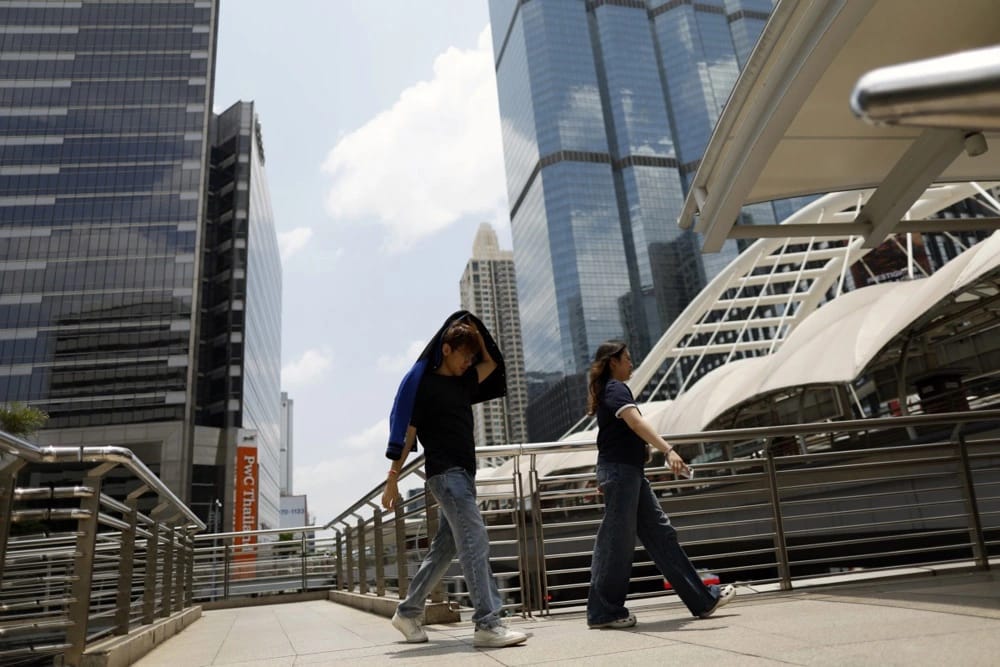
Many countries have imposed temperature controls at government workplaces since the war began, among other measures to conserve energy.
As the prolonged shutdown of the Strait of Hormuz drains energy reserves, relief does not look to be coming anytime soon with parts of the region set to bake in abnormally hot conditions in the months ahead.
Among the hardest-hit countries is Thailand, where temperatures soared to above 40℃ in recent weeks and the Bangkok government has issued multiple “dangerous” heat warnings.
In March, the Thai government ordered public sector offices to set air conditioner temperatures at 26℃-27℃.
“Sometimes it even feels hard to breathe,” said Pornpimol Sirimai, who works at the health ministry and has bought electric fans to cool down.
“The canteen and even the 7-Eleven downstairs are cooler than our office, which is why people end up gathering there,” Sirimai said.
The onset of the El Niño weather system in the summer could make it even worse.
Southeast Asia faces a “double whammy,” said Emi Gui, adjunct associate professor at Monash University in Malaysia.
“El Niño is likely to recreate extreme heat conditions, increasing the likelihood for both droughts and floods, threatening lives and agricultural activities,” it said.
El Niño will likely also unleash drought conditions that can wither crops like rice, palm oil, rubber and sugar, and deplete water levels in dams used to generate electricity just as demand rises.
Clothing is one way that governments are trying to ameliorate uncomfortable conditions in offices.
“At one branch of the Philippine Land Transportation Office, employees have been allowed to wear light, collared shirts instead of traditional attire,” said Zeus Marcelino, officer in charge at an LTO office in Manila – in 2024 the government mandated that civil servants wear “Asean-inspired” or traditional Filipino clothing on Mondays.
The Philippines is this year’s chair of the Association of Southeast Asian Nations summit and meetings.
The Philippines in early March directed government offices to set their ACs to no lower than 24℃, and the country’s weather agency issued an El Niño alert on April 22. At the central bank, the AC is maintained at 25℃.
“It’s not that cold. But it’s not hot, meaning just enough,” said Elmore Capule, a deputy governor at the central bank.
“They are coping well, I think our employees understand that we are in a crisis situation,” he said.
Malaysia meanwhile is promoting wearing traditional cotton batik shirts, and has also mandated offices set ACs to 24℃.
Norhisham Khalid, who works at the domestic trade and consumer affairs ministry, said that the temperature adjustment is a good thing as the office was so cold before “that some people had to wear sweaters”.
In the meantime, Southeast Asian governments are scrambling to find alternative supplies, even at elevated prices.
If the conflict drags on and the weather turns even hotter, the economies may go from facing an oil shock to a food shock, according to HSBC Holdings PLC.
The economic fallout may last even longer – countries reliant on energy imports are bracing for weaker growth, faster inflation and higher fiscal deficits.
While measures like temperature controls are inconvenient, they can be a part of longer-term strategies to improve energy efficiency and conservation, said Gui, who researches energy transition.
Thailand is planning to increase the use of biofuel blends to reduce crude oil demand, while Indonesia is speeding up the rollout of a higher biodiesel blend to July instead of 2027.
The country hasn’t mandated ACs to be set to a particular level, but employees at government offices and state-owned companies said internal notices have asked for electricity use to be reduced.
In some cases, including at the parliamentary complex in Jakarta, ACs, lights and escalators are turned off earlier than usual.
In Singapore, government agencies have been directed to manage the operating times of ACs, lighting and elevators.
The island’s residents were also reminded to use vouchers handed out by the government to buy energy-efficient appliances.
Some countries, including Malaysia, Thailand, Vietnam and the Philippines, have sharply raised retail prices of diesel and gasoline as the cost of subsidising them has become unsustainable.
Costly energy may prompt more prudent use even as it leads to some demand destruction, as evident in falling fuel sales in Thailand.
Some of that reduction in demand is coming from mandates by governments for employees to work from home.
That’s helping people like Norhisham, who only goes to his office in Putrajaya, Malaysia’s administrative capital, two days a week.
“I estimate that I will be able to save on one full tank of petrol a month by not driving to office,” he said.
“But more importantly I save about two hours a day driving to Putrajaya and am able to do more with the time saved,” he added.