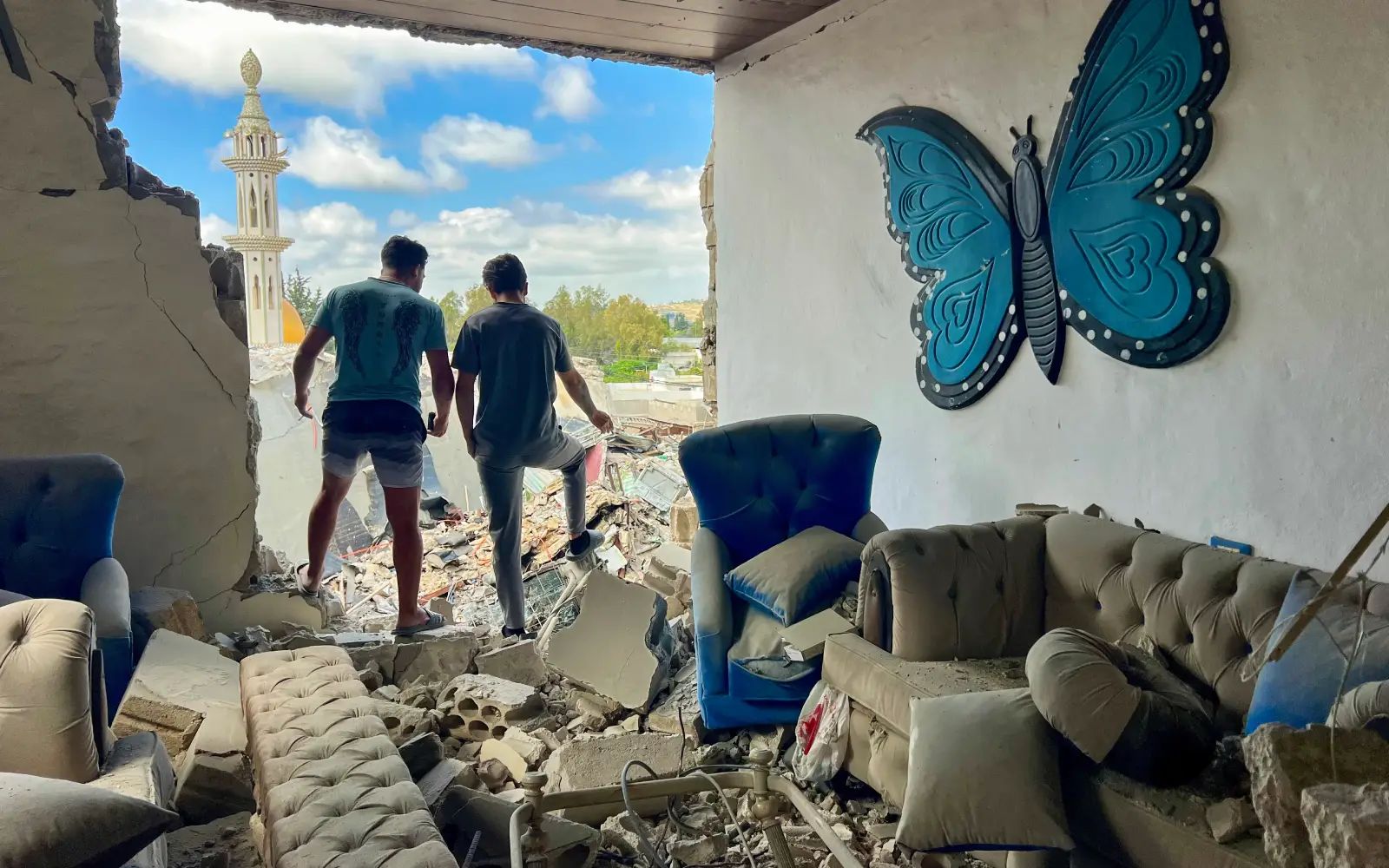
Israel the previous day had declared all areas south of Lebanon’s Zahrani River – an area roughly 40km from the border and including Tyre – as “combat zones” and told residents to evacuate ahead of attacks against Iran-backed Hezbollah.
The sweeping warning — the first of its kind since an April 17 ceasefire — came as many Lebanese tried to celebrate the Muslim holiday of Eid al-Adha.
In a fresh evacuation order to residents of parts of Tyre early on Thursday, the Israeli military said it was “compelled to take forceful action” against Hezbollah and announced in a later statement on Telegram that it had begun strikes it said targeted the group’s infrastructure.
Lebanon’s state-run National News Agency (NNA) reported two sets of Israeli strikes had taken place on the city and an area to its east on Thursday morning, hitting a building and sparking a fire in Tyre.
Israel this week vowed to ramp up operations in Lebanon and said it was expanding ground operations there, while Hezbollah said its fighters had clashed with Israel’s forces beyond an Israeli-declared “yellow line” in the south.
Israel’s army chief Lieutenant Colonel Eyal Zamir said “we are intensifying our operations in order to strike ever more severe blows to the Hezbollah organisation”.
Talks are expected on Friday between Lebanese and Israeli military delegations at the Pentagon, with a new round of direct negotiations aimed at ending the hostilities set for next week.
A delegation comprising six Lebanese officers, headed by the army’s director of operations Georges Rizkallah, will participate in the talks on Friday.
A military source told AFP the delegation will “emphasise the need for a ceasefire, and will present the army’s plan for a state weapons monopoly and the extension of state authority across the country”.
‘Yellow line’
The Israeli military had earlier issued evacuation warnings for the southern city of Nabatieh, swathes of Tyre and surrounding areas.
An AFP correspondent said that residents from threatened Tyre areas had converged on parts of the city not covered by the warning. Authorities, however, warned that shelters were full and urged people to head to Beirut instead.
The NNA also reported a series of strikes on Nabatieh city, resulting in “huge destruction” in residential areas on Wednesday.
Lebanon’s health ministry on Wednesday reported the overall death toll since the war erupted on March 2 was 3,269, an increase of 56 from a day earlier following heavy Israeli strikes.
Lebanon’s army also said Wednesday that one of its soldiers was killed in an Israeli strike in south Lebanon.
The NNA reported Israeli strikes elsewhere in the country’s south and in the eastern Bekaa valley in recent days.
Hezbollah said its fighters “clashed with the enemy forces at point-blank range” in the town of Zawtar al-Sharqiyah, just beyond the Israeli-declared “yellow line” in south Lebanon where its troops have been operating.
An Israeli military official said Tuesday that soldiers had begun operating outside the “yellow line”, which runs around 10 kilometres deep inside Lebanese territory.
Hezbollah also claimed three drone attacks on Israeli positions near the two countries’ shared border in northern Israel.
Israel’s military said several explosive drones fell in its territory but no injuries were reported.
At the site of a strike in south Lebanon’s Burj al-Shemali, an AFP correspondent saw rescuers carrying a body bag from the rubble, which was littered with household items including rugs and cushions.
West Bekaa
After Hezbollah drew Lebanon into the Middle East war with rocket fire at Israel in retaliation for US-Israeli strikes that killed Iran’s supreme leader, Israel has repeatedly struck Lebanon’s eastern Bekaa valley and warned residents to evacuate.
Strikes have intensified in recent days, particularly in the West Bekaa town of Mashghara.
The area links south Lebanon with Hezbollah strongholds in the northern Bekaa and is a key supply route for the group.
Lebanese military expert Hassan Jouni told AFP that the West Bekaa “is a necessary corridor for Hezbollah members if they want to move between the Bekaa and the south” and could become the focus of further Israeli strikes.
He said Israeli operations might soon expand to “target the north Bekaa intensively or even Beirut’s southern suburbs”, both areas that have been relatively spared since the ceasefire.