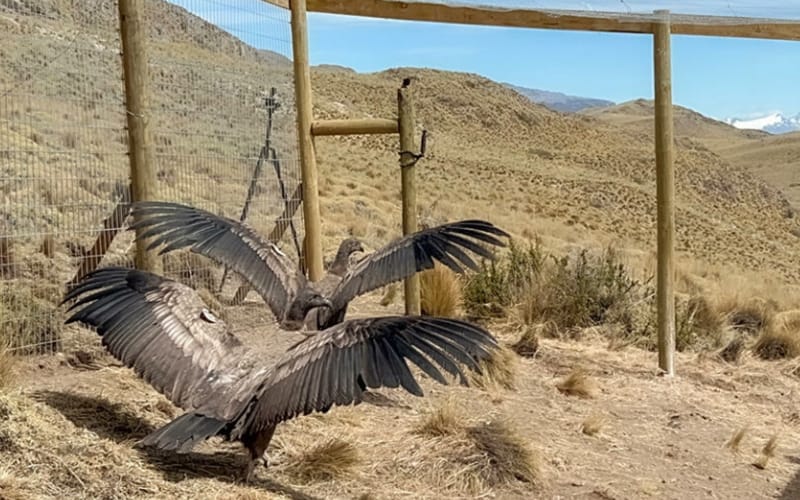
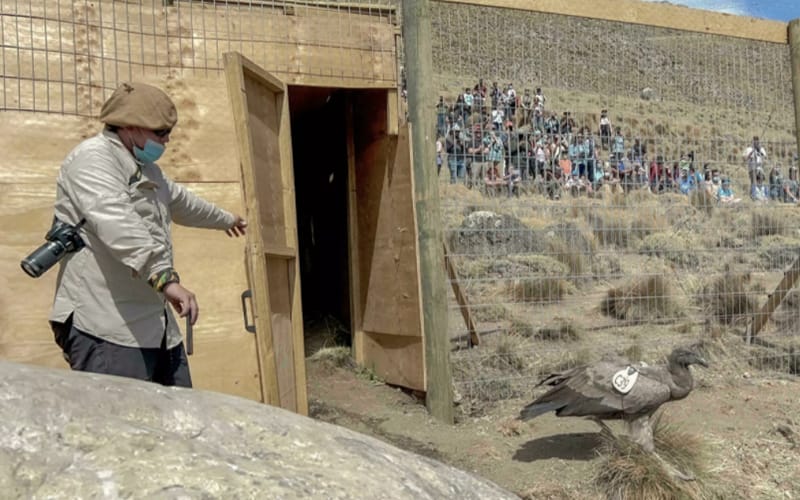
After 14 months of rehabilitation, the pair of scavengers were freed last week in the Patagonian National Park in Chile’s extreme south, where every individual counts for a species listed by the International Union for Conservation of Nature (IUCN) as “vulnerable” to extinction.
From a vast cage perched on the edge of a cliff overlooking the Patagonian valley, the pair spread their massive wings, waddled to the ledge, and took the leap of freedom, soaring away graciously.
“Today we have witnessed a milestone,” Christian Saucedo of the Rewilding Chile Foundation told AFP.
“It is a very complex process, but it means returning individuals who would otherwise be condemned to live in captivity.”
According to the IUCN, the Andean condor – a type of scavenging vulture – is a declining species, with fewer than 7,000 left in the wild.
The main threat is “direct and indirect persecution by humans”, it states.
Dominic Duran, executive director of the Manku Project for condor conservation, told AFP “the biggest threat is toxic baits set by humans to poison… pumas or wild dogs eating their livestock”.
When the condors feed on these carcasses, up to 30 at a time, they get poisoned in turn.
The first to eat, he added, are usually the breeding males and females, and “when condors are killed by toxic bait, all the reproductive individuals at the top of the chain die”.
Other threats are hunting by humans, intoxication from poorly managed landfills, and dwindling numbers of the wild animals that make up their diet.
The Patagonia National Park holds an estimated 70% of Chile’s Andean condors – the largest population in South America.
Pumalin, a male, was found over a year ago unable to fly after getting caught in a heavy storm, and Liquine, a female, was rescued struggling to make it in the wild after an earlier attempt to rehabilitate her.
They will now go back to “learning the codes of condor society”, said Saucedo.
The pair’s progress will be monitored with radio transmitters implanted in their wings.