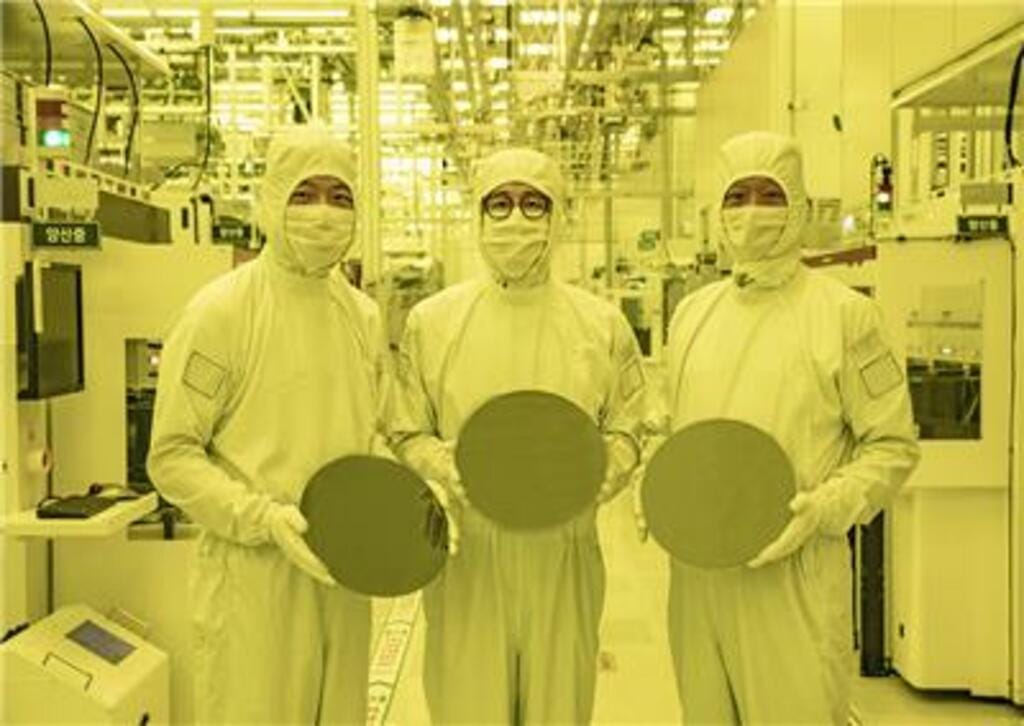
The latest milestone in a relentless race to cut the size and increase the power of semiconductors gives Samsung an edge over its arch-rival TSMC for now, though competition is only set to intensify.
The South Korean tech giant said the new advanced chip allows a 16% decrease in surface area, 23% higher performance and 45% lower power consumption compared with current 5nm chips.
Samsung has been competing with Taiwan Semiconductor Manufacturing Co to develop cutting edge chips.
Smaller, more advanced chips are harder to make because they squeeze more transistors onto the same space.
The ability to mass produce them is an indication of a manufacturer’s technological prowess.
“Samsung has grown rapidly as we continue to demonstrate leadership in applying next-generation technologies to manufacturing,” Choi Si-young, head of the company’s chip foundry business, said in a news release.
“We seek to continue this leadership with the world’s first 3nm process.”
The company also said: “Samsung is starting the first application of the nanosheet transistor with semiconductor chips for high performance, low power computing application and plans to expand to mobile processors.”
It declined to say which customers will be buying the new chips, citing confidentiality.
The announcement comes amid a global shortage of semiconductors due to bottlenecks caused by the coronavirus pandemic.
Manufacturers are still struggling to raise production.
Despite its latest improvement, Samsung will not be able to rest on its laurels.
TSMC said in June that it would begin production of ultra-advanced 2nm chips by 2025.
The Taiwanese chipmaking titan is gearing up to introduce 3nm chip production technology in the second half of this year.
Its key manufacturing site is in the city of Tainan in southern Taiwan.
Samsung is keen to catch up with TSMC in the foundry chip sector, which produces made-to-order chips for customers.
Samsung vice-chairman Lee Jae-yong and CEO Kyung Kye-hyun visited Europe earlier this month to meet executives at ASML in the Netherlands.
They discussed the supply of ASML’s extreme ultraviolet lithography systems, an essential tool for making next-generation semiconductors.
Analysts, however, say Samsung was the only foundry among the top 10 players that experienced a decline in revenue in the first quarter, as it was hit by a sudden cooling of end-market demand.
TrendForce said in a report last week that Samsung had revenue of US$5.33 billion, down 3.9% quarter-on-quarter.
Samsung said its semiconductor revenue excluding memory chips reached 26.9 trillion won in the first quarter, but did not release a figure for the foundry business.
Samsung’s market share also fell to 16.3% in the first quarter, down from 18.3% in the previous quarter, while TSMC’s increased to 53.6% from 52.1% during the same period, according to the Taipei-based research centre.
The South Korean company is building a US$17 billion semiconductor plant in the US near Austin, Texas, which is scheduled to open in the second half of 2024 and slated to produce high-performance chips for US semiconductor designers.