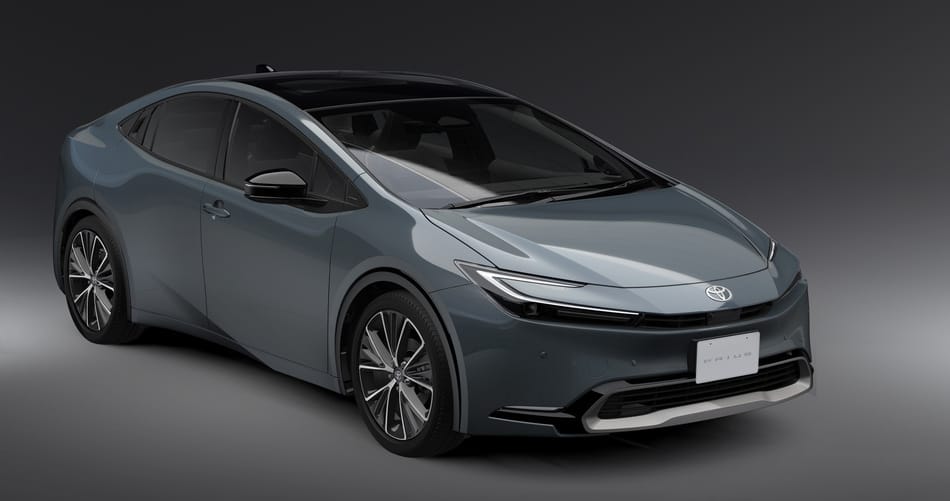
Toyota is about to find out after launching the latest version of the Prius at the Los Angeles Auto Show this month. The 2023 model addresses some of the most common complaints about the hybrid, introducing a less cartoonlike design while delivering significantly more power. But while the new Prius will be offered in both conventional and plug-in hybrid versions, Toyota decided not to add an all-electric variant, generating significant pushback from a number of green-minded groups like Public Citizen.
The new Prius “builds on its legendary status,” said David Christ, the US general manager of the Toyota brand, in an interview following the 2023 model’s debut in Los Angeles.
Christ declined to discuss sales targets for the new model, but he said Toyota was clearly optimistic that it would regain momentum after the weak performance of the 2016 model.
The original was introduced in Japan as a sedan in 1997 and refashioned as a hatchback in 2003 in the US and other markets. With its then-unique gas-electric drivetrain, it delivered what was then unheard-of fuel economy and clicked with buyers worried about rising gas prices.
US demand steadily grew, peaking in 2012 at just over 236,000 – a figure that included two other Prius models. At one point, Prius was the single bestselling nameplate in the American market. But as gas prices started sliding, US motorists began to shift to SUVs and crossovers.
By the end of the decade, the RAV-4 become the automaker’s bestseller in the US. Toyota abandoned the Prius C and V models, retaining only the original hatchback which, by 2021, generated sales of just 59,000 units. For the first 10 months of 2022, sales fell another 40%.
The shift to utility vehicles clearly played a role in Prius’ decline. But reviewers also faulted the 2016 update’s over-the-top design, as well as the lack of power that had always been a weak spot for the hybrid.
The 2023 model takes aim at both of those complaints. Visually, there will be few who confuse the 2023 Toyota Prius with its predecessor. The overall look is sleeker, with a gentle, coupe-like slope to the front end, windshield and roofline, though it retains its five-passenger hatchback layout.
The old hybrid’s jug-eared taillamps have been replaced by a crossbar mirroring the front headlights, looking much like what Toyota developed for its Mirai hydrogen fuel-cell vehicle.
Like the current Prius, the 2023 remake retains an uncluttered interior but gets a more refined finish with less of the clunky plastic parts and panels that gave the old model a cheap feel. Like Toyota’s new battery-electric bZ4X, the new Prius features a high-mounted 7-inch digital gauge cluster, with a large touch screen infotainment system mounted at the top of the centre console. The hatchback does retain more conventional controls for some vehicle functions, such as climate settings.
In terms of performance, the conventional gas-electric model replaces its old 1.8-liter gas engine with a new 2.0-liter one. It remains paired to twin electric motors, though they also have been beefed up by 60% to 193 horsepower. Fuel economy will reach as much as 57 miles per gallon, an improvement of up to 1 mile per gallon.
The Prius+ plug-in hybrid will not only yield improvements in fuel efficiency but get a 50% increase in its range in all-electric mode, to as much as 25 miles.
The question is whether Toyota has gone far enough. Some analysts question whether there is even a need for a Prius anymore.
Sam Abuelsamid, principal analyst for Guidehouse Insights, pointed out that there are now dozens of high-mileage hybrids. Toyota itself now offers gas-electric versions of virtually all of its products, even up to its full-size Tundra pickup. A number of its newest offerings, such as the Crown sedan and Sienna minivan, are offered exclusively in hybrid form.
If Toyota had hoped to win the backing of the environmentalists who hailed the arrival of early Prius models, it got an unpleasant surprise.
Public Citizen and 16 other non-profit consumer and climate groups issued a statement following the debut of the 2023 hybrid turning a collective “thumbs down” because of Toyota’s decision not to add an all-electric version.
The automaker and CEO Akio Toyoda have come under sharp criticism for laying out plans for a mix of hybrids, PHEVs, fuel-cell vehicles and EVs, rather than going all-electric.
“The new Prius model asks: What if we took the look of a Tesla, but instead made it pollute with an internal combustion engine?” East Peterson-Trujillo, the clean vehicles campaigner at Public Citizen, said in a statement. “The climate crisis demands real actions to reduce our reliance on fossil fuels. Despite over a decade of record-setting global temperatures, Toyota’s new Prius missed an opportunity to take a fully-electric step toward the future.”
But Christ claimed the hybrid had prevented the production of 82 million tons of carbon dioxide since the original model was introduced. That, he said, was the equivalent of 5.5 million battery-electric vehicles.
For now, EVs make up a relatively small figure of the US new-vehicle market, well short of the sales generated by hybrids. But Prius now faces plenty of competition, even from within Toyota.
The battery-electric market share is expected to end 2022 at around 7%, a sevenfold increase since just 2019. The consensus forecast among analysts is that this could reach 20% by 2025 and 40% to 50% by the end of the decade.