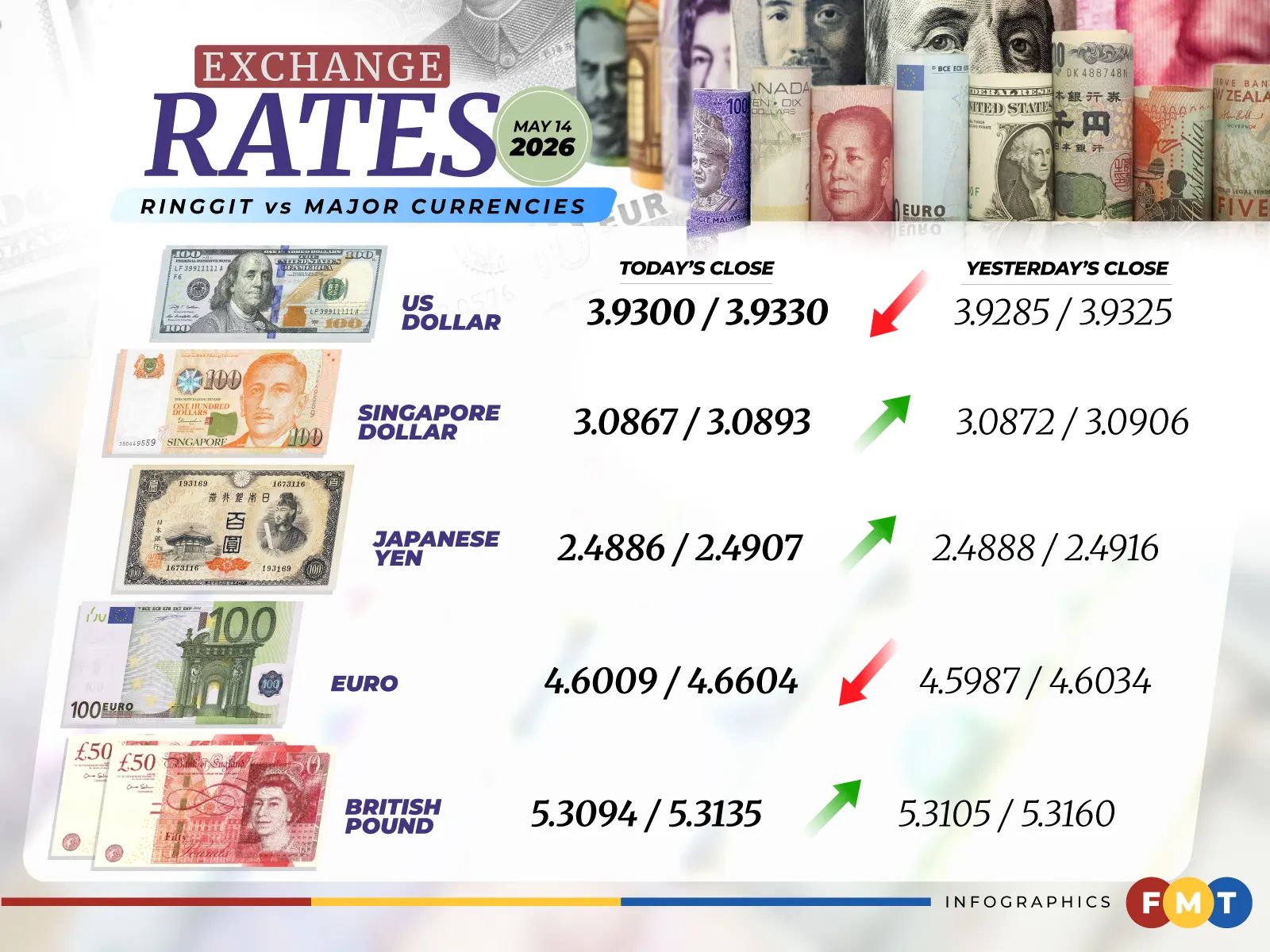
At 6pm, the ringgit depreciated to 3.9300/3.9330 against the greenback from 3.9285/3.9325 at Wednesday’s close.
Bank Muamalat Malaysia Bhd chief economist Afzanizam Rashid said early indications had been positive, with both countries signalling encouraging developments.
“Among the positive signs are the renewal of import permits for US beef plants and Trump’s remarks that US-China relations are better than ever,” he told Bernama.
He added that traders and investors would continue to monitor further developments, particularly whether the developments could lead to the reopening of the Strait of Hormuz.
However, Afzanizam noted that the ringgit remained fairly stable against the US dollar as market participants awaited the outcome of the meeting.
Also, Malaysia’s first-quarter (1Q) gross domestic product (GDP) will be announced on Friday, and the statistics department has projected the Malaysian economy to grow by 5.3% in 1Q 2026.
At the close, the ringgit traded mostly higher against a basket of major currencies.
It appreciated against the Japanese yen to 2.4886/2.4907 from 2.4888/2.4916, and strengthened versus the British pound to 5.3094/5.3135 from 5.3105/5.3160, but slid against the euro to 4.6009/4.6604 from 4.5987/4.6034 at Wednesday’s close.
The local currency also traded mostly higher against regional peers.
It rose against the Singapore dollar to 3.0867/3.0893 from 3.0872/3.0906, increased against the Indonesian rupiah to 224.1/224.4 from 224.7/225.1, and was higher against the Philippine peso at 6.37/6.38 from 6.40/6.41.
However, it slipped against the Thai baht to 12.1506/12.1652 from 12.1419/12.1599 previously.