
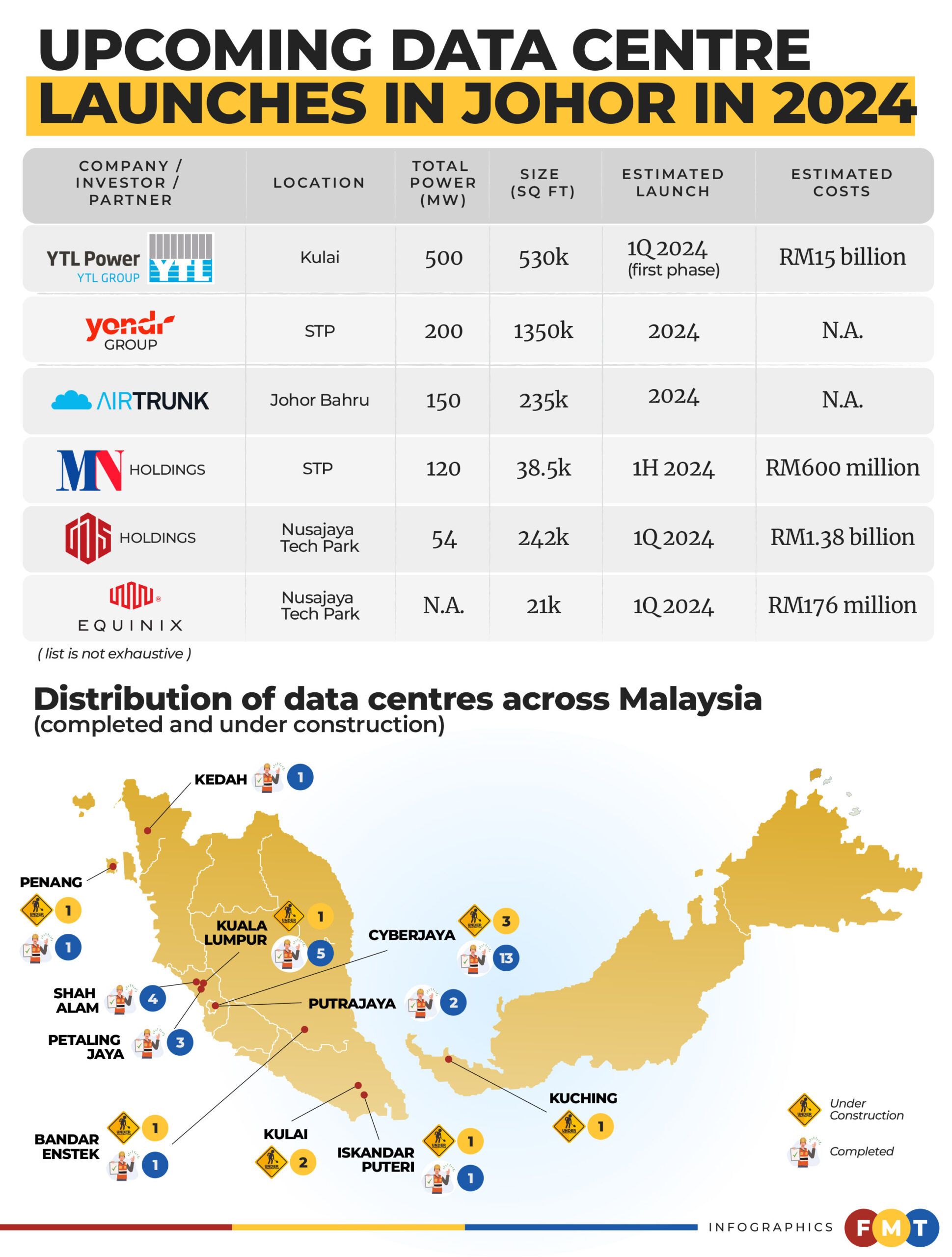
Developers and providers of data storage facilities such as Bridge Data Centres, Yondr Group, Equinix and ByteDance System have either set up shop or are making a beeline for the state.
It has been estimated that in 2024 alone, Johor will see RM17 billion worth of new investment in data centres.
Today, it already has 33MW of “live”and pipeline facilities, with more under construction or in the planning stage. Yet, it has barely scratched the surface.
(The capacity of data centres is measured by the amount of energy they use.)
Only 2.02% of the state’s IT capacity today is “live”, according to data from real estate consultancy Knight Frank.
Of the new facilities that are in the pipeline, 59.97% have yet to secure all the essential elements, such as government approval, land and power supply, for development. On the other hand, 24.35% are already under construction and another 13.65% have already been committed to end users.
Among local investors in data centres in Johor, JLand Group Sdn Bhd is opening its own facility and expanding existing ones.
Yet, Johor accounts for only 3.2% of all data centre facilities in Malaysia. Kuala Lumpur and Cyberjaya are the leaders here.
Regionally, Malaysia is behind Indonesia in data centre capacity.
The rise of Johor as a centre for data centres
Johor’s position as a leading destination for investment in data centres can be attributed to a 2019 decision by Singapore to enforce a moratorium on building new facilities over sustainability concerns.
The moratorium was lifted in 2022 but stringent conditions were imposed, including a 60MW cap to enable the island republic to meet its carbon goals.
RHB Investment Bank said the move by Singapore to lift the ban had shifted the focus from quantity to quality of data centres, leading to best-in-class energy efficient investments.
Malaysia and Indonesia have benefited extensively from the spillover effect. Johor, in particular, is giving Cyberjaya a run for its money.
Cheaper real estate is Johor’s main selling point, Fred Fitzalan Howard, associate director and data centre lead in Asia-Pacific for Knight Frank, told FMT Business.
“Customers see Johor as the next best alternative now that Singapore is effectively closed off,” he said.
Stumbling blocks for growth
Johor continues to face challenges in its journey to becoming the data centre capital of the region.
Such facilities use large amounts of energy, putting pressure on Malaysia’s power network. Fortunately, the government seems to be addressing it relatively quickly, Howard said.
Price also works in Johor’s favour. Electricity tariffs in Malaysia are the third lowest in the region, a big draw for large power consumers.
But while power is cheaper, capacity is lower compared with Singapore which is connected to 39 international submarine cables, and Indonesia, with 59. Malaysia is connected to only 25 such cables.
Recent investments in major sub-sea cables have by-passed Malaysia due to an ongoing cabotage ruling that prohibits foreign-flagged support vessels from undertaking subsea cable repairs in Malaysian waters.
RHB said this was a regressive move given Malaysia’s aim to have the most submarine cable landings in Southeast Asia by 2025, a key policy thrust in the MyDigital blueprint.
“Malaysia is also hampered by a lack of dark fibres (unused optical fibres), which makes it challenging for larger data centre players,” RHB said.
Knight Frank’s Howard said Malaysia is seen as a Tier 2 market, unlike Singapore, Sydney, Tokyo and Hong Kong, with their higher concentration of international operators, customer demand and connectivity, making them Tier 1 markets.
The future is in cloud services
The arrival of cloud service providers, such as Amazon Web Services (AWS), would lead to long-term investments in Malaysia, Howard said.
He said these service providers would need to expand their networks across Malaysia. For instance AWS has announced a RM25.5 billion investment in the country.
However, he said, most of the investment would be pumped into the Klang Valley.
Nonetheless, Johor will gain from investments from early movers such as Keppel, Bridge and Yondr, which have all secured multi-MW hyperscale contracts from either Chinese or Western cloud service providers.
In Johor, the data centres will mostly be in Nusajaya Tech Park, Sedenak Tech Park and YTL Green Data Centre Park.