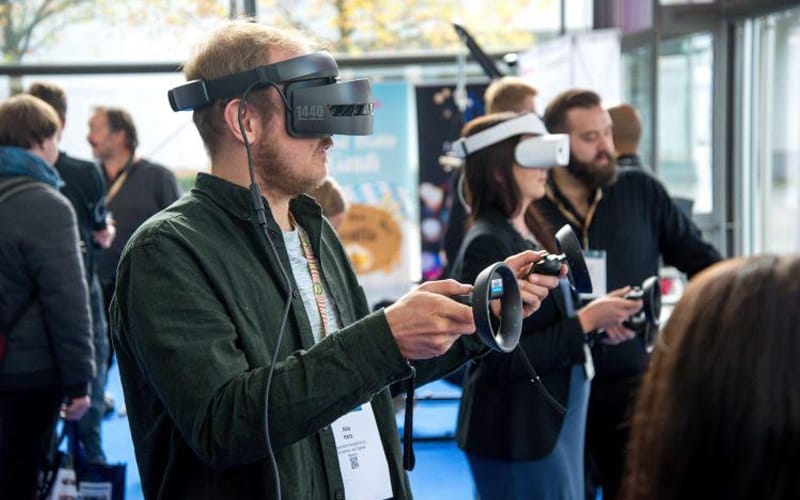
Using virtual reality (VR) in recruitment is the current trend, with analysts saying that it is a turning point for the VR industry.
For job recruiters, this presents an interesting opportunity to change and improve their candidate experience.
How VR is revolutionising recruitment
Virtual reality is an immersive, interactive experience that works through a headset to simulate another reality.
Wearing a VR headset puts you in a virtual world, a shared experience with others wearing a VR headset. Companies are exploring ways to use VR in their day to day operations.
The Training Centre of Air Conditioning and Heating launched a full technician course that allows students to get “hands-on” experience using an HVAC lab through an immersive learning simulation.
1. VR expands your remote recruitment
Virtual reality expands your candidate pool to remote candidates. You can design simulated office tours and interview candidates from around the globe.
A fully immersive experience allows candidates to see and feel the office culture and picture themselves in the role without being physically present.
VR is also more cost-effective as US companies spend an average of US4, 000 to fill an open position.
Virtual reality lets you assess more candidates without spending money to physically bring them in for multiple interviews. It lifts the constraints that many companies face in finding top talent.
2. Combining Virtual Reality with AI
The biggest use for virtual reality in recruitment is the ability to simulate on-the-job experience during the interview process.
VR is about putting people inside virtual environments and this technology will become increasingly intelligent over the next few years.
Virtual environments allow students to practice anything from construction to flight to surgery without the risks associated with real-world training.
Recruiters can combine VR with talent trials for a truly immersive on-the-job assessment of a candidate’s true talent.
As recruiters move away from misleading resumes, a fully immersive skills test highlights knowledge necessary to be successful in a position.
Talent trials can be expanded beyond editing documents, spreadsheets, or coding to include presentation skills, teamwork, and other interpersonal capabilities.
3. Going beyond one-way video interviews
One-way video interviews are a fantastic way to get to know a candidate. But what if you could go a step further?
VR lets you enjoy the benefits of one-way interviews and goes beyond the time restrictions and other limitations.
Video interviews allow you to get a feel for a candidate’s personality and culture fit, and job seekers love the video interview process.
However, pre-recorded videos can make candidates feel self-conscious; they may not work as good predictors of on-the-job success.
VR empowers you to meet a candidate “in-person” and still see them in action as a potential new employee.
4. Provides a great candidate experience
Competition for talent is steep. Companies must wow candidates to get them to sign on. VR is a sexy new tool in the recruitment world that makes a company stand out.
Nearly 60% of candidates have had a poor candidate experience during their job search; 72% of those candidates share their negative impression with others.
Online video interviewing has a positive impact on a candidate’s experience with your company, and VR promises to increase that impact exponentially by:
- Using VR to show off your workplace environment
Jet.com is an American e-commerce company that sells a wide range of products to customers across the globe.
The company uses VR in recruitment by giving potential candidates an opportunity to witness the corporate culture, office space as well as get a taste of the company’s ‘’happy hour’’ celebrations.
This gives candidates an insight into the potential workplace they may be employed at, before deciding if the environment suits them or not.
- Using VR to give candidates an insight into the role
German railway company, Deutsche Bahn received little interest from the younger generation when hiring for positions such as train conductors.
They decided to use VR to give candidates an in depth understanding of the role and what their responsibilities would entail.
The result is a huge increase in applicants with improved skills sets who are genuinely excited to work in the role.
- Using VR to understand decision making
Commonwealth Bank started to use virtual reality to test candidates’ decision making in real-life scenarios.
They gave candidates situations that their employees actually face, and use VR to assist in understanding how the candidates made decisions in stressful and confronting situations.
This gives the bank a better awareness of candidates who have the qualities and skills they are looking for.
Final thoughts
VR is still expensive and companies should focus on the immersive experience aspect to deliver in the future. How can recruiters create a real-world simulation for the candidate? Talent trials are just one option.
Augmented reality is a less expensive option that gives you the ability to showcase short presentations or office tours.
This article first appeared in vervoe.com.
At Vervoe, our mission is to fundamentally transform the hiring process from mediocracy to meritocracy.