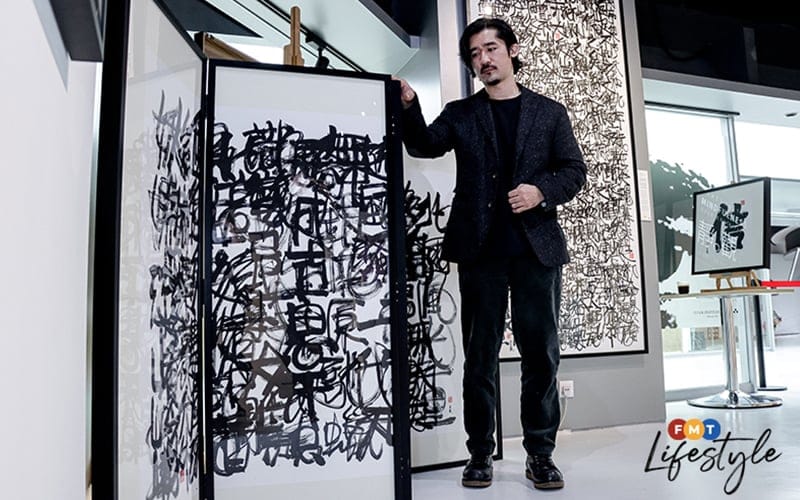
You have likely come across calligraphic works yourself, with Chinese characters written beautifully in organised columns.
However, true art has no restrictions because an artist’s imagination knows no bounds. And rules are to be broken.
A calligraphy exhibition, titled “Mindfulness”, that features 30 artworks by calligraphy artist Jameson Yap, 42, challenges the general perception of the art of calligraphy.
This is Yap’s second solo exhibition. More importantly, this is Yap’s chance to show off his unique style of calligraphy, which he created himself, called “river stroke”, or “liu su” in Mandarin.
“River stroke” stands apart from the five traditional styles of Chinese calligraphy as this style puts the spotlight on the emotional state of the artist.
According to him, the style is inspired by the flow of water in a river and likewise, characters overlap each other in a fluid manner.
It is an unorthodox style, particularly when one is used to neat columns of characters separated from each other.
Speaking to FMT, Yap explained just how he came to appreciate the art of calligraphy and why he created his unique style.
Perlis-born Yap said that during his schooling days, he was among the more creative students in his class. “As well as the naughtiest,” he added.
Apparently, the pictures in his textbooks were often subjected to his mischievous doodling. “Daydreaming was my favourite pastime then.”
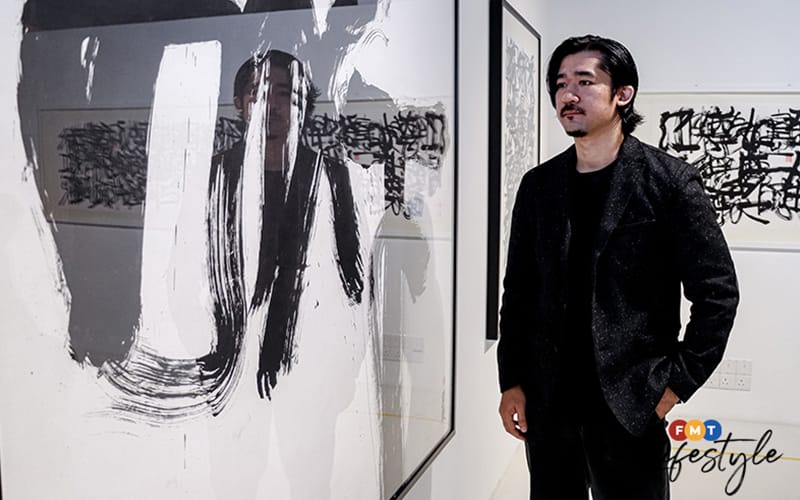
So, how did he go from schoolbook scribbles to full-blown calligraphy? He credited his late grandfather, an emigrant from China, for this.
“I started learning calligraphy from him when I was five,” he said. “He trained me to write on old newspapers, instead of the expensive xuan paper,” he said, referring to the rice paper used in calligraphy.
His grandfather was strict and only allowed him to play with his friends once he had covered every page of the newspaper in calligraphy.
He said his grandfather taught him calligraphy because “there are a lot of things from our culture that we should not forget.”
The man was such a traditionalist that even when writing letters to contacts in China, he used an inkbrush instead of a pen!
Still, the lessons Yap learnt stayed with him into adulthood. But when his grandfather passed away, he stopped practising the art for a time.

“If I want to do this, I should have direction. Without my grandpa, I actually have more freedom in doing my own form of calligraphy,” he remembered thinking before picking up the brush again.
With this newfound freedom, he began to experiment with the artform. And funnily enough, a “National Geographic” documentary on the Amazon River proved decisive.
“There was a bird’s eye view of the river, before a close up. For years then, I had been looking for an idea to call my own. And that was the one which really struck me.”
In Yap’s eyes, the river’s currents are simultaneously powerful and formless, capable of bypassing or demolishing any obstacle in its path.
Recognising that this element of freedom was something he wished to incorporate into his artistic style, he created the “river stroke”, and in the process, renewed his confidence in his own capabilities.

So, how does Yap decide what characters get onto the rice paper? “I pick words which strike me in some way.”
He pointed to one of his pieces, with a singular character adorning the rice paper; that of “xin”, or “heart”.
“My grandpa always told me, if you want to do something, you will eventually achieve it as long as you put your heart into it.”
Yap said that many people “read” the characters rather than “feel” them, impeding the appreciation of the work.
This is why, he said, viewers who cannot read Chinese sometimes have a better understanding of the emotion behind the characters they do not understand.
Where to for Yap now? Given that he was recently invited to exhibit his works in Tokyo, it does seem like his future is bright.
But with a recent addition to his family, his Tokyo exhibition has to wait. “Family comes first,” he said, with a smile.
‘Mindfulness’ is open for public viewing until June 30.
Eslite Spectrum
181, Jalan Bukit Bintang
Kuala Lumpur
Exhibition hours: 10am-10pm daily