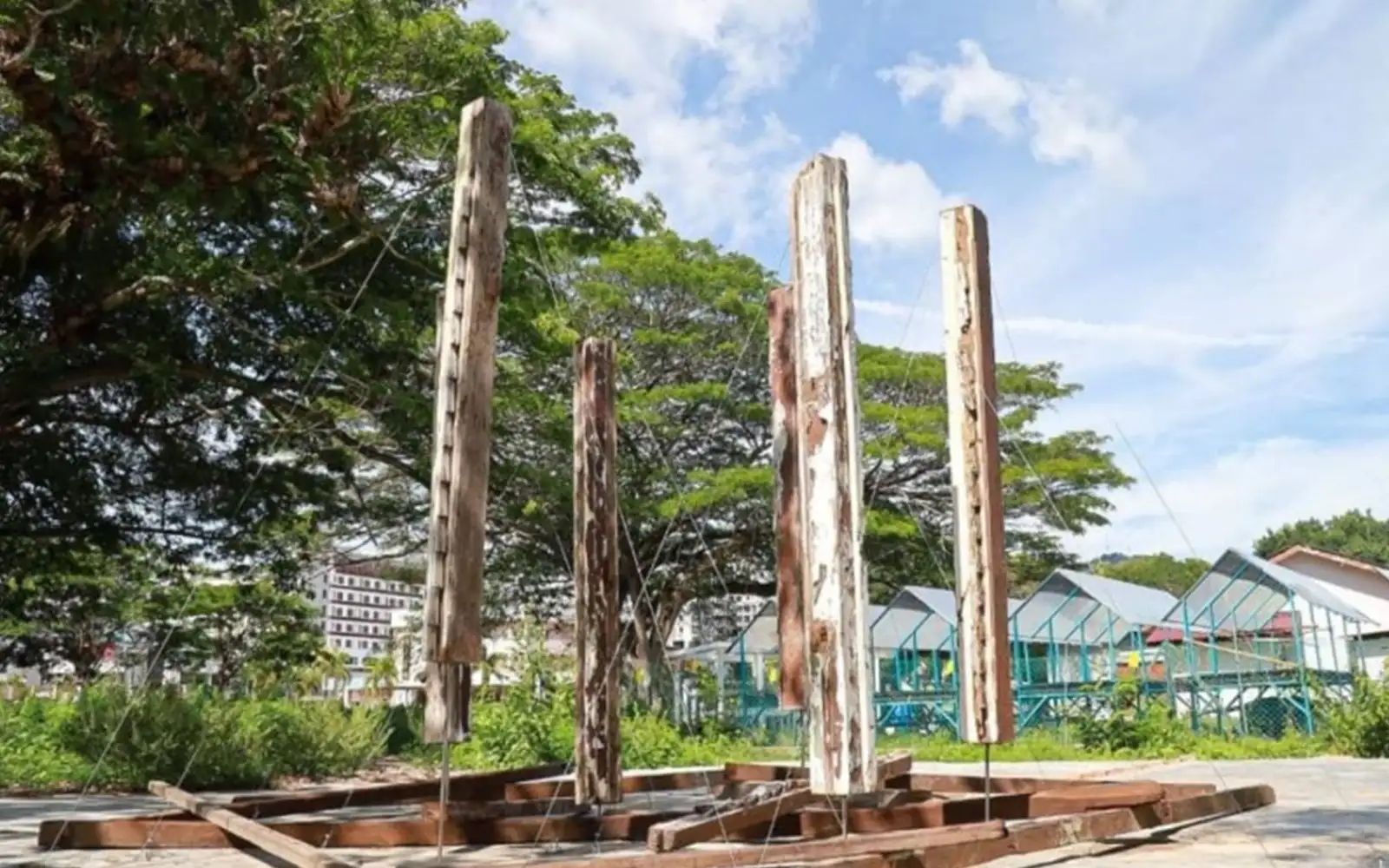
But for architect and artist Muhammad Ismail Rahim, they were fragments of memory.
The 34-year-old has transformed pieces salvaged from the former hospital site into an installation artwork titled “Nafas Tanah” (“Breath of the Earth”), giving new life to a place that once held decades of stories for the Langkawi community.
For Ismail, watching the old hospital slowly disappear left a lasting emotional impact.
“I often talk about how old buildings with historical value are demolished so easily,” he told Bernama. “But when I witnessed it happening in front of me, I felt I needed to do something.”
So he began collecting whatever remained – timber, stones and construction materials – before the site vanished completely.
The installation is now part of the 29th edition of Bakat Muda Sezaman (BMS29), organised by the National Art Gallery and running until July 26 across several locations in Langkawi.
Originally from Kemaman, Terengganu, Ismail said his architectural background strongly shapes the way he sees abandoned spaces and ageing structures.

To him, the old hospital represented far more than an unused building. “It carried memories, history and emotional connections for the local community,” he said.
When he first attended a BMS29 workshop in Langkawi last November, the hospital was still standing, though no longer operational. But by the time he returned in February, the site had already been flattened.
“The challenge then became figuring out how to give these remaining materials a new meaning,” he said.
Ismail initially planned to build a wakaf, or resting platform, for public use, but site limitations eventually led him to create a temporary installation instead.
Constructed over five days beginning April 29 with the help of local craftsmen, the artwork carefully reassembles uneven reclaimed timber into a structure that feels both fragile and enduring.
“For me, this work acts as a bridge before something disappears completely and before something new replaces it,” he said. “It becomes a temporary monument marking that moment of loss.”

The father of two described the installation as a “memory holder” – a way of preserving traces of a place steadily fading from Langkawi’s physical landscape.
Even after the exhibition ends, parts of the structure will continue serving the community. The installation will eventually be repurposed into a public resting platform and handed over to the Langkawi Senior Citizens Activity Centre.
Ismail admitted the most difficult part of the project was not the technical work, but the emotional experience of watching a familiar place disappear so quickly.
“If these materials had not been collected, everything would simply have vanished without a trace,” he said. “At least through this artwork, something remains to remind us that the place once existed.”