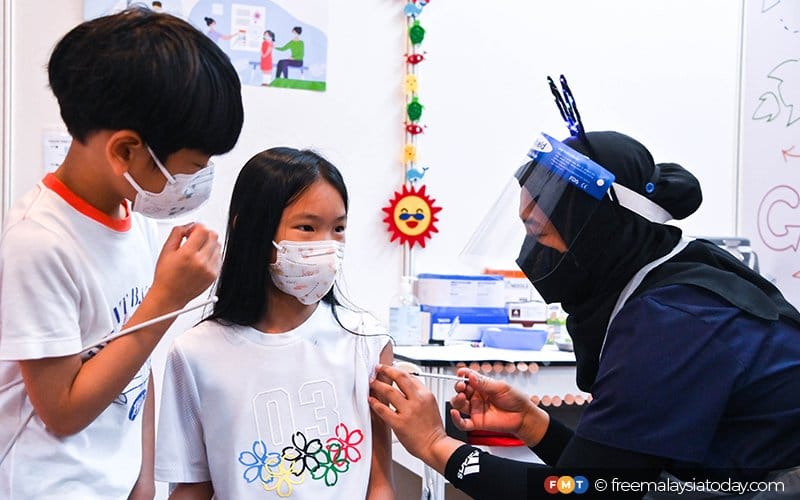
School-related Covid-19 clusters have increased substantially in Malaysia since children returned to the classroom, especially given the Omicron surge.
According to CovidNow, children aged five to 11 made up about 10% of the country’s total Covid-19 cases in recent weeks. Most stay asymptomatic but could easily transmit the virus to others.
Countries like the United States, Canada, Germany, Hungary, Singapore and Indonesia have been vaccinating young people of this age group since the end of last year. Now Malaysia, too, has followed suit.
But many parents are understandably concerned about the safety profile of the Pfizer-BioNTech vaccine for younger people.
In pre-authorisation clinical trials reported by the US Centers for Disease Control and Prevention (CDC), Pfizer vaccines were administered to 3,109 children between the ages of five and 11.
Only mild to moderate effects were reported, such as pain at the injection site, headaches, and mild fever, from which the child recovered within a few days. No serious adverse events were reported during these trials.
The CDC also reviewed reports to the Vaccine Adverse Event Reporting System (VAERS) from Nov 3-Dec 19, during which approximately 8.7 million doses of Pfizer were administered to children.
VAERS received 4,249 reports of adverse events thereafter, 97.6% of which were found to be not serious.

There has been further concern over cases of myocarditis and pericarditis following the administration of messenger ribonucleic acid (mRNA) vaccines. Reporting rates for vaccine-associated myocarditis – a rare but serious event – appear highest among males 12–29.
To date, myocarditis among children between five and 11 appears very rare, with approximately 11 cases in 8.7 million.
Myocarditis has been well-described long before the pandemic. It can occur when a virus, such as that of common cold or flu, infects the body.
Studies show that post-vaccine-related myocarditis is much milder, with symptoms lasting for a shorter amount of time and usually resolving with minimal, if any, medical treatment.
Recent randomised controlled trials on the Pfizer vaccine for kids and adolescents showed it reduced the risk of Covid-19 by more than 90%, with no serious events observed during the period of study. However, as with adults, mild reactions such as jab site pain, fatigue, and headaches were reported.
Parents and guardians should be informed of the possibility of such reactions, which are more likely after the second dose. Children should also avoid strenuous exercise up to a week after vaccination.
Herd immunity
Some parents consider opting out of vaccinating their children, choosing instead to depend on herd immunity. Traditionally, this is achieved when 80% of the population has been fully immunised against an infection.

But with Covid-19, especially with the Omicron variant, the estimates are much higher. Malaysia would require more than 95% of the population to be fully immunised to achieve a degree of protection similar to that obtained by herd immunity.
Furthermore, herd immunity is a dynamic phenomenon that depends on the movement of the herd. If a family has five adults and one child, and all adults are immunised, then one could say the family has herd immunity – provided they live in the same house, and the child never spends any time outside.
If the child goes to school, then the majority of the population are children. If these children are not immunised, there is no herd immunity in that setting.
Malaysia’s present immunisation rate stands at about 75%. If parents adopt a “wait-and-see” approach to their children’s vaccinations, it would delay the achievement of a 95% rate.
And if most parents decide to not vaccinate their children, it could spell big trouble for the general level of immunity among these young people. Consequently, the risk of their kids contracting Covid-19 is significantly higher.
So, to vaccinate or not to vaccinate?
Rest assured, from the data available, the chances of developing severe side effects from the vaccine in this age group are very rare.

Vaccination is still the most effective way to prevent Covid infection and the development of serious complications, including the likelihood of reduced transmission in the home and in school settings. It safeguards vulnerable persons and creates a safer in-person learning environment.
Without effective Covid-19 vaccines for this age group, children could potentially become ongoing reservoirs of infection and sources of newly emerging variants. Widespread vaccination across age groups is, therefore, essential for curtailing the pandemic.
Nevertheless, if your child has any pre-existing medical condition, or if you, as a parent, are in doubt, consult your general practitioner or paediatrician.
This article was written by Dr Lim Yin Sear, senior lecturer at Taylor’s University School of Medicine, and Dr Noor Hafiza Noordin, head of the pediatrics department at Hospital Banting.
CLICK HERE FOR THE LATEST DATA ON THE COVID-19 SITUATION IN MALAYSIA