
Local artisan Lee You He has seen the changes unfold from his little shop next to the main road in Kampar old town.
His rattan furniture shop, started by his father, was a fixture next to the Chinese temple decades before he was even born.
He has spent his lifetime in the shop; first growing up and helping out his father in it and then running it by himself.
“I have been operating this shop alone for 45 years. My life is here. Luckily I am passionate about making rattan furniture.”
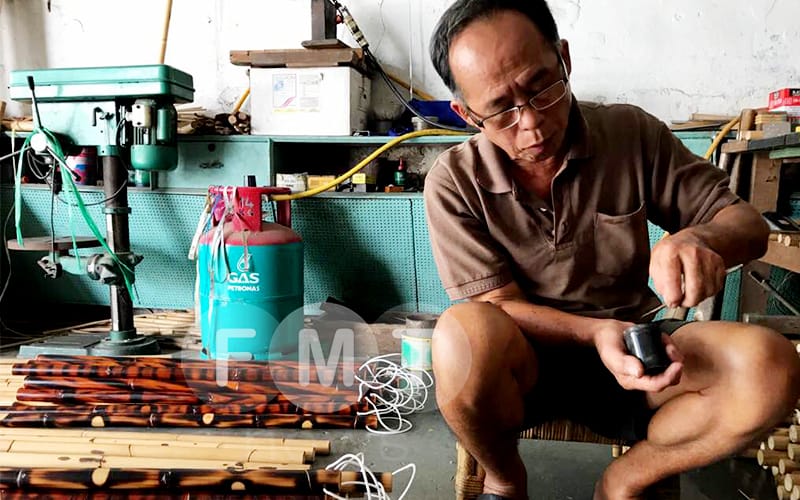
He ponders what might have been. “I had few other options as I didn’t further my studies,” he says.
Kampar is now divided into new and old towns. Lee has struggled for decades, sustaining his old shop against newer competition. His is one of the few to survive.
“Kampar was bustling with people in the fifties but it has gone downhill since,” he says.
The town sits on Federal Route 1, believed to be the nation’s earliest public highway. Begun in 1880, it was the main trunk road in Peninsular Malaysia, connecting most of the state capitals on the west coast and as a result, numerous towns grew along its route. One of these was Kampar.
Times change, however, and in 1994 Federal Route 1 was supplanted by the North–South Expressway as the backbone of the peninsula.
Kampar’s status as a bustling commercial centre vanished almost overnight as travellers stopped visiting the town, preferring to take the faster and more convenient expressway.
To compound the town’s woes, it was already reeling from the loss of most of its tin mining wealth, with the industry in terminal decline.
Situated in Perak’s tin-rich Kinta Valley, Kampar was an important mining centre from the late 1880s, through its heyday in the 1920s, up until the 1970s by which tin production was plummeting.
Kampar’s SEK tin mine, one of the largest in the state, closed down for good in 2010. Now, with no sign of the worked out mines being reopened, Kampar’s tin mining riches have well and truly petered out.
The chief remaining reminders of its mining history are the lakes pockmarking the area and the Kinta Tin Mining Museum opened in 2012 by a former tin miner.
So with tin and passing trade both gone, what hope is there for Kampar?
Lee is philosophical. “There are always ups and downs when doing business, but for me it is not so much about making big profits but rather enjoying doing what I have always done,” he says.
“Sometimes people will stop by when they see my shop, without any intention of buying anything but just to look at my rattan handiwork,” he grins. “And that has always given me pleasure.”
One important difference between his and other furniture products available in the market is the raw material he uses.
“I use genuine rattan that is only available from the forest. Usually the Orang Asli help me gather the rattan vines.”
Lee has a lot of customers who ask him to repair their old rattan furniture, and there’s no shortage of that in the area. So he remains cautiously optimistic.
Tan Kee Huat, 67, owns a nearby tailor shop and is facing the same problems as Lee.
It saddens him that there used to be a lot of tailor shops but now hardly any of them survive.
“Only four tailor shops are left here,” he sighs.
But he is sanguine about his own future and says he’ll stay in business as long as he can. He still has a lot of loyal customers even though his handmade clothing may cost more than mass-produced items.
“Sometimes I get introduced to overseas customers by my usual clients. Even though this is only a small shop, they take a liking to my sewing and become regular customers.”
However, he is saddened by the thought that his business may not survive him. He has children but they are not going to follow him into his carefully nurtured tailoring business.
“Not one of them is interested in the art of sewing, or running a small business in an old shop like this,” he says. “Just like other youngsters, my children want to look for more exciting jobs in Kuala Lumpur.”
“In the old days, children would usually inherit their father’s business. My father wanted one of his four children to learn the trade and continue the business. That turned out to be me,” he says with a resigned smile.
“At the time, it wasn’t so bad.”
Tan echoes fellow business owner Lee when lamenting his lack of study at school.
“I didn’t pay much attention in class, so I was the one to inherit the business.” He shrugs before adding, “But I have a lot of passion for what am I doing.”
He still remembers the time when he learned the art of sewing from his father each day after school.
He would go straight to the shop to help, sometimes entertaining customers while his father was busy sewing. In that way, he learned how to run a business too.
“Now, I do it all by myself. I have no one to help me, my children don’t even come to the shop after they finish their school day like I did when I was a boy,” he laughs wistfully.
Whatever the future holds for Kampar, a revival of its fortunes seems a long shot right now. But on an upbeat note, maybe when the local kids get back from the big city with new skills and high ambitions, they just might turn the town into something their parents never even dreamt of.