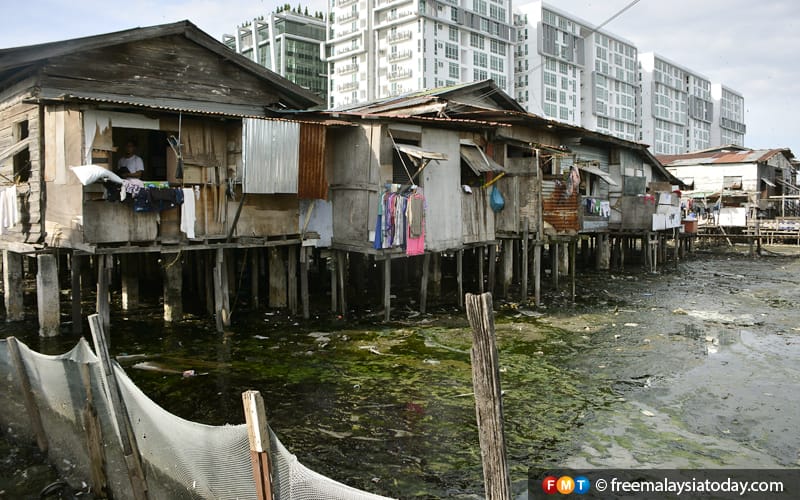
He said this was due to inequality and imbalanced development across the country in terms of wealth, income, education and infrastructure.
“We have been trying our best to mitigate this (poverty). The issue of poverty eradication remains high, if not one of the main priorities, on the government’s agenda,” The Edge quoted him as saying during the launch of the World Bank Group’s Malaysia Economic Monitor report in Kota Kinabalu.
Mustapa said the government, spearheaded by the Economic Planning Unit and Implementation Coordination Unit, plans to make the economy more inclusive and eradicate hardcore poverty.

“Malaysia aspires to be a high-income nation by 2025. However, the fruits of prosperity are often inequitably divided. Ideally, we want all parts of Malaysia to be equally developed.
“Every state in the federation should be as wealthy as the Klang Valley. The reality is that we have a long way to go,” he said.
He said that under the 12th Malaysia Plan (12MP), the government aims to reduce the gross domestic product (GDP) per capita gap between Peninsular Malaysia’s central region and Sabah from 2.7% to 2.5%.
It also aims to reduce the GDP per capita gap between Peninsular Malaysia’s central region and Sarawak from 1.3% to 1.2%.
Peninsular Malaysia’s central region comprises the Klang Valley, Negeri Sembilan and Melaka.
Sabah chief minister Hajiji Noor, who also attended the event, said the state is still recovering from the impact of the Covid-19 pandemic, including increases in the poverty rate and youth unemployment.
“The federal government has been receptive to the state’s needs through its commitments under the 12MP to enhance Sabah’s development,” he said.