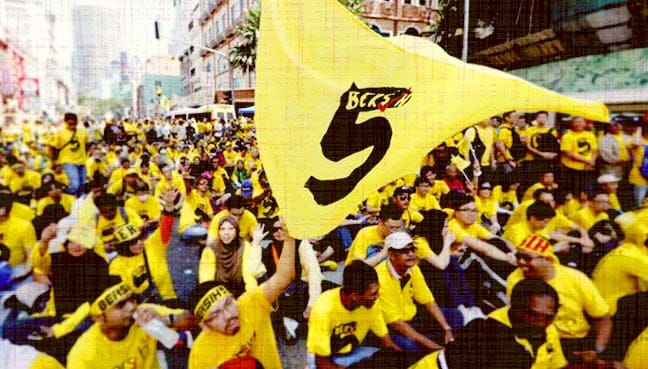
One of the big questions asked in the run-up to the Bersih 5 rally was whether or not enough Malays would participate. It was an important question because Bersih 4 was tarred as a “Chinese” movement.
By most accounts, there was a far more equitable Malay presence this year, lending the protest the multi-ethnic appeal needed to make the case for its legitimacy. But this turnout has been misrepresented as “more Malays coming out for Bersih 5 than Bersih 4”, which doesn’t get the specifics right.
Bersih claimed that 500,000 people turned up for Bersih 4 and a credible estimate has put the turnout for Bersih 5 at 100,000. Assuming the Malay turnout is even half of the 100,000, any logical measure would have that turnout dwarfed or at most equalled by the figure for Bersih 4. It’s therefore more proper to say the Malay presence was “more equitable” last weekend.
As for the total numbers themselves, there were several factors that might have caused the reduction between the fourth and fifth instalments of the protest. One of these was the pre-rally talk of the possibility of violence. If the numbers given for Bersih 4 are accurate, that means the majority of the movement’s supporters chose to stay home. The threat of a clash with the Red Shirts was a possible factor in that choice.
Another factor is disillusionment. Given that this would be the fifth march through the same streets to the same destination that the authorities had blocked every time, there must have been some who questioned the wisdom of protesting again. This does not necessarily mean that these people no longer sympathise with the cause. Rather, they probably decided that it had become futile to seek changes through a protest march. Perhaps, even, they were against Bersih’s close association with opposition politics or just its association with former PM Mahathir Mohamad.
But one must also consider the government-controlled media’s penchant for deflating Bersih numbers and Bersih’s tendency to inflate them. It cannot be denied that government media numbers seem implausible next to photo and video evidence of tens of thousands in yellow, but it is hard to truly estimate the Bersih crowd and the organisers would naturally reach for the highest possible number. Both claims are usually taken with a pinch of salt by most, but if the drop in turnout numbers is to be taken as fact, then Bersih has lost four fifths of its physical support for whatever reason.
Either way, the turnout is still not to be sniffed at, especially given that some estimates put the Red Shirt turnout at a measly 4,000, though that was certainly enough to make a mess fit for 100,000 at Padang Merbok.
What is most important is that the Malay attitude towards Bersih has shifted to a kind of passive support, thanks largely to the conduct of the Red Shirts and the discipline of Bersih during recent confrontations. As always, the challenge remains in translating those sympathies into votes at the ballot box, and much still can change between now and the 14th general election.