
Sarawak’s rural air services (RAS) is back in the news again, slightly more than five years since it was resolved that the Malaysian Aviation Commission (Mavcom), created in 2016 by the federal government, would be tasked with regulating and overseeing RAS operations and development for both Sabah and Sarawak.
The Sarawak state elections have yet again brought out the issue of connectivity problems prevalent in many parts of the state, especially in the deep interior.
I first became aware of the problems and issues associated with the RAS in Sarawak way back in 2004, when my consulting office was assigned to undertake a study there.
The RAS was seen as providing crucial access to the interiors of Sabah and Sarawak, as air transport was, and still is, the only means of connectivity.
Areas that are occupied by the Kelabit, Kenyah and Penan communities, among many others, are remotely located and, at the time, not accessible by transport except by air.
Unlike Bebuling, which is the proposed site of a new airport announced by the state government recently, there are no proper roads to those interior highland destinations.
Non-commercial services
Prior to October 2007, RAS was run on a non-subsidised basis and operated solely by Malaysia Airlines. The commercial airline claimed to have lost money on these rural services.
From the study, I recall that we defined RAS as a non-commercial aviation service, which should have warranted some form of subsidy from the government, state or federal.
It was modelled after Scotland, where similar remote islands and rural communities were provided with sea links for both passenger and cargo services, paid for by the government.
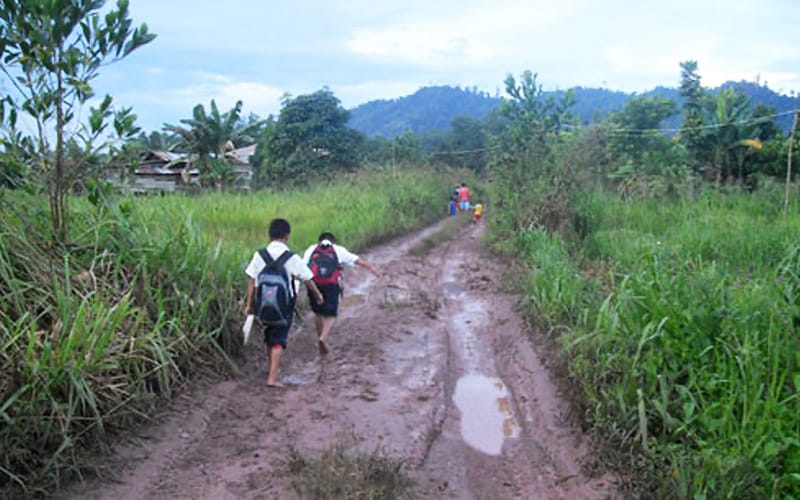
The absence of other means of transport meant that when air services were unavailable, the people in the area were totally cut off from the rest of the state.
Accessibility indices were used, often referred to as zero, which meant that the government became responsible for providing that missing link, in whatever format or airport and little aircraft they could come up with.
In total, over forty routes in Sabah and Sarawak, at the time, were considered as not economically viable due to their low passenger volume. Thus, there was no commercial load factor available.
There were 10 airports involved, including Kuching and Kota Kinabalu and 14 STOL (short take-off and landing) airfields, all of them located in some of the most remote parts of Sabah and Sarawak.
MasWings
However, despite what the study revealed, the federal aviation authority thought otherwise and experimented with an alternative operator.
In August 2006, they decided to award a 24-month contract to Fly Asia Express, a subsidiary of a low-cost airline to operate the RAS.
It started out well but the absence of good commercial returns, which was predicted, eventually hurt the entire operation. After slightly over a year, Fly Asia Express collapsed and the rural folks in Sarawak and Sabah were left in a lurch with no services at all.
It was an expensive lesson and forced the government to rethink the right strategy for RAS.
By October 2007, MasWings was formed.
MasWings is a subsidiary of the Malaysian Aviation Group, a wholly owned company of Khazanah Nasional. They took over the entire RAS and planned a new set of routes.
Under political pressure from the state, the aviation authority had no options but to bear the costs of running RAS.
The costs for the government came in the form of aircraft lease payment at a monthly rate of US$59,000 for each Twin Otter and US$170,000 for the ATR aircraft.
Thirty of those routes used Twin Otter (Viking DHC6-400) aircraft while another 19 routes used 10 ATR 72-500s.
Public service obligation
By 2017, it was decided (based on air traffic data) that six routes no longer qualified for subsidy and instead should be served purely by commercial airlines.
These routes were the Kota Kinabalu (KK) – Sandakan; KK – Tawau; KK – Miri; Kuching – Miri; Kuching – Bintulu; and the Kuching – Sibu flights.
The RAS eventually became known as a truly public service obligation (or PSO) and was fully funded by the federal government.
Together with a new service configuration purely for those remote locations, a new PSO agreement was signed in January 2019, which should continue under the same terms until 2024.
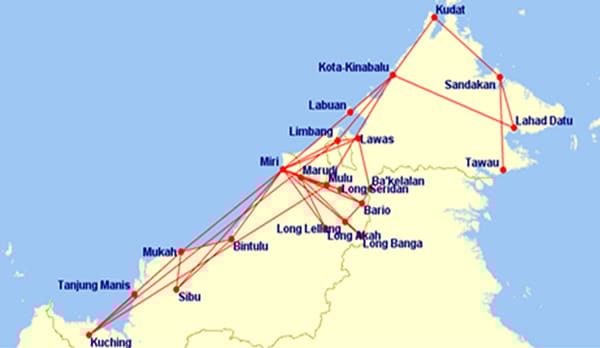
Bario, Ba’ Kelalan, Long Akah and Long Banga continued to be served and have now become popular remote tourist locations and destinations, which are commendable.
Some of these rural locations have remained inaccessible except for a small network of logging trail roads.
Logging trails
As it turned out, logging trails have now become a source of conflicting interests between the rural community and logging companies.
While government funds continue to support the RAS network, there is nothing to stop logging company personnel and workers from using such services, too, to get to their logging camps.
One doesn’t have to wonder why RAS are often fully booked.
And why lately, have there been many calls to open up more STOL airports in the most remote locations of Sarawak?
Some state politicians are calling for more budgets for remote airports and to increase allocations from the federal government for RAS purposes.
Why? Is all this for the benefit of rural communities?
More of these ongoing conflicts between logging activities and the preservation of rural communities will be addressed in Part 2.
The views expressed are those of the writer and do not necessarily reflect those of FMT.