From Boo Jia Cher
There is a familiar refrain in Malaysia: “Aiya, weather so hot, just drive lah.”
It is often said casually to justify even the shortest drive, sometimes over a distance no more than a 10-minute walk away.
For decades, the logic held. Cheap petrol, car-first planning, abundant parking and air-conditioned interiors made driving not just convenient, but rational.
That logic is beginning to crack. Temperatures in the northern states have recently surged, while much of the country now endures persistently high daily heat.
At the same time, a global oil crunch, shaped by ongoing instability in West Asia, is exposing something deeper: a structural dependence on the car that is both environmentally and economically fragile.
Car-centric cities are hotter
The discomfort Malaysians feel outdoors today is not just about rising temperatures. It is also about how our cities have been built.
Wide asphalt roads, vast parking lots and exposed concrete surfaces absorb and radiate heat, producing the urban heat island effect. Studies show that asphalt heats up to 74 degrees Celsius in extreme sun versus shaded areas near 43 degrees Celsius.
In our urban areas, shade is scarce, tree cover is inconsistent, and the cooling benefits of greenery are largely absent.
Even parked cars make things worse. Dark coloured cars absorb up to 95% of sunlight, while asphalt raises nearby air temperatures by as much as 3.8 degrees Celsius. In dense lots, extra vehicles can add up to 1.6 degrees Celsius, peaking during the day and lingering into the night.
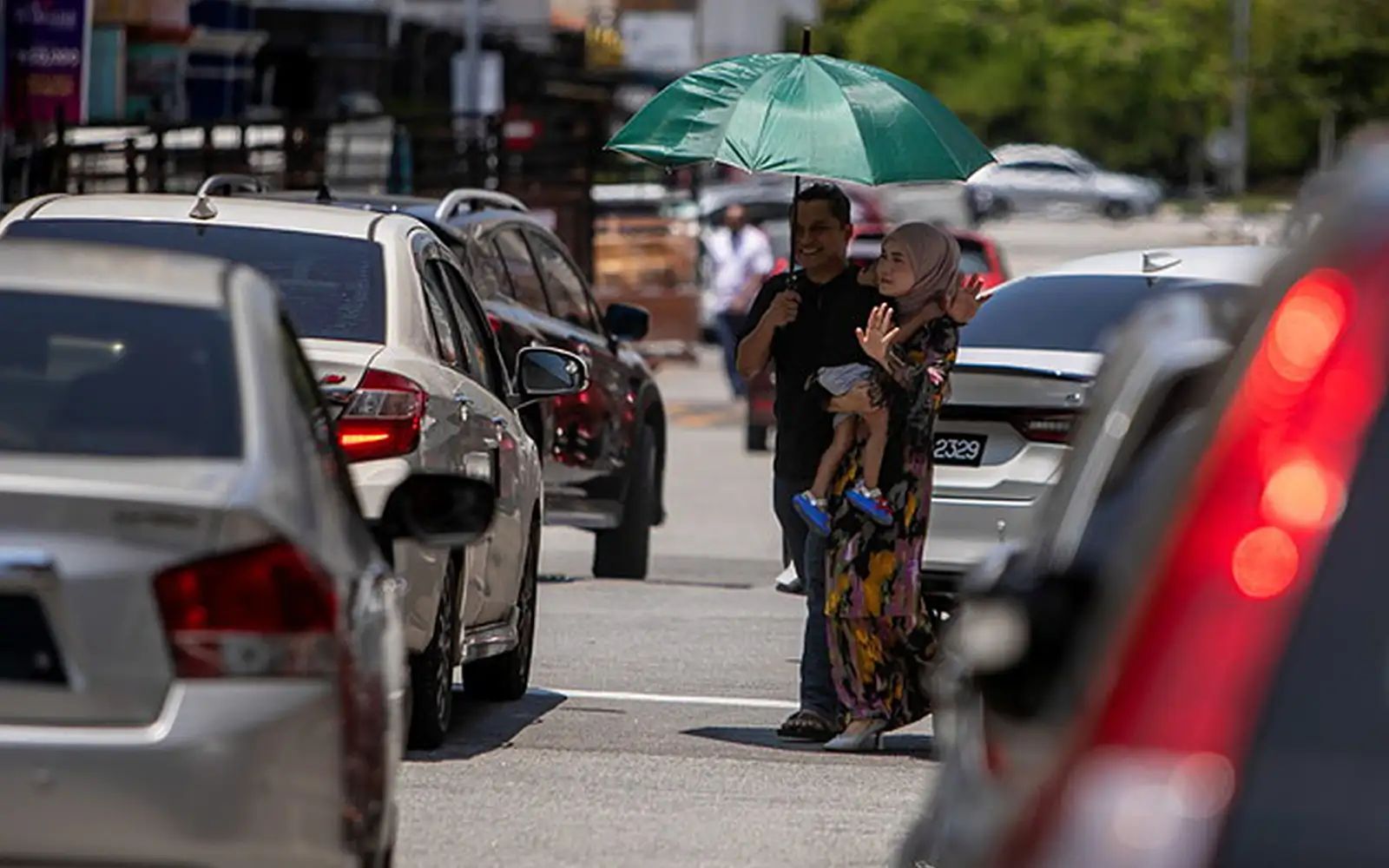
Walking, in this context, becomes punishing. Not simply because it is hot, but because there is nowhere to hide from the heat.
Distances are long, shade is minimal, and exposure to traffic is constant. The result is a built environment that amplifies climate rather than moderate it.
Our neighbours walk in the same heat
Yet heat alone does not make walking unviable in Southeast Asia.
In Singapore, daily life still depends heavily on walking, not because the weather is cooler, but because the city is designed to make it possible. Covered walkways, dense neighbourhoods and integrated public transport keep journeys short and often sheltered.
Bangkok, while far from perfect, offers a similar lesson. Sidewalks remain vibrant despite the heat because the city continues to invest in them, upgrading hundreds of kilometres of footpaths to better connect homes, streets and transit.
Walking persists not by accident, but because it has not been designed out of existence.
In Malaysia, by contrast, walking is often marginal. Zoning lengthens distances between daily needs. Pavements are discontinuous or poorly maintained. Shade is treated as optional.
Under these conditions, driving is less a choice than a necessity imposed by design.
The illusion of cheap petrol
For years, fuel subsidies have masked the inefficiencies of this system. Driving has remained artificially affordable, allowing car-dependent planning to persist without consequence.
That equilibrium is becoming harder to sustain. Global oil volatility and fiscal pressures are tightening the space for subsidies. If they weaken, the true cost of car dependence will surface quickly.
Daily routines, from commuting to running errands, are built on the assumption of cheap fuel. Remove that assumption, and the system might collapse.
Short drives will no longer feel trivial, yet walking, cycling, and public transport will remain impractical in many places.
This strain is already visible in the logistics and transport sectors. Rising diesel prices are squeezing margins, with smaller operators particularly vulnerable.
An uncomfortable truth
What is unfolding is more than a period of discomfort. It is a stress test of a development model.
Cities built around people behave differently. They are denser, more compact and better integrated.
Tree-lined streets and shaded walkways lower ambient temperatures and make movement tolerable. Public transport extends the reach of walking rather than replacing it.
In Medellín, Colombia, expanding urban tree cover along streets and pedestrian routes has reduced local temperatures by about 2 degrees Celsius, enough to meaningfully change how people experience the city.
A different direction
Retreating further into the car may feel natural in the heat, but it reinforces the very conditions that make cities hotter and less walkable.
What appears to be a personal preference for “just drive” is, in fact, shaped by structural constraints, such as vast open-air parking lots baking in the sun and road shoulders cluttered with illegal parking.
As these constraints shift, so too must the assumptions that underpin them.
Imagine transforming those parking lots into pocket parks with shade trees and benches, instantly cooling neighbourhoods while freeing up space for people.
Repurpose road shoulders into shaded, tree-lined sidewalks that invite walking instead of illegal parking.
Even add creepers climbing building facades to slash internal and external temperatures, turning concrete jungles into breathable oases.
Global warming is relentless, and the future of an oil-dependent economy is increasingly uncertain. The intersection of heatwaves and volatile oil prices thus presents a rare opportunity.
True long-term resilience will not come from hiding indoors, but from reshaping our environment; designing cities where movement is shaded, distances are short, and daily life no longer depends on a tank of fuel.
Boo Jia Cher is an FMT reader.
The views expressed are those of the writer and do not necessarily reflect those of FMT.